OpenStax Organic Chemistry: A Tenth Edition Student Solutions Manual
Chapter 14 – Conjugated Compounds and Ultraviolet Spectroscopy
Solutions to Problems
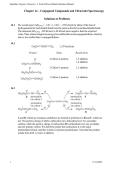
14.1 We would expect ΔHhydrog = –126 + (–126) = –252 kJ/mol for allene if the heat of
hydrogenation for each double bond were the same as that for an isolated double bond.
The measured ΔHhydrog, –298 kJ/mol, is 46 kJ/mol more negative than the expected
value. Thus, allene is higher in energy (less stable) than a nonconjugated diene, which in
turn is less stable than a conjugated diene.
14.2
Product Name Results from:
4-Chloro-2-pentene 1,2 addition
1,4 addition
3-Chloro-1-pentene 1,2 addition
1-Chloro-2-pentene 1,4 addition
14.3
A and D, which are resonance-stabilized, are formed in preference to B and C, which are
not. The positive charge of allylic carbocation A is delocalized over two secondary
carbons, while the positive charge of carbocation D is delocalized over one secondary
and one primary carbon. We therefore predict that carbocation A is the major
intermediate formed, and that 4-chloro-2-pentene predominates. Note that this product
results from both 1,2 and 1,4 addition.
1 11/14/2023
, OpenStax Organic Chemistry: A Tenth Edition Student Solutions Manual
14.4
14.5
Allylic halides can undergo slow dissociation to form stabilized carbocations (SN1
reaction). Both 3-bromo-1-butene and 1-bromo-2-butene form the same allylic
carbocation, pictured above, on dissociation. Addition of bromide ion to the allylic
carbocation then occurs to form a mixture of bromobutenes. Since the reaction is run
under equilibrium conditions, the thermodynamically more stable 1-bromo-2-butene
predominates.
14.6
1,4 adducts are more stable than 1,2 adducts because disubstituted double bonds are more
stable than monosubstituted double bonds (see Chapter 7).
10/27/2023 2
, OpenStax Organic Chemistry: A Tenth Edition Student Solutions Manual
14.7 Draw the reactants in an orientation that shows where the new bonds will form. Form the new
bonds by connecting the two reactants, removing two double bonds, and relocating the
remaining double bond so that it lies between carbon 2 and carbon 3 of the diene. The
substituents on the dienophile retain their trans relationship in the product. The product is a
racemic mixture.
14.8 Good dienophiles have an electron-withdrawing group conjugated with a double bond.
Good dienophiles: (a) (d)
Poor dienophiles: (b) (c) (e)
Compounds (a) and (d) are good dienophiles because they have electron-withdrawing
groups conjugated with a carbon–carbon double bond. Alkene (c) is a poor dienophile
because it has no electron-withdrawing functional group. Compounds (b) and (e) are poor
dienophiles because their electron-withdrawing groups are not conjugated with the
double bond.
14.9 (a) This diene has an s-cis conformation and should undergo Diels–Alder
cycloaddition.
(b) This diene has an s-trans conformation. Because the double bonds are in a fused
ring system, it is not possible for them to rotate to an s-cis conformation.
(c) Rotation can occur about the single bond of this s-trans diene. The resulting s-cis,
however, has an unfavorable steric interaction of a methyl group with a hydrogen at
carbon 1. Rotation to the s-cis conformation is possible but not favored.
3 11/15/2023
Chapter 14 – Conjugated Compounds and Ultraviolet Spectroscopy
Solutions to Problems
14.1 We would expect ΔHhydrog = –126 + (–126) = –252 kJ/mol for allene if the heat of
hydrogenation for each double bond were the same as that for an isolated double bond.
The measured ΔHhydrog, –298 kJ/mol, is 46 kJ/mol more negative than the expected
value. Thus, allene is higher in energy (less stable) than a nonconjugated diene, which in
turn is less stable than a conjugated diene.
14.2
Product Name Results from:
4-Chloro-2-pentene 1,2 addition
1,4 addition
3-Chloro-1-pentene 1,2 addition
1-Chloro-2-pentene 1,4 addition
14.3
A and D, which are resonance-stabilized, are formed in preference to B and C, which are
not. The positive charge of allylic carbocation A is delocalized over two secondary
carbons, while the positive charge of carbocation D is delocalized over one secondary
and one primary carbon. We therefore predict that carbocation A is the major
intermediate formed, and that 4-chloro-2-pentene predominates. Note that this product
results from both 1,2 and 1,4 addition.
1 11/14/2023
, OpenStax Organic Chemistry: A Tenth Edition Student Solutions Manual
14.4
14.5
Allylic halides can undergo slow dissociation to form stabilized carbocations (SN1
reaction). Both 3-bromo-1-butene and 1-bromo-2-butene form the same allylic
carbocation, pictured above, on dissociation. Addition of bromide ion to the allylic
carbocation then occurs to form a mixture of bromobutenes. Since the reaction is run
under equilibrium conditions, the thermodynamically more stable 1-bromo-2-butene
predominates.
14.6
1,4 adducts are more stable than 1,2 adducts because disubstituted double bonds are more
stable than monosubstituted double bonds (see Chapter 7).
10/27/2023 2
, OpenStax Organic Chemistry: A Tenth Edition Student Solutions Manual
14.7 Draw the reactants in an orientation that shows where the new bonds will form. Form the new
bonds by connecting the two reactants, removing two double bonds, and relocating the
remaining double bond so that it lies between carbon 2 and carbon 3 of the diene. The
substituents on the dienophile retain their trans relationship in the product. The product is a
racemic mixture.
14.8 Good dienophiles have an electron-withdrawing group conjugated with a double bond.
Good dienophiles: (a) (d)
Poor dienophiles: (b) (c) (e)
Compounds (a) and (d) are good dienophiles because they have electron-withdrawing
groups conjugated with a carbon–carbon double bond. Alkene (c) is a poor dienophile
because it has no electron-withdrawing functional group. Compounds (b) and (e) are poor
dienophiles because their electron-withdrawing groups are not conjugated with the
double bond.
14.9 (a) This diene has an s-cis conformation and should undergo Diels–Alder
cycloaddition.
(b) This diene has an s-trans conformation. Because the double bonds are in a fused
ring system, it is not possible for them to rotate to an s-cis conformation.
(c) Rotation can occur about the single bond of this s-trans diene. The resulting s-cis,
however, has an unfavorable steric interaction of a methyl group with a hydrogen at
carbon 1. Rotation to the s-cis conformation is possible but not favored.
3 11/15/2023