THREE-PHASE CIRCUITS
Master Guide with Step-by-Step Solutions
Solved Examples
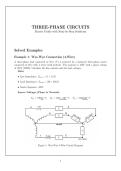
Example 1: Wye-Wye Connection (4-Wire)
A three-phase load connected in Wye (Y) is powered by a balanced three-phase source
connected in Wye with 4 wires (with neutral). The sequence is ABC with a phase voltage
of 120 V (RMS). Calculate the line currents and the load voltages.
Data:
• Line Impedance: ZLine = (1 + 1i)Ω
• Load Impedance: ZLoad = (20 + 20i)Ω
• Source Sequence: ABC
Source Voltages (Phase to Neutral):
Van = 120 0◦ V, Vbn = 120 −120◦ V, Vcn = 120 120◦ V
Figure 1: Wye-Wye 4-Wire Circuit Diagram
1
, Solution:
Using Ohm’s Law for a single phase (since neutral exists): The total impedance per phase
is ZT = ZLine + ZLoad = (1 + 1i) + (20 + 20i) = 21 + 21iΩ.
Line Currents:
Van 120 0◦
IaA = = = 2.857 + −2.857i = 4.04 −45◦ A
ZT 21 + 21i
Vbn 120 −120◦
IbB = = = 4.04 −165◦ A
ZT 21 + 21i
Vcn 120 120◦
IcC = = = 4.04 75◦ A
ZT 21 + 21i
Load Voltages (VAn ):
VAn = IaA × ZLoad = (4.04 −45◦ ) × (20 + 20i) = 114.28 0◦ V
Similarly for other phases, shifted by 120◦ .
Example 2: Delta-Delta Connection (Balanced)
A three-phase, 3-wire system connected to a balanced source (sequence ABC) feeds three
balanced loads connected in Delta (∆). The effective (RMS) line voltage is 120 V.
Calculate: The line currents.
Figure 2: Delta-Delta Balanced Circuit
Solution:
Given VL(rms) = 120 V. Convert to Peak/Max values:
√
VL(max) = 2 × 120 = 169.7 V
For Sequence ABC, line voltages lead phase voltages by 30◦ :
VAB = 169.7 30◦ V, VBC = 169.7 −90◦ V, VCA = 169.7 150◦ V
2
Master Guide with Step-by-Step Solutions
Solved Examples
Example 1: Wye-Wye Connection (4-Wire)
A three-phase load connected in Wye (Y) is powered by a balanced three-phase source
connected in Wye with 4 wires (with neutral). The sequence is ABC with a phase voltage
of 120 V (RMS). Calculate the line currents and the load voltages.
Data:
• Line Impedance: ZLine = (1 + 1i)Ω
• Load Impedance: ZLoad = (20 + 20i)Ω
• Source Sequence: ABC
Source Voltages (Phase to Neutral):
Van = 120 0◦ V, Vbn = 120 −120◦ V, Vcn = 120 120◦ V
Figure 1: Wye-Wye 4-Wire Circuit Diagram
1
, Solution:
Using Ohm’s Law for a single phase (since neutral exists): The total impedance per phase
is ZT = ZLine + ZLoad = (1 + 1i) + (20 + 20i) = 21 + 21iΩ.
Line Currents:
Van 120 0◦
IaA = = = 2.857 + −2.857i = 4.04 −45◦ A
ZT 21 + 21i
Vbn 120 −120◦
IbB = = = 4.04 −165◦ A
ZT 21 + 21i
Vcn 120 120◦
IcC = = = 4.04 75◦ A
ZT 21 + 21i
Load Voltages (VAn ):
VAn = IaA × ZLoad = (4.04 −45◦ ) × (20 + 20i) = 114.28 0◦ V
Similarly for other phases, shifted by 120◦ .
Example 2: Delta-Delta Connection (Balanced)
A three-phase, 3-wire system connected to a balanced source (sequence ABC) feeds three
balanced loads connected in Delta (∆). The effective (RMS) line voltage is 120 V.
Calculate: The line currents.
Figure 2: Delta-Delta Balanced Circuit
Solution:
Given VL(rms) = 120 V. Convert to Peak/Max values:
√
VL(max) = 2 × 120 = 169.7 V
For Sequence ABC, line voltages lead phase voltages by 30◦ :
VAB = 169.7 30◦ V, VBC = 169.7 −90◦ V, VCA = 169.7 150◦ V
2