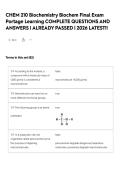
CHEM 210 Biochemistry Biochem Final Exam
Portage Learning COMPLETE QUESTIONS AND
ANSWERS | ALREADY PASSED | 2026 LATEST!!
Save
Terms in this set (82)
T/F: According to the module, a false
compound with a molecular mass of
1,000 g/mol is considered a macromolecule >5,000 g/mol
macromolecule.
T/F: Biomolecules can have two or true
more different functional groups.
T/F: The following group is an amine. true
C2H5NH2
T/F: In a eukaryotic cell, the false
organelles called peroxisomes serve
the purpose of digesting peroxisomes degrade dangerous/hazardous
macromolecules. molecules, lysosomes degrade macromolecules
, T/F: In a eukaryotic cell, the true
organelles called lysosomes serve
the purpose of digesting
macromolecules.
T/F: Carbon dioxide has a linear false
molecular shape AND has a bond
angle of 109.5 degrees. linear shape = 180 degrees
Of the following, ___ is not a property Forming ionic bonds
of carbon.
Forming ionic bonds
Forming cyclic structures
Forming multiple bonds
Forming bonds with oxygen
Bonding in long chains
Which of the following is an element Br
not typically found in living
organisms?
Br
Ca
H
S
Na
What are the functional groups carbonyls (C=O)
found in carbohydrates? alcohol/hydroxyls (-OH)
ketones
aldehydes
What is a ketone? carbonyl group bonded to 2 carbons
Portage Learning COMPLETE QUESTIONS AND
ANSWERS | ALREADY PASSED | 2026 LATEST!!
Save
Terms in this set (82)
T/F: According to the module, a false
compound with a molecular mass of
1,000 g/mol is considered a macromolecule >5,000 g/mol
macromolecule.
T/F: Biomolecules can have two or true
more different functional groups.
T/F: The following group is an amine. true
C2H5NH2
T/F: In a eukaryotic cell, the false
organelles called peroxisomes serve
the purpose of digesting peroxisomes degrade dangerous/hazardous
macromolecules. molecules, lysosomes degrade macromolecules
, T/F: In a eukaryotic cell, the true
organelles called lysosomes serve
the purpose of digesting
macromolecules.
T/F: Carbon dioxide has a linear false
molecular shape AND has a bond
angle of 109.5 degrees. linear shape = 180 degrees
Of the following, ___ is not a property Forming ionic bonds
of carbon.
Forming ionic bonds
Forming cyclic structures
Forming multiple bonds
Forming bonds with oxygen
Bonding in long chains
Which of the following is an element Br
not typically found in living
organisms?
Br
Ca
H
S
Na
What are the functional groups carbonyls (C=O)
found in carbohydrates? alcohol/hydroxyls (-OH)
ketones
aldehydes
What is a ketone? carbonyl group bonded to 2 carbons