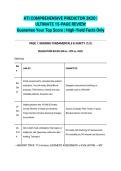
ATI COMPREHENSIVE PREDICTOR 2K20 |
ULTIMATE 15-PAGE REVIEW
Guarantee Your Top Score | High-Yield Facts Only
PAGE 1: NURSING FUNDAMENTALS & SAFETY (1/3)
DELEGATION RULES (RN vs. LPN vs. UAP)
TableCopy
Rol
CAN DO CANNOT DO
e
Initial assessments, care planning, patient
RN
education, IV push meds, Blood/Blood Delegate assessment, teaching, or
ON
products, TPN/Chemo, Central line care, unstable care to LPN/UAP
LY
Unstable patients, Evaluate care
Stable patients only. PO/IM/SQ meds
LP
(most), Monitor IV fluids (no titration), Assess, Evaluate, Plan, Teach, IV push,
N/L
Foley insertion, Routine dressing changes, Blood products, Central lines
VN
Accuchecks
UA ADLs (bath, feed, ambulate), Vital signs on
NO meds, NO teaching, NO assessment,
P/N stable pts, I&O, Specimen collection, Bed
NO unstable pts, NO wound care decisions
A making, Transport
→ MEMORY TRICK: "If it involves JUDGMENT, ASSESSMENT, or EVALUATION → RN."
,Common Distractor: LPNs can "monitor" but not "assess." Monitoring = watching numbers.
Assessment = interpreting meaning.
PRIORITIZATION: MASLOW & ABCs
1. Airway/Breathing/Circulation (ABCs) → Always FIRST
● Airway obstruction, Apnea, Hemorrhage, Cardiac arrest
2. Safety/Risk → Immediate danger
● Falls, Seizures, Suicide, Fire, Infection outbreak, Anaphylaxis
3. Physiological Needs → Pain, elimination, nutrition
● Exception: Chest pain → ABCs first, then pain
4. Psychosocial/Love & Belonging → Anxiety, family dynamics
5. Self-Esteem/Self-Actualization → Teaching, long-term goals
→ IN A LIST OF CLIENTS: Choose the one with AIRWAY or ACTIVE BLEEDING first. Then
unstable vitals. Then pain.
INFORMED CONSENT (ATI FAVORITE)
TableCopy
Who Can Sign? Who CANNOT?
Minors (except emancipated, married, military,
Adult (18+) competent
self-sufficient)
, Emancipated minor Unconscious/Intoxicated (emergency = implied consent)
Guardian/POA for healthcare Family members (unless designated)
Parent/Legal guardian for minor RN/Physician (cannot obtain consent for own procedure)
→ RN Role: Witness signature. Verify understanding. NOT to explain procedure
(physician's duty).
THERAPEUTIC vs. NON-THERAPEUTIC COMMUNICATION
TableCopy
THERAPEUTIC (USE) NON-THERAPEUTIC (AVOID)
Open-ended questions "Why" questions ("Why did you do that?")
Reflection ("You seem anxious") False reassurance ("Everything will be fine")
Silence Giving advice ("You should...")
Offering self ("I'm here to listen") Changing subject
Focusing Judgmental statements
Clarifying Medical jargon
→ MEMORY TRICK: If the nurse's response starts with "You should..." → It's WRONG.
, PAGE 2: NURSING FUNDAMENTALS & SAFETY (2/3)
LAB VALUES: PANIC LEVELS (Must Memorize)
TableCopy
Test Normal Panic Low Panic High
Sodium (Na+) 136-145 mEq/L <120 (seizures) >160
>6.5 (cardiac
Potassium (K+) 3.5-5.0 mEq/L <2.5 (cardiac arrest)
arrest)
Calcium (Ca2+) 9.0-10.5 mg/dL <7 (tetany) >13
Magnesium >4 (respiratory
1.3-2.1 mEq/L <1 (seizures)
(Mg2+) arrest)
Glucose
70-100 mg/dL <40 >400
(Fasting)
F: 12-16, M: 14-18
Hgb <7 (transfuse) —
g/dL
<20,000 (spontaneous
Platelets 150,000-400,000 —
bleed)
ULTIMATE 15-PAGE REVIEW
Guarantee Your Top Score | High-Yield Facts Only
PAGE 1: NURSING FUNDAMENTALS & SAFETY (1/3)
DELEGATION RULES (RN vs. LPN vs. UAP)
TableCopy
Rol
CAN DO CANNOT DO
e
Initial assessments, care planning, patient
RN
education, IV push meds, Blood/Blood Delegate assessment, teaching, or
ON
products, TPN/Chemo, Central line care, unstable care to LPN/UAP
LY
Unstable patients, Evaluate care
Stable patients only. PO/IM/SQ meds
LP
(most), Monitor IV fluids (no titration), Assess, Evaluate, Plan, Teach, IV push,
N/L
Foley insertion, Routine dressing changes, Blood products, Central lines
VN
Accuchecks
UA ADLs (bath, feed, ambulate), Vital signs on
NO meds, NO teaching, NO assessment,
P/N stable pts, I&O, Specimen collection, Bed
NO unstable pts, NO wound care decisions
A making, Transport
→ MEMORY TRICK: "If it involves JUDGMENT, ASSESSMENT, or EVALUATION → RN."
,Common Distractor: LPNs can "monitor" but not "assess." Monitoring = watching numbers.
Assessment = interpreting meaning.
PRIORITIZATION: MASLOW & ABCs
1. Airway/Breathing/Circulation (ABCs) → Always FIRST
● Airway obstruction, Apnea, Hemorrhage, Cardiac arrest
2. Safety/Risk → Immediate danger
● Falls, Seizures, Suicide, Fire, Infection outbreak, Anaphylaxis
3. Physiological Needs → Pain, elimination, nutrition
● Exception: Chest pain → ABCs first, then pain
4. Psychosocial/Love & Belonging → Anxiety, family dynamics
5. Self-Esteem/Self-Actualization → Teaching, long-term goals
→ IN A LIST OF CLIENTS: Choose the one with AIRWAY or ACTIVE BLEEDING first. Then
unstable vitals. Then pain.
INFORMED CONSENT (ATI FAVORITE)
TableCopy
Who Can Sign? Who CANNOT?
Minors (except emancipated, married, military,
Adult (18+) competent
self-sufficient)
, Emancipated minor Unconscious/Intoxicated (emergency = implied consent)
Guardian/POA for healthcare Family members (unless designated)
Parent/Legal guardian for minor RN/Physician (cannot obtain consent for own procedure)
→ RN Role: Witness signature. Verify understanding. NOT to explain procedure
(physician's duty).
THERAPEUTIC vs. NON-THERAPEUTIC COMMUNICATION
TableCopy
THERAPEUTIC (USE) NON-THERAPEUTIC (AVOID)
Open-ended questions "Why" questions ("Why did you do that?")
Reflection ("You seem anxious") False reassurance ("Everything will be fine")
Silence Giving advice ("You should...")
Offering self ("I'm here to listen") Changing subject
Focusing Judgmental statements
Clarifying Medical jargon
→ MEMORY TRICK: If the nurse's response starts with "You should..." → It's WRONG.
, PAGE 2: NURSING FUNDAMENTALS & SAFETY (2/3)
LAB VALUES: PANIC LEVELS (Must Memorize)
TableCopy
Test Normal Panic Low Panic High
Sodium (Na+) 136-145 mEq/L <120 (seizures) >160
>6.5 (cardiac
Potassium (K+) 3.5-5.0 mEq/L <2.5 (cardiac arrest)
arrest)
Calcium (Ca2+) 9.0-10.5 mg/dL <7 (tetany) >13
Magnesium >4 (respiratory
1.3-2.1 mEq/L <1 (seizures)
(Mg2+) arrest)
Glucose
70-100 mg/dL <40 >400
(Fasting)
F: 12-16, M: 14-18
Hgb <7 (transfuse) —
g/dL
<20,000 (spontaneous
Platelets 150,000-400,000 —
bleed)