

Written by students who passed Immediately available after payment Read online or as PDF Wrong document? Swap it for free 4.6 TrustPilot
logo-home
Document preview thumbnail
Preview 2 out of 9 pages
Exam (elaborations)

Hesi Case Study Stroke complete questions & verified correct answers

Document preview thumbnail
Preview 2 out of 9 pages

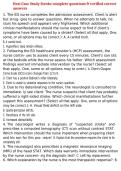
1. The ED nurse completes the admission assessment. Client is alert but strug- gles to answer questions. When he attempts to talk, he slurs his speech and appears very frightened. Which additional clinical manifestations should the nurse expect to find if client's symptoms have been caused by a stroke? (Select all that apply. One, some, or all options may be correct.): A. A carotid bruit. B. A carotid bruit. C. Hyporeflexic deep tendon reflexes. 2. Following the ED healthcare provider's (HCP) assessment, the nurse contin- ues to assess client every 15 minutes. Client's son sits at the bedside while the nurse assess his father. Which assessment findings warrant immediate intervention by the nurse? (Select all that apply. One, some or all options may be correct.): A. Client's Glasgow Coma Scale (GCS) score changes from 12 to 9. D. Client has a positive Babinski's reflex bilaterally. E. Client is unable to verbalize responses to the nurse's questions. 3. Due to his deteriorating condition, the neurologist is consulted to immediate- ly see client. The nurse suspects that client has probably suffered a right-sided stroke. Which clinical manifestations further support this assessment? (Select all that apply. One, some or all options may be correct.): A. Visual field deficit on the left side. B. Spatial-perceptual deficits. C. Paresthesia of the left side. D. Increased distractibility. 4. The neurologist writes a diagnosis of "suspected stroke" and prescribes a computed tomography (CT) scan without contrast STAT. Which intervention should the nurse implement when preparing client and his son for this pro- cedure?: B. Explain that the procedure requires the client to lie completely still. 5. The neurologist also prescribes a magnetic resonance imaging (MRI) of the head STAT. Which data warrants immediate intervention by the nurse concern- ing this diagnostic test?: C. Left hip replacement. 6. Which explanation by the nurse is the most therapeutic response?: B. "Your father has had a stroke, and the blood supply to the brain has been compromised." 7. The son is visibly upset and states, "Dad has been fine all week. We even went out to dinner. I love him so much and I am scared." How should the nurse respond?: B. "I know this is scary for you. Would you like to sit and talk?" 8. The neurologist diagnoses an ischemic right-sided stroke. The neurologist determines that client is not a candidate for tissue plasminogen activator (tPA). Enoxaparin sodium 1 mg/kg subcutaneously every 12 hours is ordered. Client weighs 170 pounds. How many mg of enoxaparin sodium will the nurse administer in each dose?: 77 9. With a diagnosis of a stroke, which priority interventions should the nurse include in client's plan of care?: A. Monitor PTT daily. B. Assess neurological status every hour. D. Keep the head of the bed elevated. E. Monitor blood glucose levels daily. 10. The nurse continues to closely monitor client's condition. Which findings would require immediate intervention by the nurse? (Select all that apply. One, some or all options may be correct.): B. Client's pulse oximeter reading has dropped to 90%. C. Client's serum potassium level is 3.0 mEq/L (mmol/L). E. Client's serum glucose is 150 (8.32 mmol/L). 11. Over the next 24 hour, client's SaO2, potassium level, and telemetry readings are within normal limits for his age, but his cardiac output decreases. The HCP needs to be notified regarding decreased cardiac output to decide whether to initiate IV fluid if hypovolemia is an issue and to determine other medical interventions. Which nursing interventions would be priority at this time? (Select all that apply. One, some or all options may be correct.): A. Monitor level of consciousness (LOC). C. Monitor intake and output every hour. D. Monitor capillary refill every 2 to 4 hours. E. Monitor pulse oximetry. 12. As the nurse assesses client, his son asks, "Why isn't my dad a candidate for thrombolytic therapy?" How should the nurse respond?: B."He is not a candidate because of therapeutic time constraints related to this medication." 13. Mr. Jones spends 3 days in the ICU. Once stabilized, he is transferred to a 30-bed medical unit. Client has left-sided paralysis, facial drooping with dys- phagia, left visual field deficit and aphasia. His IV fluids are discontinued, but he continues with a 20 gauge saline lock, now in the right forearm. He also has an indwelling urinary catheter. The HCP prescribes bedrest and sitting upright in a chair 4 times a day. Which nursing problem has the highest priority?: D. Swallowing problems. 14. Which nursing intervention should be implemented to address client's in- ability to care for himself?: B. Use plate guards when client is eating. 15. Client's son asks the nurse, "Why did my dad have this stroke? Does this mean I might have a stroke when I get older?" The nurse discusses the differ- ence between modifiable and nonmodifiable risk factors for a stroke. Which conditions are considered a modifiable risk factor for a stroke? (Select all that apply. One, some or all options may be correct.): A. High cholesterol levels. B. Diet. C. Lifestyle. D. History of atrial fibrillation. 16. Client's son tells the nurse that he is going to go outside to smoke a cigarette and will only be gone for a few minutes. Which statement is warranted in this situation, since the son inquired about risk factors for stroke?: A. "I should also let you know that smoking is a strong risk factor for a stroke." 17. Client is experiencing homonymous hemianopsia as the result of his stroke. Which nursing intervention would the nurse implement to address this condi- tion?: B. Place the objects client needs for activities of daily living on the right side of the table. 18. Client is experiencing pain in his left shoulder. The nurse is aware that up to 70% of clients with a stroke experience severe pain in the shoulder that prevents them from learning new skills. Shoulder function helps clients achieve balance, perform transfer skills, and participate in self-care activities.: D. Instruct client to clasp the left hand with the right hand and raise both h

Content preview

Hesi Case Study Stroke complete questions & verified correct
answers
1. The ED nurse completes the admission assessment. Client is alert
but strug- gles to answer questions. When he attempts to talk, he
slurs his speech and appears very frightened. Which additional
clinical manifestations should the nurse expect to find if client's
symptoms have been caused by a stroke? (Select all that apply. One,
some, or all options may be correct.): A. A carotid bruit.
B. A carotid bruit.
C. Hyporeflexic deep tendon reflexes.
2. Following the ED healthcare provider's (HCP) assessment, the
nurse contin- ues to assess client every 15 minutes. Client's son sits
at the bedside while the nurse assess his father. Which assessment
findings warrant immediate intervention by the nurse? (Select all
that apply. One, some or all options may be correct.): A. Client's Glasgow
Coma Scale (GCS) score changes from 12 to 9.
D. Client has a positive Babinski's reflex bilaterally.
E. Client is unable to verbalize responses to the nurse's questions.
3. Due to his deteriorating condition, the neurologist is consulted to
immediate- ly see client. The nurse suspects that client has probably
suffered a right-sided stroke. Which clinical manifestations further
support this assessment? (Select all that apply. One, some or all options
may be correct.): A. Visual field deficit on the left side.
B. Spatial-perceptual deficits.
C. Paresthesia of the left side.
D. Increased distractibility.
4. The neurologist writes a diagnosis of "suspected stroke" and
prescribes a computed tomography (CT) scan without contrast STAT.
Which intervention should the nurse implement when preparing client
and his son for this pro- cedure?: B. Explain that the procedure requires the client to lie
completely still.
5. The neurologist also prescribes a magnetic resonance imaging
(MRI) of the head STAT. Which data warrants immediate intervention
by the nurse concern- ing this diagnostic test?: C. Left hip replacement.
6. Which explanation by the nurse is the most therapeutic response?: B.
1/
9

, Hesi Case Study Stroke complete questions & verified correct
answers
"Your father has had a stroke, and the blood supply to the brain has been compromised."


2/
9

Document information

Uploaded on
February 8, 2026
Number of pages
9
Written in
2025/2026
Type
Exam (elaborations)
Contains
Questions & answers
$21.89

Wrong document? Swap it for free Within 14 days of purchase and before downloading, you can choose a different document. You can simply spend the amount again.
Written by students who passed
Immediately available after payment
Read online or as PDF

Sold
0
Followers
0
Items
51
Last sold
-


Why students choose Stuvia

Created by fellow students, verified by reviews

Quality you can trust: written by students who passed their tests and reviewed by others who've used these notes.

Didn't get what you expected? Choose another document

No worries! You can instantly pick a different document that better fits what you're looking for.

Pay as you like, start learning right away

No subscription, no commitments. Pay the way you're used to via credit card and download your PDF document instantly.

Student with book image

“Bought, downloaded, and aced it. It really can be that simple.”

Alisha Student

Working on your references?

Create accurate citations in APA, MLA and Harvard with our free citation generator.

Working on your references?

Frequently asked questions

