

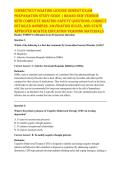
CONNECTICUT BOATING LICENSE NEWEST EXAM
PREPARATION STUDY GUIDE | BRAND NEW VERSION
WITH COMPLETE BOATING SAFETY QUESTIONS, CORRECT
DETAILED ANSWERS, NAVIGATION RULES, AND STATE
APPROVED BOATER EDUCATION TRAINING MATERIALS
Barkley PMHNP Certification Exam Preparation Questions
Question 1:
Which of the following is a first-line treatment for Generalized Anxiety Disorder (GAD)?
A. Tricyclic Antidepressants
B. Buspirone
C. Selective Serotonin Reuptake Inhibitors (SSRIs)
D. Benzodiazepines
Correct Answer: C. Selective Serotonin Reuptake Inhibitors (SSRIs)
Rationale:
SSRIs, such as sertraline and escitalopram, are considered first-line pharmacotherapy for
Generalized Anxiety Disorder due to their efficacy and relatively favorable side effect profile
compared to other classes of medications. They work by increasing serotonin levels in the brain,
which helps to alleviate anxiety symptoms. Although benzodiazepines may provide short-term
relief, they are not recommended for long-term management due to the risk of dependence.
Buspirone is an alternative but is typically not the first choice. Tricyclic antidepressants may be
effective but are often avoided first due to their side effects.
Question 2:
What is the primary purpose of Cognitive Behavioral Therapy (CBT) in treating
depression?
A. To uncover unconscious processes
B. To modify negative thought patterns
C. To enhance interpersonal relationships
D. To express emotions freely
Correct Answer: B. To modify negative thought patterns
Rationale:
Cognitive Behavioral Therapy (CBT) is designed to identify and change negative thought
patterns and behaviors that contribute to depressive symptoms. By addressing cognitive
distortions, CBT helps patients develop healthier thinking styles and coping strategies, leading to
, significant improvements in mood and functioning. Unlike psychodynamic therapies, which
focus on unconscious processes, CBT is practical and goal-oriented. Enhancing interpersonal
relationships and expressing emotions have their importance but are not the primary focus of
CBT in the context of depression.
Question 3:
In which situation would you most likely consider the use of Lithium in your patient?
A. Patient with a major depressive episode
B. Patient with bipolar disorder experiencing mania
C. Patient with anxiety disorder
D. Patient with schizophrenia
Correct Answer: B. Patient with bipolar disorder experiencing mania
Rationale:
Lithium is a mood stabilizer that is particularly effective in treating acute mania and preventing
future mood episodes in patients with bipolar disorder. Its mechanism involves stabilizing mood
and reducing the frequency and severity of manic and depressive episodes. For major depressive
episodes, lithium can sometimes be considered as an adjunctive treatment but is not a first-line
therapy on its own. It is not indicated for anxiety disorders or schizophrenia as other medications
are more appropriate for those conditions.
Question 4:
Which of the following is NOT a safe boating practice?
• A) Checking the weather before going out
• B) Overloading your boat with passengers or gear
• C) Keeping a proper lookout while underway
• D) Learning the navigational rules
Correct Option: B) Overloading your boat with passengers or gear
Rationale:
Overloading a boat can lead to instability, making it more likely to capsize or sink. Safe boating
practices include following weight limits and ensuring the boat is balanced with passengers and
gear. Being aware of these limits is essential for maintaining safety on the water.
Question 5:
What is the correct action to take when you hear a foghorn?
PREPARATION STUDY GUIDE | BRAND NEW VERSION
WITH COMPLETE BOATING SAFETY QUESTIONS, CORRECT
DETAILED ANSWERS, NAVIGATION RULES, AND STATE
APPROVED BOATER EDUCATION TRAINING MATERIALS
Barkley PMHNP Certification Exam Preparation Questions
Question 1:
Which of the following is a first-line treatment for Generalized Anxiety Disorder (GAD)?
A. Tricyclic Antidepressants
B. Buspirone
C. Selective Serotonin Reuptake Inhibitors (SSRIs)
D. Benzodiazepines
Correct Answer: C. Selective Serotonin Reuptake Inhibitors (SSRIs)
Rationale:
SSRIs, such as sertraline and escitalopram, are considered first-line pharmacotherapy for
Generalized Anxiety Disorder due to their efficacy and relatively favorable side effect profile
compared to other classes of medications. They work by increasing serotonin levels in the brain,
which helps to alleviate anxiety symptoms. Although benzodiazepines may provide short-term
relief, they are not recommended for long-term management due to the risk of dependence.
Buspirone is an alternative but is typically not the first choice. Tricyclic antidepressants may be
effective but are often avoided first due to their side effects.
Question 2:
What is the primary purpose of Cognitive Behavioral Therapy (CBT) in treating
depression?
A. To uncover unconscious processes
B. To modify negative thought patterns
C. To enhance interpersonal relationships
D. To express emotions freely
Correct Answer: B. To modify negative thought patterns
Rationale:
Cognitive Behavioral Therapy (CBT) is designed to identify and change negative thought
patterns and behaviors that contribute to depressive symptoms. By addressing cognitive
distortions, CBT helps patients develop healthier thinking styles and coping strategies, leading to
, significant improvements in mood and functioning. Unlike psychodynamic therapies, which
focus on unconscious processes, CBT is practical and goal-oriented. Enhancing interpersonal
relationships and expressing emotions have their importance but are not the primary focus of
CBT in the context of depression.
Question 3:
In which situation would you most likely consider the use of Lithium in your patient?
A. Patient with a major depressive episode
B. Patient with bipolar disorder experiencing mania
C. Patient with anxiety disorder
D. Patient with schizophrenia
Correct Answer: B. Patient with bipolar disorder experiencing mania
Rationale:
Lithium is a mood stabilizer that is particularly effective in treating acute mania and preventing
future mood episodes in patients with bipolar disorder. Its mechanism involves stabilizing mood
and reducing the frequency and severity of manic and depressive episodes. For major depressive
episodes, lithium can sometimes be considered as an adjunctive treatment but is not a first-line
therapy on its own. It is not indicated for anxiety disorders or schizophrenia as other medications
are more appropriate for those conditions.
Question 4:
Which of the following is NOT a safe boating practice?
• A) Checking the weather before going out
• B) Overloading your boat with passengers or gear
• C) Keeping a proper lookout while underway
• D) Learning the navigational rules
Correct Option: B) Overloading your boat with passengers or gear
Rationale:
Overloading a boat can lead to instability, making it more likely to capsize or sink. Safe boating
practices include following weight limits and ensuring the boat is balanced with passengers and
gear. Being aware of these limits is essential for maintaining safety on the water.
Question 5:
What is the correct action to take when you hear a foghorn?


