

Written by students who passed Immediately available after payment Read online or as PDF Wrong document? Swap it for free 4.6 TrustPilot
logo-home
Document preview thumbnail
Preview 1 out of 4 pages
Exam (elaborations)

Biochemistry Chapter 9 Exam – DNA Technology, Restriction Enzymes & Molecular Analysis |Verified Questions Complete with A+ Graded Rationales Latest Updated 2026

Document preview thumbnail
Preview 1 out of 4 pages

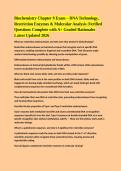
Biochemistry Chapter 9 Exam – DNA Technology, Restriction Enzymes & Molecular Analysis |Verified Questions Complete with A+ Graded Rationales Latest Updated 2026 What are restriction endonucleases and why were they pivotal in biotechnology? Restriction endonucleases are bacterial enzymes that recognize and cut specific DNA sequences, enabling scientists to fragment and recombine DNA. Their discovery made modern biotechnology possible by allowing precise manipulation of genes. Differentiate between endonucleases and exonucleases. Endonucleases cut internal phosphodiester bonds within a DNA strand, while exonucleases remove nucleotides from the terminal ends of DNA. What are blunt ends versus sticky ends, and why are sticky ends important? Blunt ends result from cuts at the same position on both DNA strands. Sticky ends are staggered cuts leaving single-stranded overhangs, which can easily hydrogen bond with complementary sequences for recombinant DNA formation. How do host bacterial cells protect their DNA from their own restriction enzymes? They methylate their own DNA at restriction sites, preventing endonucleases from recognizing and cleaving those sequences. Describe the key properties of Type I and Type II restriction endonucleases. Type I enzymes both methylate host DNA and cleave unmethylated DNA at recognition sequences (usually far from the site). Type II enzymes cut double-stranded DNA at or near specific recognition sites without methylation activity — these are the primary tools used in molecular biology. What is a palindromic sequence, and why is it significant for restriction enzymes? A palindromic sequence reads the same on both DNA strands in the 5'→3' direction; restriction enzymes often recognize these symmetrical sites, ensuring precise and reproducible cutting. How do ligases complement restriction enzymes in molecular cloning? DNA ligases rejoin DNA fragments by catalyzing the formation of phosphodiester bonds between sticky or blunt ends, sealing recombinant DNA. What is the purpose of gel electrophoresis in DNA technology? It separates DNA fragments by size when subjected to an electric field; smaller fragments migrate faster toward the positive electrode due to DNA's negative charge. What are the two main types of gels used and what are they for? Agarose gels are used for separating DNA, while polyacrylamide gels are used for separating proteins or small nucleic acids. How can DNA fragments be visualized in gels? By staining with dyes (e.g., ethidium bromide) that intercalate into DNA and fluoresce under UV light, or by autoradiography when radioactive isotopes are incorporated into DNA. What is autoradiography and when is it used? A detection method using radioactive DNA; exposed X-ray film reveals the position of DNA bands that emit radiation. What is the function of ethidium bromide in electrophoresis? It binds to DNA and fluoresces under UV light, allowing the visualization of DNA bands in the gel. What is a restriction map and how is it used? A diagram showing specific cleavage sites for restriction enzymes within a DNA molecule, used to identify, characterize, or compare DNA sequences. How does DNA fingerprinting utilize restriction enzymes? By analyzing the unique pattern of restriction fragments produced from variable DNA regions, enabling individual identification or genetic comparison. Why are DNA fingerprints unique to individuals? Highly variable noncoding regions differ between individuals, producing distinct fragment patterns when cut by restriction enzymes. Explain the purpose of the Southern blot technique. To identify specific DNA sequences among many fragments using complementary labeled probes that bind to their target sequences after transfer to a membrane. How do

Content preview

Biochemistry Chapter 9 Exam – DNA Technology,
Restriction Enzymes & Molecular Analysis |Verified
Questions Complete with A+ Graded Rationales
Latest Updated 2026
What are restriction endonucleases and why were they pivotal in biotechnology?

Restriction endonucleases are bacterial enzymes that recognize and cut specific DNA
sequences, enabling scientists to fragment and recombine DNA. Their discovery made
modern biotechnology possible by allowing precise manipulation of genes.

Differentiate between endonucleases and exonucleases.

Endonucleases cut internal phosphodiester bonds within a DNA strand, while exonucleases
remove nucleotides from the terminal ends of DNA.

What are blunt ends versus sticky ends, and why are sticky ends important?

Blunt ends result from cuts at the same position on both DNA strands. Sticky ends are
staggered cuts leaving single-stranded overhangs, which can easily hydrogen bond with
complementary sequences for recombinant DNA formation.

How do host bacterial cells protect their DNA from their own restriction enzymes?

They methylate their own DNA at restriction sites, preventing endonucleases from recognizing
and cleaving those sequences.

Describe the key properties of Type I and Type II restriction endonucleases.

Type I enzymes both methylate host DNA and cleave unmethylated DNA at recognition
sequences (usually far from the site). Type II enzymes cut double-stranded DNA at or near
specific recognition sites without methylation activity — these are the primary tools used in
molecular biology.

What is a palindromic sequence, and why is it significant for restriction enzymes?

A palindromic sequence reads the same on both DNA strands in the 5'→3' direction;
restriction enzymes often recognize these symmetrical sites, ensuring precise and
reproducible cutting.

How do ligases complement restriction enzymes in molecular cloning?

Document information

Uploaded on
February 7, 2026
Number of pages
4
Written in
2025/2026
Type
Exam (elaborations)
Contains
Questions & answers
$16.49

Wrong document? Swap it for free Within 14 days of purchase and before downloading, you can choose a different document. You can simply spend the amount again.
Written by students who passed
Immediately available after payment
Read online or as PDF

Seller avatar
Reputation scores are based on the amount of documents a seller has sold for a fee and the reviews they have received for those documents. There are three levels: Bronze, Silver and Gold. The better the reputation, the more your can rely on the quality of the sellers work.
ACADEMICAIDSTORE
4.1
(176)
Sold
1220
Followers
893
Items
12059
Last sold
5 days ago


Why students choose Stuvia

Created by fellow students, verified by reviews

Quality you can trust: written by students who passed their tests and reviewed by others who've used these notes.

Didn't get what you expected? Choose another document

No worries! You can instantly pick a different document that better fits what you're looking for.

Pay as you like, start learning right away

No subscription, no commitments. Pay the way you're used to via credit card and download your PDF document instantly.

Student with book image

“Bought, downloaded, and aced it. It really can be that simple.”

Alisha Student

Working on your references?

Create accurate citations in APA, MLA and Harvard with our free citation generator.

Working on your references?

Frequently asked questions
