

Written by students who passed Immediately available after payment Read online or as PDF Wrong document? Swap it for free 4.6 TrustPilot
logo-home
Document preview thumbnail
Preview 1 out of 4 pages
Exam (elaborations)

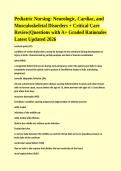
Pediatric Nursing: Neurologic, Cardiac, and Musculoskeletal Disorders + Critical Care Review|Questions with A+ Graded Rationales Latest Updated 2026

Document preview thumbnail
Preview 1 out of 4 pages

Pediatric Nursing: Neurologic, Cardiac, and Musculoskeletal Disorders + Critical Care Review|Questions with A+ Graded Rationales Latest Updated 2026 cerebral palsy (CP) condition of motor dysfunction caused by damage to the cerebrum during development or injury at birth; characterized by partial paralysis and lack of muscle coordination spina bifida a congenital defect that occurs during early pregnancy when the spinal canal fails to close completely around the spinal cord to protect it (insufficient intake of folic acid during pregnancy) Juvenile Idiopathic Arthritis (JIA) chronic autoimmune inflammatory disease causing inflammation to joints and other tissues with no known cause, occurs before the age of 16, often between the ages of 1-3 and affects girls often than boys muscular dystrophy (MD) hereditary condition causing progressive degeneration of skeletal muscles otitis media infection of the middle ear otitis media with effusion fluid in the middle ear without acute infection Eustachian tube A narrow tube between the middle ear and the throat that serves to equalize pressure on both sides of the eardrum ventricular septal defect (VSD) flaw or hole in the septum that divides the two ventricles of the heart atrial septal defect (ASD) flaw or hole in the septum that divides the two atria of the heart Tetralogy of Fallot congenital malformation involving four (tetra-) distinct heart defects (pulmonary stenosis, ventricular septal defect, overriding aorta and right ventricular hypertrophy) infective endocarditis inflammation of the inner layer of heart tissue as a result of an infectious microorganism cardiogenic shock When enough oxygen is not delivered to the tissues of the body, caused by low output of blood from the heart. anaphylactic shock A severe reaction that occurs when an allergen is introduced to the bloodstream of an allergic individual. Characterized by bronchoconstriction, labored breathing, widespread vasodilation, circulatory shock, and sometimes sudden death. Digoxin Improves myocardial contractility Monitor pulse rates Toxicity: bradycardia/dysrhythmias/nausea/vomiting Captopril ACE inhibitor (reduced afterload by causing vasodilation) Monitor BP before and after administration and for hyperkalemia Metoprolol or carvedilol beta blocker (decreases heart rate and BP) monitor for dizziness/hypotension/headache Furosemide (Lasix) Diuretic (potassium-wasting diuretics rid the body of excess fluid and sodium) monitor daily weights/intake and output monitor for hypokalemia encourage high potassium diet Kawasaki disease An acute sys

Content preview

Pediatric Nursing: Neurologic, Cardiac, and
Musculoskeletal Disorders + Critical Care
Review|Questions with A+ Graded Rationales
Latest Updated 2026
cerebral palsy (CP)

condition of motor dysfunction caused by damage to the cerebrum during development or
injury at birth; characterized by partial paralysis and lack of muscle coordination

spina bifida

a congenital defect that occurs during early pregnancy when the spinal canal fails to close
completely around the spinal cord to protect it (insufficient intake of folic acid during
pregnancy)

Juvenile Idiopathic Arthritis (JIA)

chronic autoimmune inflammatory disease causing inflammation to joints and other tissues
with no known cause, occurs before the age of 16, often between the ages of 1-3 and affects
girls often than boys

muscular dystrophy (MD)

hereditary condition causing progressive degeneration of skeletal muscles

otitis media

infection of the middle ear

otitis media with effusion

fluid in the middle ear without acute infection

Eustachian tube

A narrow tube between the middle ear and the throat that serves to equalize pressure on
both sides of the eardrum

ventricular septal defect (VSD)

flaw or hole in the septum that divides the two ventricles of the heart

atrial septal defect (ASD)

Document information

Uploaded on
February 5, 2026
Number of pages
4
Written in
2025/2026
Type
Exam (elaborations)
Contains
Questions & answers
$15.99

Wrong document? Swap it for free Within 14 days of purchase and before downloading, you can choose a different document. You can simply spend the amount again.
Written by students who passed
Immediately available after payment
Read online or as PDF

Seller avatar
Reputation scores are based on the amount of documents a seller has sold for a fee and the reviews they have received for those documents. There are three levels: Bronze, Silver and Gold. The better the reputation, the more your can rely on the quality of the sellers work.
ACADEMICAIDSTORE
4.1
(176)
Sold
1220
Followers
893
Items
12059
Last sold
5 days ago


Why students choose Stuvia

Created by fellow students, verified by reviews

Quality you can trust: written by students who passed their tests and reviewed by others who've used these notes.

Didn't get what you expected? Choose another document

No worries! You can instantly pick a different document that better fits what you're looking for.

Pay as you like, start learning right away

No subscription, no commitments. Pay the way you're used to via credit card and download your PDF document instantly.

Student with book image

“Bought, downloaded, and aced it. It really can be that simple.”

Alisha Student

Working on your references?

Create accurate citations in APA, MLA and Harvard with our free citation generator.

Working on your references?

Frequently asked questions
