

California Pest Control Adviser PCA Weeds:
Weed ID Exam Guide 2026
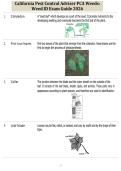
1. Cotyledon A "seed leaf" which develops as a part of the seed. It provides nutrients to the
developing seedling and eventually becomes the first leaf of the plant.
2. First true leaves first two leaves of the plant that emerge from the cotyledon. these leaves are the
first to begin the process of photosynthesis
3. Collar The junction between the blade and the outer sheath on the outside of the
leaf. It consists of the leaf blade, sheath, ligule, and auricles. These parts vary in
appearance according to plant species, and therefore are used in identification.
4. Leaf blade Leaves may be flat, rolled, or twisted, and vary by width and by the shape of their
tips.
, California Pest Control Adviser PCA Weeds:
Weed ID Exam Guide 2026
5. Node Stems are usually round and have visible bulges or joints where the leaves attach.
They are usually hollow except at the nodes. It is a site of great cellular activity and
growth. It is here that small buds develop into leaves, stems or flowers.
6. Internode A segment of a plant stem between the points where leaves are attached. The
blood vessels carrying water, hormones, and food from node to node.
7. Leaf sheath An elongated, cylindrical structure that encloses younger parts of the shoot. Its
major function is to protect younger shoots inside of it and to support the whole
plant, which explains why there are very few chloroplasts found in the sheath
mesophyll.
8. Petiole The stalk that attaches the leaf blade to the stem, and is able to twist the leaf to
face the sun. This gives a characteristic foliage arrangement to the plant.
, California Pest Control Adviser PCA Weeds:
Weed ID Exam Guide 2026
9. Auricle Small, clasping outgrowths that may or may not be present on the leaf collar.
10. Ligule A membranous or hairy structure on the inside of a leaf at the junction of the leaf
blade and sheath. It has been assumed to act in a passive way in protecting the
culm and leaves that it encloses from the entry of water, dust and harmful spores.
11. Awn Either bristles or hair-like outgrowths of lemmas in the florets, are one of the typi-
cal morphological characteristics of grass species. These stitt structures contribute
to grain dispersal and burial and fend ott animal predators.
12. Hypocotyl The part of a plant embryo directly below the cotyledons, forming a connection
with the radicle. important for emergence of the radicle, the hypocotyl emerges
and lifts the growing tip (usually including the seed coat) above the ground,
bearing the embryonic leaves (called cotyledons), and the plumule that gives rise
to the first true leaves.
Weed ID Exam Guide 2026
1. Cotyledon A "seed leaf" which develops as a part of the seed. It provides nutrients to the
developing seedling and eventually becomes the first leaf of the plant.
2. First true leaves first two leaves of the plant that emerge from the cotyledon. these leaves are the
first to begin the process of photosynthesis
3. Collar The junction between the blade and the outer sheath on the outside of the
leaf. It consists of the leaf blade, sheath, ligule, and auricles. These parts vary in
appearance according to plant species, and therefore are used in identification.
4. Leaf blade Leaves may be flat, rolled, or twisted, and vary by width and by the shape of their
tips.
, California Pest Control Adviser PCA Weeds:
Weed ID Exam Guide 2026
5. Node Stems are usually round and have visible bulges or joints where the leaves attach.
They are usually hollow except at the nodes. It is a site of great cellular activity and
growth. It is here that small buds develop into leaves, stems or flowers.
6. Internode A segment of a plant stem between the points where leaves are attached. The
blood vessels carrying water, hormones, and food from node to node.
7. Leaf sheath An elongated, cylindrical structure that encloses younger parts of the shoot. Its
major function is to protect younger shoots inside of it and to support the whole
plant, which explains why there are very few chloroplasts found in the sheath
mesophyll.
8. Petiole The stalk that attaches the leaf blade to the stem, and is able to twist the leaf to
face the sun. This gives a characteristic foliage arrangement to the plant.
, California Pest Control Adviser PCA Weeds:
Weed ID Exam Guide 2026
9. Auricle Small, clasping outgrowths that may or may not be present on the leaf collar.
10. Ligule A membranous or hairy structure on the inside of a leaf at the junction of the leaf
blade and sheath. It has been assumed to act in a passive way in protecting the
culm and leaves that it encloses from the entry of water, dust and harmful spores.
11. Awn Either bristles or hair-like outgrowths of lemmas in the florets, are one of the typi-
cal morphological characteristics of grass species. These stitt structures contribute
to grain dispersal and burial and fend ott animal predators.
12. Hypocotyl The part of a plant embryo directly below the cotyledons, forming a connection
with the radicle. important for emergence of the radicle, the hypocotyl emerges
and lifts the growing tip (usually including the seed coat) above the ground,
bearing the embryonic leaves (called cotyledons), and the plumule that gives rise
to the first true leaves.


