

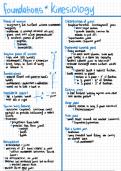
foundations- Kinesiology
Planes of motion classification of joints
*
Imaginary 2d Surface where movement .
1 Amphiarthrodial (cartilaginous) joints
*allow
happens slight motion
* movement is
always around an axis -
&
provide stability lanchor for
* plane and axis more perpendicular )
muscles to pull on
3 cardinal planes of motion .Synarthrodian
2 joints
1
Sagittal 3 Diathrodial (Synovial joints)
.
2 frontal
DiathrodialSunovialit is
. transverse
3
& =
Sagittal plane of motion blueen
·
* no direct munt bone ends
* right and left halves
mmm
*
joint "cavity" sleeve like
is a
capsulery
* movements : flexion - extension * secretes synovial to lubricate
joints
* limbs in front of
bring body & articular Cartilage covers surfaces inside
behind it
or cavity
y absorbs shock o reduces friction
frontal pland ⑭ have motions in
anteriorstrontandposteriorba
planes
motion in 1 plane = 10 of freedom
- num
halves
* in 2planes 2offreedomm
=
* moves out to side - back in
Glidingindes butting against
p
transverse planes each other
* top a bottom halves
um -
* little motion possible
* twist left or
right
Hinge joints
Typical bony features * allows motion in only 1 plane cuniaxial)
& articular chyaline) Cartilage sovers * flexion/extension
epinysis to provide cushioning - reduce
friction Pivot
joint
* processes : * bones rotate around one another (uniaxial)
*
projections from bone ↑
Supination/pronation
* processes that form
joints
·
condyle Ball - Socket joint
·
facet * multiaxial
·
head *
bony rounded head fitting into cavity
on another bone
Articulation * all movements
* articulation =
joint
*
meeting of 2 + bones creates a joint
*allows movement between those
bones
D MO articulation , no
joint
* Skeleton has moveable parts but no force
* muscles create force
* musale force only pulls
Planes of motion classification of joints
*
Imaginary 2d Surface where movement .
1 Amphiarthrodial (cartilaginous) joints
*allow
happens slight motion
* movement is
always around an axis -
&
provide stability lanchor for
* plane and axis more perpendicular )
muscles to pull on
3 cardinal planes of motion .Synarthrodian
2 joints
1
Sagittal 3 Diathrodial (Synovial joints)
.
2 frontal
DiathrodialSunovialit is
. transverse
3
& =
Sagittal plane of motion blueen
·
* no direct munt bone ends
* right and left halves
mmm
*
joint "cavity" sleeve like
is a
capsulery
* movements : flexion - extension * secretes synovial to lubricate
joints
* limbs in front of
bring body & articular Cartilage covers surfaces inside
behind it
or cavity
y absorbs shock o reduces friction
frontal pland ⑭ have motions in
anteriorstrontandposteriorba
planes
motion in 1 plane = 10 of freedom
- num
halves
* in 2planes 2offreedomm
=
* moves out to side - back in
Glidingindes butting against
p
transverse planes each other
* top a bottom halves
um -
* little motion possible
* twist left or
right
Hinge joints
Typical bony features * allows motion in only 1 plane cuniaxial)
& articular chyaline) Cartilage sovers * flexion/extension
epinysis to provide cushioning - reduce
friction Pivot
joint
* processes : * bones rotate around one another (uniaxial)
*
projections from bone ↑
Supination/pronation
* processes that form
joints
·
condyle Ball - Socket joint
·
facet * multiaxial
·
head *
bony rounded head fitting into cavity
on another bone
Articulation * all movements
* articulation =
joint
*
meeting of 2 + bones creates a joint
*allows movement between those
bones
D MO articulation , no
joint
* Skeleton has moveable parts but no force
* muscles create force
* musale force only pulls


