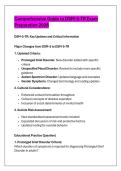
Comprehensive Guide to DSM-5-TR Exam
Preparation 2026
DSM-5-TR: Key Updates and Critical Information
Major Changes from DSM-5 to DSM-5-TR
1. Updated Criteria:
• Prolonged Grief Disorder: New disorder added with specific
criteria
• Unspecified Mood Disorder: Revised to include more specific
guidance
• Autism Spectrum Disorder: Updated language and examples
• Gender Dysphoria: Changed terminology and coding updates
2. Cultural Considerations:
• Enhanced cultural formulation throughout
• Cultural concepts of distress expanded
• Inclusion of social determinants of mental health
3. Suicide Risk Assessment:
• New standardized assessment tools included
• Expanded discussion of risk and protective factors
• Updated coding for suicidal behavior
Educational Practice Question)
1. Prolonged Grief Disorder Criteria:
Which duration of symptoms is required for diagnosing Prolonged Grief
Disorder in adults?
, • A. At least 6 months
• B. At least 12 months
• C. At least 3 months
• D. At least 9 months
Educational Answer: B - At least 12 months
*Explanation: DSM-5-TR specifies that in adults, symptoms must persist
at least 12 months post-bereavement. For children/adolescents, it's at
least 6 months.*
2. Autism Spectrum Disorder:
*Which specifier was added to Autism Spectrum Disorder in DSM-5-TR
to better capture associated features?*
• A. With catatonia
• B. With intellectual impairment
• C. With language impairment
• D. With ADHD features
Educational Answer: A - With catatonia
*Explanation: DSM-5-TR added "with catatonia" as a specifier for Autism
Spectrum Disorder, consistent with its use across other disorders.*
3. Unspecified Mood Disorder:
*What major change was made to "Unspecified Mood Disorder" in DSM-
5-TR?*
• A. It was eliminated entirely
• B. It now requires presence of mania
• C. It was expanded to include more specific guidance for clinical
use
• D. It was combined with bipolar disorders
Educational Answer: C - It was expanded to include more specific
guidance for clinical use
, Explanation: The criteria were revised to provide clearer guidance on
when to use this category.
Key Diagnostic Categories and Changes
4. Substance-Related Disorders:
"Caffeine withdrawal" is now:
• A. A new disorder added in DSM-5-TR
• B. Included as a condition for further study
• C. Moved from Appendix to main diagnostic criteria
• D. Eliminated from DSM-5-TR
Educational Answer: B - Included as a condition for further study
Explanation: Caffeine withdrawal remains in Section 3 (conditions
needing further research).
5. Gender Dysphoria:
*What terminology change was made in DSM-5-TR regarding gender-
related diagnoses?*
• A. "Gender Identity Disorder" was reinstated
• B. "Desistance" was removed from the text
• C. "Transsexualism" was added as a specifier
• D. No changes were made
Educational Answer: B - "Desistance" was removed from the text
Explanation: The term "desistance" was removed as it was considered
misleading and potentially stigmatizing.
6. Cultural Formulation:
*The Cultural Formulation Interview (CFI) in DSM-5-TR:*
• A. Was eliminated due to complexity
• B. Was expanded with more detailed modules
Preparation 2026
DSM-5-TR: Key Updates and Critical Information
Major Changes from DSM-5 to DSM-5-TR
1. Updated Criteria:
• Prolonged Grief Disorder: New disorder added with specific
criteria
• Unspecified Mood Disorder: Revised to include more specific
guidance
• Autism Spectrum Disorder: Updated language and examples
• Gender Dysphoria: Changed terminology and coding updates
2. Cultural Considerations:
• Enhanced cultural formulation throughout
• Cultural concepts of distress expanded
• Inclusion of social determinants of mental health
3. Suicide Risk Assessment:
• New standardized assessment tools included
• Expanded discussion of risk and protective factors
• Updated coding for suicidal behavior
Educational Practice Question)
1. Prolonged Grief Disorder Criteria:
Which duration of symptoms is required for diagnosing Prolonged Grief
Disorder in adults?
, • A. At least 6 months
• B. At least 12 months
• C. At least 3 months
• D. At least 9 months
Educational Answer: B - At least 12 months
*Explanation: DSM-5-TR specifies that in adults, symptoms must persist
at least 12 months post-bereavement. For children/adolescents, it's at
least 6 months.*
2. Autism Spectrum Disorder:
*Which specifier was added to Autism Spectrum Disorder in DSM-5-TR
to better capture associated features?*
• A. With catatonia
• B. With intellectual impairment
• C. With language impairment
• D. With ADHD features
Educational Answer: A - With catatonia
*Explanation: DSM-5-TR added "with catatonia" as a specifier for Autism
Spectrum Disorder, consistent with its use across other disorders.*
3. Unspecified Mood Disorder:
*What major change was made to "Unspecified Mood Disorder" in DSM-
5-TR?*
• A. It was eliminated entirely
• B. It now requires presence of mania
• C. It was expanded to include more specific guidance for clinical
use
• D. It was combined with bipolar disorders
Educational Answer: C - It was expanded to include more specific
guidance for clinical use
, Explanation: The criteria were revised to provide clearer guidance on
when to use this category.
Key Diagnostic Categories and Changes
4. Substance-Related Disorders:
"Caffeine withdrawal" is now:
• A. A new disorder added in DSM-5-TR
• B. Included as a condition for further study
• C. Moved from Appendix to main diagnostic criteria
• D. Eliminated from DSM-5-TR
Educational Answer: B - Included as a condition for further study
Explanation: Caffeine withdrawal remains in Section 3 (conditions
needing further research).
5. Gender Dysphoria:
*What terminology change was made in DSM-5-TR regarding gender-
related diagnoses?*
• A. "Gender Identity Disorder" was reinstated
• B. "Desistance" was removed from the text
• C. "Transsexualism" was added as a specifier
• D. No changes were made
Educational Answer: B - "Desistance" was removed from the text
Explanation: The term "desistance" was removed as it was considered
misleading and potentially stigmatizing.
6. Cultural Formulation:
*The Cultural Formulation Interview (CFI) in DSM-5-TR:*
• A. Was eliminated due to complexity
• B. Was expanded with more detailed modules