

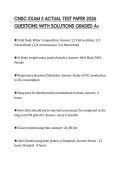
CNSC EXAM 2 ACTUAL TEST PAPER 2026
QUESTIONS WITH SOLUTIONS GRADED A+
◉ Total Body Water Composition. Answer: 2/3 Intracellular, 1/3
Extracellular (1/4 intravascular, 3/4 Interstitial)
◉ % Body weight water (male/female). Answer: 60% Male/50%
Female
◉ Respiratory Quotient Definition. Answer: Ratio of CO2 production
to O2 consumption
◉ Hang time for blenderized/reconstituted formula. Answer: 4
hours
◉ How often should micro-nutrient assessment be completed in the
long-term PN patient?. Answer: every 6 months
◉ Closed system hang time. Answer: 24-48 hrs
◉ Open System hang time (home vs hospital). Answer: Home - 12
hours Hospital - 8 hours
,◉ Max Daily Dose of ILE. Answer: 2.5 g/kg/d
◉ Minimum ILE to prevent EFAD in infants. Answer: 0.5-1 g/kg/day
◉ pH of dextrose solutions. Answer: acidic 3.5-6.5
◉ What factors increase calcium-phosphorus precipitation?.
Answer: Warmer temperature
Lower amino acid amounts
Use of calcium chloride
◉ Filter size for 2-in-1 forumlations. Answer: 0.22 micro meter
◉ What is the smallest pore size you can use for TNA?. Answer: 1.22
micro meter
◉ What is the size of fat particles?. Answer: 0.1-1 micro meter
◉ What is Glycerol?. Answer: A sugar alcohol that provides 4.3
kcal/kg; a component of one SCAPN for peripheral use
◉ Amino acid to nitrogen conversion. Answer: 6.25 g amino acid = 1
g nitrogen
, ◉ Which two commercially available AA solutions contain
phosphate?. Answer: FreeAmine III; Heptamine (10 mmoll/L)
◉ Max infusion rate for ILE infusion. Answer: 0.11 g/kg/h
◉ Preferred forms of calcium and magnesium. Answer: calcium
gluconate and magnesium sulfate
◉ ASPEN recommended changes to trace elements in TPN. Answer:
Decreased Copper (0.3->0.5 mg/d)
Decrease manganese to 55 mcg/d
Increase selenium (60-100 mcg/d)
Eliminate chromium or max 1 mcg/d
Keep Copper contamination < 0.1 mg/d Cu and 40 mcg/d Mn
◉ Carnitine. Answer: a nonessential, nonprotein amino acid made in
the body from lysine that helps transport fatty acids across the
mitochondrial membrane
◉ Iron recommendation for pre-term infants. Answer: 2-4 mg/kg/d
◉ Max Osmolality for Infant Formula. Answer: 460 mOsm/kg
QUESTIONS WITH SOLUTIONS GRADED A+
◉ Total Body Water Composition. Answer: 2/3 Intracellular, 1/3
Extracellular (1/4 intravascular, 3/4 Interstitial)
◉ % Body weight water (male/female). Answer: 60% Male/50%
Female
◉ Respiratory Quotient Definition. Answer: Ratio of CO2 production
to O2 consumption
◉ Hang time for blenderized/reconstituted formula. Answer: 4
hours
◉ How often should micro-nutrient assessment be completed in the
long-term PN patient?. Answer: every 6 months
◉ Closed system hang time. Answer: 24-48 hrs
◉ Open System hang time (home vs hospital). Answer: Home - 12
hours Hospital - 8 hours
,◉ Max Daily Dose of ILE. Answer: 2.5 g/kg/d
◉ Minimum ILE to prevent EFAD in infants. Answer: 0.5-1 g/kg/day
◉ pH of dextrose solutions. Answer: acidic 3.5-6.5
◉ What factors increase calcium-phosphorus precipitation?.
Answer: Warmer temperature
Lower amino acid amounts
Use of calcium chloride
◉ Filter size for 2-in-1 forumlations. Answer: 0.22 micro meter
◉ What is the smallest pore size you can use for TNA?. Answer: 1.22
micro meter
◉ What is the size of fat particles?. Answer: 0.1-1 micro meter
◉ What is Glycerol?. Answer: A sugar alcohol that provides 4.3
kcal/kg; a component of one SCAPN for peripheral use
◉ Amino acid to nitrogen conversion. Answer: 6.25 g amino acid = 1
g nitrogen
, ◉ Which two commercially available AA solutions contain
phosphate?. Answer: FreeAmine III; Heptamine (10 mmoll/L)
◉ Max infusion rate for ILE infusion. Answer: 0.11 g/kg/h
◉ Preferred forms of calcium and magnesium. Answer: calcium
gluconate and magnesium sulfate
◉ ASPEN recommended changes to trace elements in TPN. Answer:
Decreased Copper (0.3->0.5 mg/d)
Decrease manganese to 55 mcg/d
Increase selenium (60-100 mcg/d)
Eliminate chromium or max 1 mcg/d
Keep Copper contamination < 0.1 mg/d Cu and 40 mcg/d Mn
◉ Carnitine. Answer: a nonessential, nonprotein amino acid made in
the body from lysine that helps transport fatty acids across the
mitochondrial membrane
◉ Iron recommendation for pre-term infants. Answer: 2-4 mg/kg/d
◉ Max Osmolality for Infant Formula. Answer: 460 mOsm/kg


