OpenStax Organic Chemistry: A Tenth Edition Student Solutions Manual
Chapter 17 – Alcohols and Phenols
Solutions to Problems
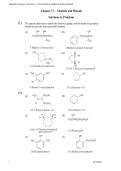
17.1 The parent chain must contain the hydroxyl group, and the hydroxyl group(s)
should receive the lowest possible number.
(a) (b)
(c) (d)
(e) (f)
17.2
(a) (b)
(c) (d)
(e) (f)
1 10/3/2023
, OpenStax Organic Chemistry: A Tenth Edition Student Solutions Manual
17.3 In general, the boiling points of a series of isomers decrease with branching. The more
nearly spherical a compound becomes, the less surface area it has relative to a straight
chain compound of the same molecular weight and functional group type. A smaller
surface area allows fewer van der Waals interactions, the weak forces that cause
covalent molecules to be attracted to each other.
In addition, branching in alcohols makes it more difficult for hydroxyl groups to
approach each other to form hydrogen bonds. A given volume of 2-methyl-2-propanol
therefore contains fewer hydrogen bonds than the same volume of 1-butanol, and less
energy is needed to break them in boiling.
17.4
(a)
HC≡CH < (CH3)2CHOH < CH3OH < (CF3)2CHOH
alkyne hindered alcohol alcohol with electron-
alcohol withdrawing groups
(b)
p-Methylphenol < Phenol < p-(Trifluoromethyl)phenol
phenol with phenol with electron-
electron-donating withdrawing groups
groups
(c)
Benzyl alcohol < Phenol < p-Hydroxybenzoic acid
alcohol carboxylic acid
17.5 We saw in Chapter 16 that a nitro group is electron-withdrawing. Since electron-
withdrawing groups stabilize anions, p-nitrobenzyl alcohol is more acidic than benzyl
alcohol. The methoxyl group, which is electron-donating, destabilizes an alkoxide
ion, making p-methoxybenzyl alcohol less acidic than benzyl alcohol.
17.6 (a)
In a hydroboration/oxidation reaction, the hydroxyl group is bonded to the less
substituted carbon.
(b)
Markovnikov product results from oxymercuration/reduction
10/3/2023 2
,OpenStax Organic Chemistry: A Tenth Edition Student Solutions Manual
(c)
Hydroxylation results in a diol with syn stereochemistry.
17.7 (a)
NaBH4 reduces aldehydes and ketones without interfering with other functional
groups.
(b)
LiAlH4, a stronger reducing agent, reduces both ketones and esters.
(c)
LiAlH4 reduces carbonyl functional groups without reducing double bonds.
17.8 (a)
Benzyl alcohol may be the reduction product of an aldehyde, a carboxylic acid, or an
ester. NaBH4 may be used to reduce the aldehyde.
(b)
Reduction of a ketone yields the secondary alcohol. NaBH4 may also be
used here and in (c).
3 10/3/2023
, OpenStax Organic Chemistry: A Tenth Edition Student Solutions Manual
(c)
(d)
17.9 All of the products have an –OH and a methyl group bonded to what was formerly a
ketone carbon.
(a)
(b)
(c)
17.10 First, identify the type of alcohol. If the alcohol is primary, it can only be synthesized
from formaldehyde plus the appropriate Grignard reagent. If the alcohol is secondary, it
is synthesized from an aldehyde and a Grignard reagent. (Usually, there are two
combinations of aldehyde and a Grignard reagent). A tertiary alcohol is synthesized
from a ketone and a Grignard reagent. If all three groups on the tertiary alcohol are
different, there are often three different combinations of ketone and a Grignard reagent.
If two of the groups on the alcohol carbon are the same, the alcohol may also be
synthesized from an ester and two equivalents of Grignard reagents.
(a) 2-Methyl-2-propanol is a tertiary alcohol. To synthesize a tertiary alcohol, start
with a ketone.
If two or more alkyl groups bonded to the carbon bearing the –OH group are the
same, an alcohol can be synthesized from an ester and a Grignard reagent.
10/3/2023 4
Chapter 17 – Alcohols and Phenols
Solutions to Problems
17.1 The parent chain must contain the hydroxyl group, and the hydroxyl group(s)
should receive the lowest possible number.
(a) (b)
(c) (d)
(e) (f)
17.2
(a) (b)
(c) (d)
(e) (f)
1 10/3/2023
, OpenStax Organic Chemistry: A Tenth Edition Student Solutions Manual
17.3 In general, the boiling points of a series of isomers decrease with branching. The more
nearly spherical a compound becomes, the less surface area it has relative to a straight
chain compound of the same molecular weight and functional group type. A smaller
surface area allows fewer van der Waals interactions, the weak forces that cause
covalent molecules to be attracted to each other.
In addition, branching in alcohols makes it more difficult for hydroxyl groups to
approach each other to form hydrogen bonds. A given volume of 2-methyl-2-propanol
therefore contains fewer hydrogen bonds than the same volume of 1-butanol, and less
energy is needed to break them in boiling.
17.4
(a)
HC≡CH < (CH3)2CHOH < CH3OH < (CF3)2CHOH
alkyne hindered alcohol alcohol with electron-
alcohol withdrawing groups
(b)
p-Methylphenol < Phenol < p-(Trifluoromethyl)phenol
phenol with phenol with electron-
electron-donating withdrawing groups
groups
(c)
Benzyl alcohol < Phenol < p-Hydroxybenzoic acid
alcohol carboxylic acid
17.5 We saw in Chapter 16 that a nitro group is electron-withdrawing. Since electron-
withdrawing groups stabilize anions, p-nitrobenzyl alcohol is more acidic than benzyl
alcohol. The methoxyl group, which is electron-donating, destabilizes an alkoxide
ion, making p-methoxybenzyl alcohol less acidic than benzyl alcohol.
17.6 (a)
In a hydroboration/oxidation reaction, the hydroxyl group is bonded to the less
substituted carbon.
(b)
Markovnikov product results from oxymercuration/reduction
10/3/2023 2
,OpenStax Organic Chemistry: A Tenth Edition Student Solutions Manual
(c)
Hydroxylation results in a diol with syn stereochemistry.
17.7 (a)
NaBH4 reduces aldehydes and ketones without interfering with other functional
groups.
(b)
LiAlH4, a stronger reducing agent, reduces both ketones and esters.
(c)
LiAlH4 reduces carbonyl functional groups without reducing double bonds.
17.8 (a)
Benzyl alcohol may be the reduction product of an aldehyde, a carboxylic acid, or an
ester. NaBH4 may be used to reduce the aldehyde.
(b)
Reduction of a ketone yields the secondary alcohol. NaBH4 may also be
used here and in (c).
3 10/3/2023
, OpenStax Organic Chemistry: A Tenth Edition Student Solutions Manual
(c)
(d)
17.9 All of the products have an –OH and a methyl group bonded to what was formerly a
ketone carbon.
(a)
(b)
(c)
17.10 First, identify the type of alcohol. If the alcohol is primary, it can only be synthesized
from formaldehyde plus the appropriate Grignard reagent. If the alcohol is secondary, it
is synthesized from an aldehyde and a Grignard reagent. (Usually, there are two
combinations of aldehyde and a Grignard reagent). A tertiary alcohol is synthesized
from a ketone and a Grignard reagent. If all three groups on the tertiary alcohol are
different, there are often three different combinations of ketone and a Grignard reagent.
If two of the groups on the alcohol carbon are the same, the alcohol may also be
synthesized from an ester and two equivalents of Grignard reagents.
(a) 2-Methyl-2-propanol is a tertiary alcohol. To synthesize a tertiary alcohol, start
with a ketone.
If two or more alkyl groups bonded to the carbon bearing the –OH group are the
same, an alcohol can be synthesized from an ester and a Grignard reagent.
10/3/2023 4