Q1.
Sodium thiosulfate reacts with dilute hydrochloric acid as shown.
Na2S2O3(aq) + 2 HCl(aq) → 2 NaCl(aq) + SO2 (g) + S(s) + H2O(l)
(a) Give the simplest ionic equation for this reaction.
___________________________________________________________________
(1)
(b) The gas SO2 is a pollutant.
State the property of SO2 that causes pollution when it enters rivers.
Give an equation to show the reaction of SO2 with water.
Property ___________________________________________________________
Equation __________________________________________________________
(2)
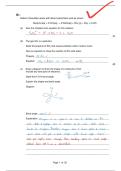
(c) Draw a diagram to show the shape of a molecule of H2O
Include any lone pairs of electrons.
State the H-O-H bond angle.
Explain this shape and bond angle.
Diagram
Bond angle _________________________________________________________
Explanation _________________________________________________________
___________________________________________________________________
___________________________________________________________________
___________________________________________________________________
___________________________________________________________________
___________________________________________________________________
___________________________________________________________________
___________________________________________________________________
Page 1 of 35
, (4)
(d) The initial rate of the reaction between sodium thiosulfate and hydrochloric acid can
be monitored by measuring the time taken for a fixed amount of sulfur to be
produced.
Describe an experiment to investigate the effect of temperature on the initial rate of
this reaction.
Include
• a brief outline of your method
• how you will measure the time taken for a fixed amount of sulfur to be formed
• how you will present your results in graphical form
• a sketch of the graph that you would expect.
___________________________________________________________________
___________________________________________________________________
___________________________________________________________________
___________________________________________________________________
___________________________________________________________________
___________________________________________________________________
___________________________________________________________________
___________________________________________________________________
___________________________________________________________________
___________________________________________________________________
___________________________________________________________________
___________________________________________________________________
(6)
(Total 13 marks)
Q2.
This question is about sulfuric acid and its salts.
(a) Draw the displayed formula of a molecule of H2SO4
(1)
Page 2 of 35
,(b) In aqueous solution, sulfuric acid acts as a strong acid. The H2SO4 dissociates to
form HSO4– ions and H+ ions.
The HSO4– ions act as a weak acid and dissociate to form SO42– ions and H+ ions.
Give an equation to show each stage in the dissociation of sulfuric acid in aqueous
solution.
Include appropriate arrows in your equations.
Equation 1 __________________________________________________________
Equation 2 __________________________________________________________
(2)
(c) A student is required to make 250 cm3 of an aqueous solution that contains an
accurately measured mass of sodium hydrogensulfate (NaHSO4).
Describe the method that the student should use to make this solution.
___________________________________________________________________
___________________________________________________________________
___________________________________________________________________
___________________________________________________________________
___________________________________________________________________
___________________________________________________________________
___________________________________________________________________
___________________________________________________________________
___________________________________________________________________
___________________________________________________________________
___________________________________________________________________
___________________________________________________________________
(4)
(d) A solution that contains 605 mg of NaHSO4 in 100 cm3 of solution has a pH of 1.72
Calculate the value of Ka for the hydrogensulfate ion (HSO4–) that is behaving as a
weak acid.
Give your answer to three significant figures.
State the units of Ka
Page 3 of 35
, K ___________________________ Units ___________________________
(6)
(e) Some sodium sulfate is dissolved in a sample of the solution from part (d).
Explain why this increases the pH of the solution.
___________________________________________________________________
___________________________________________________________________
___________________________________________________________________
___________________________________________________________________
___________________________________________________________________
___________________________________________________________________
(2)
(Total 15 marks)
Q3.
The diagram represents the cell used to measure the standard electrode potential for the
Fe3+/Fe2+ electrode.
(a) Name the piece of apparatus labelled A.
___________________________________________________________________
(1)
(b) State the purpose of A.
___________________________________________________________________
___________________________________________________________________
(1)
(c) Name the substance used as electrode B in the diagram above.
Page 4 of 35
Sodium thiosulfate reacts with dilute hydrochloric acid as shown.
Na2S2O3(aq) + 2 HCl(aq) → 2 NaCl(aq) + SO2 (g) + S(s) + H2O(l)
(a) Give the simplest ionic equation for this reaction.
___________________________________________________________________
(1)
(b) The gas SO2 is a pollutant.
State the property of SO2 that causes pollution when it enters rivers.
Give an equation to show the reaction of SO2 with water.
Property ___________________________________________________________
Equation __________________________________________________________
(2)
(c) Draw a diagram to show the shape of a molecule of H2O
Include any lone pairs of electrons.
State the H-O-H bond angle.
Explain this shape and bond angle.
Diagram
Bond angle _________________________________________________________
Explanation _________________________________________________________
___________________________________________________________________
___________________________________________________________________
___________________________________________________________________
___________________________________________________________________
___________________________________________________________________
___________________________________________________________________
___________________________________________________________________
Page 1 of 35
, (4)
(d) The initial rate of the reaction between sodium thiosulfate and hydrochloric acid can
be monitored by measuring the time taken for a fixed amount of sulfur to be
produced.
Describe an experiment to investigate the effect of temperature on the initial rate of
this reaction.
Include
• a brief outline of your method
• how you will measure the time taken for a fixed amount of sulfur to be formed
• how you will present your results in graphical form
• a sketch of the graph that you would expect.
___________________________________________________________________
___________________________________________________________________
___________________________________________________________________
___________________________________________________________________
___________________________________________________________________
___________________________________________________________________
___________________________________________________________________
___________________________________________________________________
___________________________________________________________________
___________________________________________________________________
___________________________________________________________________
___________________________________________________________________
(6)
(Total 13 marks)
Q2.
This question is about sulfuric acid and its salts.
(a) Draw the displayed formula of a molecule of H2SO4
(1)
Page 2 of 35
,(b) In aqueous solution, sulfuric acid acts as a strong acid. The H2SO4 dissociates to
form HSO4– ions and H+ ions.
The HSO4– ions act as a weak acid and dissociate to form SO42– ions and H+ ions.
Give an equation to show each stage in the dissociation of sulfuric acid in aqueous
solution.
Include appropriate arrows in your equations.
Equation 1 __________________________________________________________
Equation 2 __________________________________________________________
(2)
(c) A student is required to make 250 cm3 of an aqueous solution that contains an
accurately measured mass of sodium hydrogensulfate (NaHSO4).
Describe the method that the student should use to make this solution.
___________________________________________________________________
___________________________________________________________________
___________________________________________________________________
___________________________________________________________________
___________________________________________________________________
___________________________________________________________________
___________________________________________________________________
___________________________________________________________________
___________________________________________________________________
___________________________________________________________________
___________________________________________________________________
___________________________________________________________________
(4)
(d) A solution that contains 605 mg of NaHSO4 in 100 cm3 of solution has a pH of 1.72
Calculate the value of Ka for the hydrogensulfate ion (HSO4–) that is behaving as a
weak acid.
Give your answer to three significant figures.
State the units of Ka
Page 3 of 35
, K ___________________________ Units ___________________________
(6)
(e) Some sodium sulfate is dissolved in a sample of the solution from part (d).
Explain why this increases the pH of the solution.
___________________________________________________________________
___________________________________________________________________
___________________________________________________________________
___________________________________________________________________
___________________________________________________________________
___________________________________________________________________
(2)
(Total 15 marks)
Q3.
The diagram represents the cell used to measure the standard electrode potential for the
Fe3+/Fe2+ electrode.
(a) Name the piece of apparatus labelled A.
___________________________________________________________________
(1)
(b) State the purpose of A.
___________________________________________________________________
___________________________________________________________________
(1)
(c) Name the substance used as electrode B in the diagram above.
Page 4 of 35