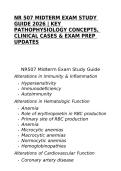
NR 507 MIDTERM EXAM STUDY
GUIDE 2026 | KEY
PATHOPHYSIOLOGY CONCEPTS,
CLINICAL CASES & EXAM PREP
UPDATES
NR507 Midterm Exam Study Guide
Alterations in Immunity & Inflammation
• Hypersensitivity
• Immunodeficiency
• Autoimmunity
Alterations in Hematologic Function
• Anemia
• Role of erythropoietin in RBC production
• Primary site of RBC production
• Anemia
• Microcytic anemias
• Macrocytic anemias
• Normocytic anemias
• Hemoglobinopathies
Alterations of Cardiovascular Function
• Coronary artery disease
, • Heart failure
• Heart valve disorders
Function and Alterations of the Pulmonary
System
• Mechanics of breathing
• Obstructive and Restrictive Lung
Diseases
• Chronic Obstructive Pulmonary
Disease
• Asthma
• Interstitial Lung Disease
Alterations of Renal and Urinary Tract
Function: In addition to course readings
and Edapt review, also review the
recorded presentation on Acute and
Chronic Renal Failure
• Urinary Tract Infections
• Renal Calculi
• Urinary Incontinence
• Acute Kidney Injury
• Chronic Kidney Disease
Alterations of the Male Reproductive
Systems
• Benign Prostatic Hypertrophy
,Hypersensitivity: Type I
• Type I hypersensitivity reactions are
immediate and primarily driven by
IgE antibodies that sensitize mast
cells and basophils.
• Upon subsequent exposure to the
same allergen, these cells rapidly
release proinflammatory mediators,
such as histamine, leukotrienes,
prostaglandins, and cytokines.
• These mediators induce clinical
manifestations like vasodilation
(which leads to a drop in blood
pressure), bronchial smooth muscle
contraction (which can cause
respiratory difficulty), and increased
mucus production (potentially
obstructing airways).
Hypersensitivity: Type II
• Type II hypersensitivity reactions, or
cytotoxic hypersensitivity, are
characterized by the immune
system's assault on cells that
display modified self-antigens.
• This attack is mediated by
autoantibodies that recognize
, these altered antigens on cell
surfaces, a process that can result
in the destruction of these cells
through various mechanisms.
• The clinical symptoms manifest
according to the tissue or organ
where the altered antigens are
expressed.
• Precautions such as blood typing
and cross-matching are essential to
prevent cytotoxic reactions during
procedures like hemolytic
transfusions, where the compatibility
of donor and recipient blood is
critical to avoid an immune system
attack on the transfused blood cells.
Hypersensitivity: Type III
• In Type III hypersensitivity, also
known as immune complex-
mediated hypersensitivity,
antibodies bind to soluble antigens
in the blood, leading to the
formation of immune complexes.
These complexes circulate and
eventually deposit in various
tissues.
• Once deposited, these immune
GUIDE 2026 | KEY
PATHOPHYSIOLOGY CONCEPTS,
CLINICAL CASES & EXAM PREP
UPDATES
NR507 Midterm Exam Study Guide
Alterations in Immunity & Inflammation
• Hypersensitivity
• Immunodeficiency
• Autoimmunity
Alterations in Hematologic Function
• Anemia
• Role of erythropoietin in RBC production
• Primary site of RBC production
• Anemia
• Microcytic anemias
• Macrocytic anemias
• Normocytic anemias
• Hemoglobinopathies
Alterations of Cardiovascular Function
• Coronary artery disease
, • Heart failure
• Heart valve disorders
Function and Alterations of the Pulmonary
System
• Mechanics of breathing
• Obstructive and Restrictive Lung
Diseases
• Chronic Obstructive Pulmonary
Disease
• Asthma
• Interstitial Lung Disease
Alterations of Renal and Urinary Tract
Function: In addition to course readings
and Edapt review, also review the
recorded presentation on Acute and
Chronic Renal Failure
• Urinary Tract Infections
• Renal Calculi
• Urinary Incontinence
• Acute Kidney Injury
• Chronic Kidney Disease
Alterations of the Male Reproductive
Systems
• Benign Prostatic Hypertrophy
,Hypersensitivity: Type I
• Type I hypersensitivity reactions are
immediate and primarily driven by
IgE antibodies that sensitize mast
cells and basophils.
• Upon subsequent exposure to the
same allergen, these cells rapidly
release proinflammatory mediators,
such as histamine, leukotrienes,
prostaglandins, and cytokines.
• These mediators induce clinical
manifestations like vasodilation
(which leads to a drop in blood
pressure), bronchial smooth muscle
contraction (which can cause
respiratory difficulty), and increased
mucus production (potentially
obstructing airways).
Hypersensitivity: Type II
• Type II hypersensitivity reactions, or
cytotoxic hypersensitivity, are
characterized by the immune
system's assault on cells that
display modified self-antigens.
• This attack is mediated by
autoantibodies that recognize
, these altered antigens on cell
surfaces, a process that can result
in the destruction of these cells
through various mechanisms.
• The clinical symptoms manifest
according to the tissue or organ
where the altered antigens are
expressed.
• Precautions such as blood typing
and cross-matching are essential to
prevent cytotoxic reactions during
procedures like hemolytic
transfusions, where the compatibility
of donor and recipient blood is
critical to avoid an immune system
attack on the transfused blood cells.
Hypersensitivity: Type III
• In Type III hypersensitivity, also
known as immune complex-
mediated hypersensitivity,
antibodies bind to soluble antigens
in the blood, leading to the
formation of immune complexes.
These complexes circulate and
eventually deposit in various
tissues.
• Once deposited, these immune