NU 578
UNIT 3 EXAM
University of South Alabama.
High-Yield Qs & Verified Answers
with Rationales
This Exam Features:
This document includes 50 high-yield Exam
questions with verified answers and detailed
rationales for Unit 3 of NU 578 at the University of
South Alabama. It is designed to help students quickly review and
reinforce core concepts likely to appear on assessments. The
structured Q&A format supports focused exam preparation and
strengthens clinical reasoning and test-taking skills.
,Question 1
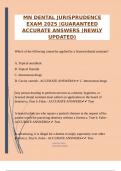
In the treatment of allergic rhinitis which of the following should be
limited to no more than 5 consecutive days use?
A. Antihistamines
B. Oral adrenergics
C. Topical vasoconstrictors
D. Topical glucocorticoids
E. Nasal sprays containing normal saline
Correct Answer: C. Topical vasoconstrictors
Expert Rationale:
Topical nasal vasoconstrictors (e.g., oxymetazoline) provide rapid relief of
nasal congestion but can cause rebound congestion (rhinitis medicamentosa)
if used longer than 3–5 days. This rebound effect worsens symptoms upon
discontinuation. Antihistamines and topical steroids can be used longer safely.
Saline sprays help moisturize without risk of rebound.
---
Question 2
The patient must be informed of possible damage to the lungs when
prescribed oral therapy with which of the following drugs?
A. amiodarone (Cordarone)
B. dofetilide (Tikosyn)
C. propafenone (Rhythmol)
,D. propranolol (Inderal)
Correct Answer: A. amiodarone (Cordarone)
Expert Rationale:
Amiodarone is associated with pulmonary toxicity, including pneumonitis and
fibrosis, which can be life-threatening. Patients require monitoring for
respiratory symptoms. Other antiarrhythmics like dofetilide, propafenone, and
propranolol do not commonly cause lung damage.
---
Question 3
Although aspirin is often combined with P2Y12 Adenosine Diphosphate
Receptor Antagonists, its use with these agents may:
A. Increase the risk of edema
B. Increase the risk of renal toxicity
C. Increase the risk of hepatotoxicity
D. Increase the risk of GI bleeds
Correct Answer: D. Increase the risk of GI bleeds
Expert Rationale:
Aspirin combined with P2Y12 inhibitors (e.g., clopidogrel) increases bleeding
risk, particularly gastrointestinal bleeding, due to the additive effect on
platelet inhibition and mucosal irritation caused by aspirin.
, ---
Question 4
Calcium channel blockers that are dihydropyridines:
A. Work primarily on the SA node
B. Include Verapamil and Diltiazem
C. Interact strongly with grapefruit juice
D. Are often combined with a beta blocker to suppress reflex tachycardia
Correct Answer: D. Are often combined with a beta blocker to suppress reflex
tachycardia
Expert Rationale:
Dihydropyridine calcium channel blockers (e.g., nifedipine) primarily cause
vasodilation and can induce reflex tachycardia; combining with beta blockers
blunts this reflex. Verapamil and diltiazem are non-dihydropyridines acting on
cardiac conduction. Grapefruit juice interacts strongly mainly with non-
dihydropyridines.
---
Question 5
Which of the following is a true statement:
A. Dextromethorphan has not been shown to be effective in suppressing cough
associated with the common cold.
UNIT 3 EXAM
University of South Alabama.
High-Yield Qs & Verified Answers
with Rationales
This Exam Features:
This document includes 50 high-yield Exam
questions with verified answers and detailed
rationales for Unit 3 of NU 578 at the University of
South Alabama. It is designed to help students quickly review and
reinforce core concepts likely to appear on assessments. The
structured Q&A format supports focused exam preparation and
strengthens clinical reasoning and test-taking skills.
,Question 1
In the treatment of allergic rhinitis which of the following should be
limited to no more than 5 consecutive days use?
A. Antihistamines
B. Oral adrenergics
C. Topical vasoconstrictors
D. Topical glucocorticoids
E. Nasal sprays containing normal saline
Correct Answer: C. Topical vasoconstrictors
Expert Rationale:
Topical nasal vasoconstrictors (e.g., oxymetazoline) provide rapid relief of
nasal congestion but can cause rebound congestion (rhinitis medicamentosa)
if used longer than 3–5 days. This rebound effect worsens symptoms upon
discontinuation. Antihistamines and topical steroids can be used longer safely.
Saline sprays help moisturize without risk of rebound.
---
Question 2
The patient must be informed of possible damage to the lungs when
prescribed oral therapy with which of the following drugs?
A. amiodarone (Cordarone)
B. dofetilide (Tikosyn)
C. propafenone (Rhythmol)
,D. propranolol (Inderal)
Correct Answer: A. amiodarone (Cordarone)
Expert Rationale:
Amiodarone is associated with pulmonary toxicity, including pneumonitis and
fibrosis, which can be life-threatening. Patients require monitoring for
respiratory symptoms. Other antiarrhythmics like dofetilide, propafenone, and
propranolol do not commonly cause lung damage.
---
Question 3
Although aspirin is often combined with P2Y12 Adenosine Diphosphate
Receptor Antagonists, its use with these agents may:
A. Increase the risk of edema
B. Increase the risk of renal toxicity
C. Increase the risk of hepatotoxicity
D. Increase the risk of GI bleeds
Correct Answer: D. Increase the risk of GI bleeds
Expert Rationale:
Aspirin combined with P2Y12 inhibitors (e.g., clopidogrel) increases bleeding
risk, particularly gastrointestinal bleeding, due to the additive effect on
platelet inhibition and mucosal irritation caused by aspirin.
, ---
Question 4
Calcium channel blockers that are dihydropyridines:
A. Work primarily on the SA node
B. Include Verapamil and Diltiazem
C. Interact strongly with grapefruit juice
D. Are often combined with a beta blocker to suppress reflex tachycardia
Correct Answer: D. Are often combined with a beta blocker to suppress reflex
tachycardia
Expert Rationale:
Dihydropyridine calcium channel blockers (e.g., nifedipine) primarily cause
vasodilation and can induce reflex tachycardia; combining with beta blockers
blunts this reflex. Verapamil and diltiazem are non-dihydropyridines acting on
cardiac conduction. Grapefruit juice interacts strongly mainly with non-
dihydropyridines.
---
Question 5
Which of the following is a true statement:
A. Dextromethorphan has not been shown to be effective in suppressing cough
associated with the common cold.