

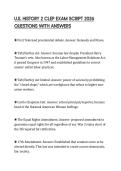
U.S. HISTORY 2 CLEP EXAM SCRIPT 2026
QUESTIONS WITH ANSWERS
◉ First Televised presidential debate. Answer: Kennedy and Nixon.
◉ Taft/Hartley Act. Answer: became law despite President Harry
Truman's veto. Also known as the Labor-Management Relations Act,
it passed Congress in 1947 and established guidelines to correct
unions' unfair labor practices.
◉ Taft/Hartley Act limited. Answer: power of unions by prohibiting
the "closed shops" which are workplaces that refuse to higher non-
union workers.
◉ Carrie Chapman Catt. Answer: school principal/reporter, became
head of the National American Woman Suffrage.
◉ The Equal Rights Amendment. Answer: proposed amendment to
guarantee equal rights for all regardless of sex. Was 3 states short of
the 38 required for ratification.
◉ 17th Amendment. Answer: Established that senators were to be
elected directly. This law was intended to create a more democratic,
fair society.
,◉ dumbbell tenements. Answer: early 1900's it was designed as a
dumbbell and had more apartments for more families and shared
restrooms. these tenements were fire hazards, waste and disease.
◉ Wade/Davis Bill. Answer: made re-admittance to the Union of
former Confederate states contingent on a majority in each Southern
state to take the Ironclad oath that they had never supported the
Confederacy. It was pocket vetoed by Lincoln.
◉ Dawes Severalty Act. Answer: authorized survey American Indian
tribal land and divide it into allotments for individual Indians. Its
purpose was to assimilate Indians into mainstream American
society and sell "excess" Indian reservation land in the open market.
◉ Homestead Act. Answer: effort to promote agricultural
development of the land west of the Mississippi River. It awarded
160 acres of land to each family which resided on the land for five
years.
◉ Hatch Act. Answer: forbid federal employees from running for
office, making political contributions and working for a campaign.
, ◉ Morrill Land Grant Act. Answer: allowed for land grant colleges.
resulted in the creation of 12 new state colleges, 8 agricultural and
mechanical colleges, and 6 black colleges.
◉ National Woman's Party. Answer: founded by Alice Paul and Lucy
Burns,fought for women's suffrage. Once suffrage was granted by the
19th amendment, NWP turned its attention to an Equal Rights
Amendment.
◉ Dr. Alfred Kinsey. Answer: He was a sexologist of the 1940s best
known for writing Sexual Behavior in the Human Male and Female
as well as developing the Kinsey Scale.
◉ Geneva Accords. Answer: The Geneva Accords of 1954
temporarily separated Vietnam into two at the 17th parallel giving
the north to Ho Chi Minh (communist) and the south to Bao Dai
(French supported).
◉ Ralph Nader. Answer: Automobile safety "Unsafe at Any Speed,"
published in 1965, is a book accusing car manufacturers of
resistance to the introduction of safety features such as seat belts,
and their general reluctance to spend money on improving safety.
◉ WEB Dubois. Answer: Leader of the Niagara movement & NAACP;
Wrote 'Souls of Black Folks'.
QUESTIONS WITH ANSWERS
◉ First Televised presidential debate. Answer: Kennedy and Nixon.
◉ Taft/Hartley Act. Answer: became law despite President Harry
Truman's veto. Also known as the Labor-Management Relations Act,
it passed Congress in 1947 and established guidelines to correct
unions' unfair labor practices.
◉ Taft/Hartley Act limited. Answer: power of unions by prohibiting
the "closed shops" which are workplaces that refuse to higher non-
union workers.
◉ Carrie Chapman Catt. Answer: school principal/reporter, became
head of the National American Woman Suffrage.
◉ The Equal Rights Amendment. Answer: proposed amendment to
guarantee equal rights for all regardless of sex. Was 3 states short of
the 38 required for ratification.
◉ 17th Amendment. Answer: Established that senators were to be
elected directly. This law was intended to create a more democratic,
fair society.
,◉ dumbbell tenements. Answer: early 1900's it was designed as a
dumbbell and had more apartments for more families and shared
restrooms. these tenements were fire hazards, waste and disease.
◉ Wade/Davis Bill. Answer: made re-admittance to the Union of
former Confederate states contingent on a majority in each Southern
state to take the Ironclad oath that they had never supported the
Confederacy. It was pocket vetoed by Lincoln.
◉ Dawes Severalty Act. Answer: authorized survey American Indian
tribal land and divide it into allotments for individual Indians. Its
purpose was to assimilate Indians into mainstream American
society and sell "excess" Indian reservation land in the open market.
◉ Homestead Act. Answer: effort to promote agricultural
development of the land west of the Mississippi River. It awarded
160 acres of land to each family which resided on the land for five
years.
◉ Hatch Act. Answer: forbid federal employees from running for
office, making political contributions and working for a campaign.
, ◉ Morrill Land Grant Act. Answer: allowed for land grant colleges.
resulted in the creation of 12 new state colleges, 8 agricultural and
mechanical colleges, and 6 black colleges.
◉ National Woman's Party. Answer: founded by Alice Paul and Lucy
Burns,fought for women's suffrage. Once suffrage was granted by the
19th amendment, NWP turned its attention to an Equal Rights
Amendment.
◉ Dr. Alfred Kinsey. Answer: He was a sexologist of the 1940s best
known for writing Sexual Behavior in the Human Male and Female
as well as developing the Kinsey Scale.
◉ Geneva Accords. Answer: The Geneva Accords of 1954
temporarily separated Vietnam into two at the 17th parallel giving
the north to Ho Chi Minh (communist) and the south to Bao Dai
(French supported).
◉ Ralph Nader. Answer: Automobile safety "Unsafe at Any Speed,"
published in 1965, is a book accusing car manufacturers of
resistance to the introduction of safety features such as seat belts,
and their general reluctance to spend money on improving safety.
◉ WEB Dubois. Answer: Leader of the Niagara movement & NAACP;
Wrote 'Souls of Black Folks'.


