

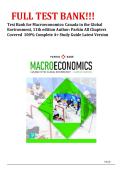
FULL TEST BANK!!!
Test Bank for Macroeconomics: Canada in the Global
Environment, 11th edition Author: Parkin All Chapters
Covered 100% Complete A+ Study Guide Latest Version
PAGE 1
, Table of Contents are Given Below
"Microeconomics: Canada in the Global Environment" (11th Edition) by Michael Parkin and Robin
Bade is structured into several chapters that cover fundamental concepts and applications in
microeconomics. The chapters are organized as follows:
Part 1: Introduction
1. What Is Economics?
2. The Economic Problem
Part 2: How Markets Work
3. Demand and Supply
4. Elasticity
5. Efficiency and Equity
6. Government Actions in Markets
7. Global Markets in Action
Part 3: Households’ Choices
8. Utility and Demand
9. Possibilities, Preferences, and Choices
Part 4: Firms and Markets
10. Organizing Production
11. Output and Costs
12. Perfect Competition
13. Monopoly
14. Monopolistic Competition
15. Oligopoly
Part 5: Market Failure and Government
16. Public Choices and Public Goods
17. Externalities
PAGE 2
,Part 6: Factor Markets, Inequality, and Uncertainty
PAGE 3
, 18. Markets for Factors of Production
19. Economic Inequality
20. Uncertainty and Information
This comprehensive structure provides a solid foundation for understanding microeconomic principles,
with a focus on both theoretical frameworks and real-world applications relevant to the Canadian and
global economic environments.
PART 1: INTRODUCTION
1. What Is Economics?
Question 1:
Economics is best defined as:
A) The study of how societies use scarce resources to produce valuable commodities and distribute
them among different people.
B) The study of financial markets and investment strategies.
C) The analysis of government policies and their impact on businesses.
D) The examination of consumer behavior in various markets.
Answer: A
Explanation:
Economics focuses on how societies allocate limited resources to produce goods and services and
distribute them among individuals.
Question 2:
Which of the following is a central question in economics?
A) How to maximize personal happiness.
B) What goods and services to produce.
C) How to create artistic value.
D) The history of economic thought.
PAGE 4
Test Bank for Macroeconomics: Canada in the Global
Environment, 11th edition Author: Parkin All Chapters
Covered 100% Complete A+ Study Guide Latest Version
PAGE 1
, Table of Contents are Given Below
"Microeconomics: Canada in the Global Environment" (11th Edition) by Michael Parkin and Robin
Bade is structured into several chapters that cover fundamental concepts and applications in
microeconomics. The chapters are organized as follows:
Part 1: Introduction
1. What Is Economics?
2. The Economic Problem
Part 2: How Markets Work
3. Demand and Supply
4. Elasticity
5. Efficiency and Equity
6. Government Actions in Markets
7. Global Markets in Action
Part 3: Households’ Choices
8. Utility and Demand
9. Possibilities, Preferences, and Choices
Part 4: Firms and Markets
10. Organizing Production
11. Output and Costs
12. Perfect Competition
13. Monopoly
14. Monopolistic Competition
15. Oligopoly
Part 5: Market Failure and Government
16. Public Choices and Public Goods
17. Externalities
PAGE 2
,Part 6: Factor Markets, Inequality, and Uncertainty
PAGE 3
, 18. Markets for Factors of Production
19. Economic Inequality
20. Uncertainty and Information
This comprehensive structure provides a solid foundation for understanding microeconomic principles,
with a focus on both theoretical frameworks and real-world applications relevant to the Canadian and
global economic environments.
PART 1: INTRODUCTION
1. What Is Economics?
Question 1:
Economics is best defined as:
A) The study of how societies use scarce resources to produce valuable commodities and distribute
them among different people.
B) The study of financial markets and investment strategies.
C) The analysis of government policies and their impact on businesses.
D) The examination of consumer behavior in various markets.
Answer: A
Explanation:
Economics focuses on how societies allocate limited resources to produce goods and services and
distribute them among individuals.
Question 2:
Which of the following is a central question in economics?
A) How to maximize personal happiness.
B) What goods and services to produce.
C) How to create artistic value.
D) The history of economic thought.
PAGE 4


