Exam (elaborations) MATH 302 WEEK 4
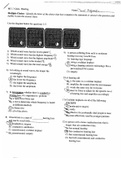
Week 4 Test Part 1 of 6 - Calculations of Probabilities Questions 3.0/ 3.0 Points Question 1 of 20 1.0/ 1.0 Points The mean yearly rainfall in Sydney, Australia, is about 134 mm and the standard deviation is about 66 mm ("Annual maximums of," 2013). Assume rainfall is normally distributed. How many yearly mm of rainfall would there be in the top 15%? Round answer to 2 decimal places. Answer: 202.40 Answer Key:202.40 Feedback: Top 15%, is in the bottom 85% percentile. In Excel, =NORM.INV(.85,134,66) Question 2 of 20 1.0/ 1.0 Points Find P(Z ≥ .42). Round answer to 4 decimal places. Answer: 0.3372 Answer Key:0.3372|.3372 Feedback: In Excel, =1-NORM.S.DIST(0.42,TRUE) Question 3 of 20 1.0/ 1.0 Points Find the area under the standard normal distribution to the left of z = -1.35. Round answer to 4 decimal places. Answer: 0.0885 Answer Key:0.0885|.0885 Feedback: In Excel, =NORM.S.DIST(-1.35,TRUE) Part 2 of 6 - Continuous Random Variables and Probability Functions Questions 0.0/ 1.0 Points Question 4 of 20 0.0/ 1.0 Points Find the probability that falls in the shaded area. • A. 0.525 • B. 0.1257 • C. 0.438 • D. 0.375 Answer Key:D Feedback:(21 - 12)*(1/24) Part 3 of 6 - The Central Limit Theorem Questions 0.0/ 1.0 Points Question 5 of 20 0.0/ 1.0 Points Click to see additional instructions The manufacturer of a new compact car claims the miles per gallon (mpg) for the gasoline consumption is mound-shaped and symmetric with a mean of 27.4 mpg and a standard deviation of 10.2 mpg. If 29 such cars are tested, what is the probability the average mpg achieved by these 29 cars will be greater than 29? Answer: Round your answer to 4 decimal places as necessary. For example, 0.1357 would be a legitimate entry. Make sure you include the 0 before the decimal. Answer Key:0.1991 Feedback: This is a sampling distribution problem with μ = 27.4. σ = 10.2, and sample size n = 29. New SD = 10.2/SQRT(29) = 1. P(x > 29) = 1 – NORM.DIST(29, 27.4,1., TRUE) Part 4 of 6 - The Exponential Distribution Questions 4.0/ 4.0 Points Question 6 of 20 1.0/ 1.0 Points The commute time for people in a city has an exponential distribution with an average of 0.66 hours. What is the probability that a randomly selected person in this city will have a commute time between 0.55 and 1.1 hours? Answer: (round to 3 decimal places) 0.246 Answer Key:0.246|.246 Feedback: P(.55 < x < 1.1) P(x < 1.1) - P(x < .55) In Excel, =EXPON.DIST(1.1,1/0.66,TRUE)-EXPON.DIST(0.55,1/0.66,TRUE) Question 7 of 20 1.0/ 1.0 Points The average lifetime of a set of tires is 3.4 years. The manufacturer will replace any set of tires failing within three years of the date of purchase. The lifetime of these tires is known to follow an exponential distribution. What is the probability that the tires will fail within three years of the date of purchase? • A. 0.5862 • B. 0.4138 • C. 0.4866 • D. 0.7568 Answer Key:A Feedback: P(x < 3) In Excel, =EXPON.DIST(3,1/3.4,TRUE) Question 8 of 20 1.0/ 1.0 Points Suppose that the longevity of a light bulb is exponential with a mean lifetime of 7.6 years. Find the probability that a light bulb lasts less than three years. • A. 0.1175 • B. 0.3261 • C. 8.5634 • D. 0.6739 • E. 0.3907 Answer Key:B Feedback: P(x < 3) In Excel, =EXPON.DIST(3,1/7.6,TRUE) Question 9 of 20 1.0/ 1.0 Points The life of an electric component has an exponential distribution with a mean of 7.2 years. What is the probability that a randomly selected one such component has a life less than 4 years? Answer: (round to 4 decimal places) 0.4262 Answer Key:0.4262|.4262 Feedback: P(x < 4) In Excel, =EXPON.DIST(4,1/7.2,TRUE) Part 5 of 6 - The Uniform Distribution Questions 6.0/ 6.0 Points Question 10 of 20 1.0/ 1.0 Points Miles per gallon of a vehicle is a random variable with a uniform distribution from 23 to 47. The probability that a random vehicle gets between 25 and 30 miles per gallon is: Answer: (Round to four decimal places) 0.2083 Answer Key:0.2083|.2083 Feedback: Interval goes from 23 < x < 47 P(25 < x < 30) = (30 - 25) * Question 11 of 20 1.0/ 1.0 Points The waiting time for an Uber has a uniform distribution between 5 and 37 minutes. What is the probability that the waiting time for this Uber is less than 13 minutes on a given day? Answer: (Round to two decimal places.) 0.25 Answer Key:0.25|.25 Feedback: Interval goes from 5 < x < 37 P(x < 13) = (13 - 5) * Question 12 of 20 1.0/ 1.0 Points The waiting time for a bus has a uniform distribution between 2 and 13 minutes. What is the probability that the waiting time for this bus is less than 4.5 minutes on a given day? Answer: (Round to four decimal places.) 0.2273 Answer Key:0.2273|.2273 Feedback: Interval goes from 2 < x < 13 P(x < 4.5) = (4.5 - 2) * Question 13 of 20 1.0/ 1.0 Points Miles per gallon of a vehicle is a random variable with a uniform distribution from 23 to 47. The probability that a random vehicle gets between 28 and 36 miles per gallon is: Answer: (Round to four decimal places) 0.3333 Answer Key:0.3333|.3333 Feedback: Interval goes from 23 < x < 47 P(28 < x < 36) = (36 - 28)* Question 14 of 20 1.0/ 1.0 Points Suppose the time it takes a barber to complete a haircuts is uniformly distributed between 8 and 22 minutes, inclusive. Let X = the time, in minutes, it takes a barber to complete a haircut. Then X ~ U (8, 22). Find the probability that a randomly selected barber needs at least 14 minutes to complete the haircut, P(x > 14) (round answer to 4 decimal places) Answer: 0.5714 Answer Key:0.5714|.5714 Feedback: Interval goes from 8 < x < 22 P(x > 14) = (22- 14) * Question 15 of 20 1.0/ 1.0 Points The waiting time in line at an ice cream shop has a uniform distribution between 3 and 14 minutes. What is the 75th percentile of this distribution? (Recall: The 75th percentile divides the distribution into 2 parts so that 75% of area is to the left of 75th percentile) _______ minutes Answer: (Round answer to two decimal places.) 11.25 Answer Key:11.25 Feedback: Interval goes from 3 < x < 14. 75th percentile use .75 P(X < x) = .75 .75 = .75*11 = x - 3 8.25 = x - 3 11.25 = x Part 6 of 6 - Using the Central Limit Theorem Questions 3.0/ 5.0 Points Question 16 of 20 0.0/ 1.0 Points The average amount of water in randomly selected 16-ounce bottles of water is 16.15 ounces with a standard deviation of 0.45 ounces. If a random sample of thirty-five 16-ounce bottles of water are selected, what is the probability that the mean of this sample is less than 15.99 ounces of water? Answer: (round to 4 decimal places) Answer Key:0.0177|.0177 Feedback: New SD = .45/SQRT(35) = 0. P(x < 15.99), in Excel =NORM.DIST(15.99,16.15,0.,TRUE) Question 17 of 20 1.0/ 1.0 Points The average amount of a beverage in randomly selected 16-ounce beverage can is 15.96 ounces with a standard deviation of 0.5 ounces. If a random sample of sixty-five 16-ounce beverage cans are selected, what is the probability that the mean of this sample is less than 16.05 ounces of beverage? Answer: (round to 4 decimal places) 0.9266 Answer Key:0.9266|.9266 Feedback: New SD = .5/SQRT(65) = 0. P(x < 16.05), in Excel =NORM.DIST(16.05,15.96,0.,TRUE) Question 18 of 20 0.0/ 1.0 Points The time a student sleeps per night has a distribution with mean 6.06 hours and a standard deviation of 0.55 hours. Find the probability that average sleeping time for a randomly selected sample of 35 students is more than 6.15 hours per night. Answer: (round to 4 decimal places) Answer Key:0.1665|.1665 Feedback: New SD = .55/SQRT(35) = 0. P(x > 6.15), in Excel =1-NORM.DIST(6.15,6.06,0.,TRUE) Question 19 of 20 1.0/ 1.0 Points The MAX light rail in Portland, OR has a waiting time that is normally distributed with a mean waiting time of 4.22 minutes with a standard deviation of 1.7 minutes. A random sample of 35 wait times was selected, what is the probability the sample mean wait time is under 3.74 minutes? Round answer to 4 decimal places. Answer: 0.0474 Answer Key:0.0474|.0474 Feedback: New SD = 1.7/SQRT(35) =0. P(x < 3.74), using Excel =NORM.DIST(3.74,4.22,0.,TRUE) Question 20 of 20 1.0/ 1.0 Points The average amount of a beverage in randomly selected 16-ounce beverage can is 16.18 ounces with a standard deviation of 0.38 ounces. If a random sample of eighty 16-ounce beverage cans are selected, what is the probability that mean of this sample is less than 16.1 ounces of beverage? Answer: (round to 4 decimal places) 0.0298 Answer Key:0.0298|.0298 Feedback: New SD = .38/SQRT(80) = 0. P(x < 16.1), in Excel =NORM.DIST(16.1,16.18,0.,TRUE)
Written for
- Institution
-
American Public University
- Course
-
MATH 302
Document information
- Uploaded on
- March 17, 2021
- Number of pages
- 10
- Written in
- 2020/2021
- Type
- Exam (elaborations)
- Contains
- Questions & answers
Subjects
-
math 302math302 week 4
-
100 correct question and answers