

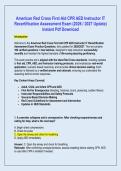
American Red Cross First Aid CPR AED Instructor IT
Recertification Assessment Exam ( Update)
Instant Pdf Download
Introduction
Welcome to the American Red Cross First Aid CPR AED Instructor IT Recertification
Assessment Exam Practice Questions, fully updated for 2026/2027. This set contains
100 verified questions in two batches, designed to help instructors successfully
recertify and maintain the highest standard of life-saving teaching proficiency.
This exam practice set is aligned with the latest Red Cross standards, including updates
to first aid, CPR, AED, and instructor training protocols, and emphasizes real-world
application, scenario-based reasoning, and accurate clinical decision-making. Each
question is followed by a verified answer and rationale, ensuring you understand the
reasoning behind correct responses.
Key Content Areas Covered:
Adult, Child, and Infant CPR and AED
First Aid for Emergencies (bleeding, fractures, burns, poisoning, sudden illness)
Instructor Responsibilities and Safety Protocols
Scenario-Based Decision Making
Red Cross Guidelines for Assessment and Intervention
Updates in 2026 Standards
1. A coworker collapses and is unresponsive. After checking responsiveness and
calling for help, what is the next step?
A. Begin chest compressions
B. Check for pulse
C. Open the airway and check for breathing
D. Apply AED immediately
Answer: C. Open the airway and check for breathing
Rationale: After confirming unresponsiveness, assess breathing before starting CPR. AED
is used after CPR is initiated if needed.
,2. True or False: Hands-only CPR is recommended for adults who suddenly collapse
in the community.
Answer: True
Rationale: For adult sudden cardiac arrest, hands-only CPR is effective until EMS or AED
arrives.
3. Scenario: A child is choking and cannot cough or speak. What should the rescuer
do first?
A. Perform abdominal thrusts (Heimlich maneuver)
B. Give back blows only
C. Begin chest compressions
D. Call EMS immediately
Answer: A. Perform abdominal thrusts (Heimlich maneuver)
Rationale: For conscious children with complete airway obstruction, abdominal thrusts help
dislodge the object.
4. What is the recommended compression rate for adult CPR?
A. 60–80/min
B. 80–100/min
C. 100–120/min
D. 120–140/min
Answer: C. 100–120/min
Rationale: Current guidelines recommend compressions at 100–120 per minute for optimal
perfusion.
5. SATA: Which are signs of a heart attack?
A. Chest pain or discomfort
B. Nausea or vomiting
, C. Sudden shortness of breath
D. Sweating
E. Fever
Answer: A, B, C, D
Rationale: Fever is not a typical MI symptom; other listed signs indicate myocardial
infarction.
6. True or False: When performing CPR on an infant, you should cover the infant’s
nose and mouth with your mouth for rescue breaths.
Answer: True
Rationale: Use your mouth to cover both the nose and mouth for effective ventilation in
infants.
7. Scenario: You witness an adult collapse at a shopping mall. What is the first
action?
A. Begin CPR
B. Check responsiveness and call EMS
C. Apply AED
D. Give rescue breaths
Answer: B. Check responsiveness and call EMS
Rationale: Always assess responsiveness and activate emergency response before
initiating interventions.
8. What is the correct depth for adult chest compressions?
A. About 1 inch (2.5 cm)
B. About 2 inches (5 cm)
C. About 3 inches (7.5 cm)
D. About 0.5 inches (1.5 cm)
Recertification Assessment Exam ( Update)
Instant Pdf Download
Introduction
Welcome to the American Red Cross First Aid CPR AED Instructor IT Recertification
Assessment Exam Practice Questions, fully updated for 2026/2027. This set contains
100 verified questions in two batches, designed to help instructors successfully
recertify and maintain the highest standard of life-saving teaching proficiency.
This exam practice set is aligned with the latest Red Cross standards, including updates
to first aid, CPR, AED, and instructor training protocols, and emphasizes real-world
application, scenario-based reasoning, and accurate clinical decision-making. Each
question is followed by a verified answer and rationale, ensuring you understand the
reasoning behind correct responses.
Key Content Areas Covered:
Adult, Child, and Infant CPR and AED
First Aid for Emergencies (bleeding, fractures, burns, poisoning, sudden illness)
Instructor Responsibilities and Safety Protocols
Scenario-Based Decision Making
Red Cross Guidelines for Assessment and Intervention
Updates in 2026 Standards
1. A coworker collapses and is unresponsive. After checking responsiveness and
calling for help, what is the next step?
A. Begin chest compressions
B. Check for pulse
C. Open the airway and check for breathing
D. Apply AED immediately
Answer: C. Open the airway and check for breathing
Rationale: After confirming unresponsiveness, assess breathing before starting CPR. AED
is used after CPR is initiated if needed.
,2. True or False: Hands-only CPR is recommended for adults who suddenly collapse
in the community.
Answer: True
Rationale: For adult sudden cardiac arrest, hands-only CPR is effective until EMS or AED
arrives.
3. Scenario: A child is choking and cannot cough or speak. What should the rescuer
do first?
A. Perform abdominal thrusts (Heimlich maneuver)
B. Give back blows only
C. Begin chest compressions
D. Call EMS immediately
Answer: A. Perform abdominal thrusts (Heimlich maneuver)
Rationale: For conscious children with complete airway obstruction, abdominal thrusts help
dislodge the object.
4. What is the recommended compression rate for adult CPR?
A. 60–80/min
B. 80–100/min
C. 100–120/min
D. 120–140/min
Answer: C. 100–120/min
Rationale: Current guidelines recommend compressions at 100–120 per minute for optimal
perfusion.
5. SATA: Which are signs of a heart attack?
A. Chest pain or discomfort
B. Nausea or vomiting
, C. Sudden shortness of breath
D. Sweating
E. Fever
Answer: A, B, C, D
Rationale: Fever is not a typical MI symptom; other listed signs indicate myocardial
infarction.
6. True or False: When performing CPR on an infant, you should cover the infant’s
nose and mouth with your mouth for rescue breaths.
Answer: True
Rationale: Use your mouth to cover both the nose and mouth for effective ventilation in
infants.
7. Scenario: You witness an adult collapse at a shopping mall. What is the first
action?
A. Begin CPR
B. Check responsiveness and call EMS
C. Apply AED
D. Give rescue breaths
Answer: B. Check responsiveness and call EMS
Rationale: Always assess responsiveness and activate emergency response before
initiating interventions.
8. What is the correct depth for adult chest compressions?
A. About 1 inch (2.5 cm)
B. About 2 inches (5 cm)
C. About 3 inches (7.5 cm)
D. About 0.5 inches (1.5 cm)


