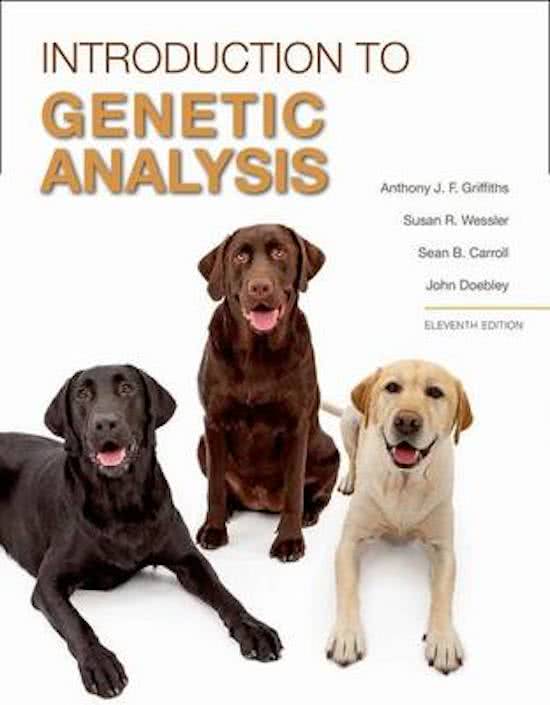
Introduction to Genetic Analysis Questions
With Correct Answers (Verified Answers) Plus
Rationales 2026 Q&A | Instant Download Pdf
1. A heterozygous pea plant (Tt) is crossed with another
heterozygous pea plant (Tt). What is the expected phenotypic
ratio of the offspring?
A. 1:1
B. 3:1
C. 1:2:1
D. 9:3:3:1
Answer: B
Rationale: According to Mendel’s law of segregation, crossing Tt × Tt
results in 1 TT : 2 Tt : 1 tt genotype, which translates to a 3:1 phenotypic
ratio for the dominant trait.
2. In a dihybrid cross AaBb × AaBb, what is the expected ratio of
offspring showing both dominant traits?
A. 9/16
B. 3/16
C. 1/16
D. 1/4
Answer: A
Rationale: Using the law of independent assortment, the combination of
both dominant alleles occurs in 9 of 16 offspring.
3. Which of the following best describes incomplete dominance?
A. One allele completely masks the effect of another
, B. Heterozygotes show a phenotype intermediate between the
two homozygotes
C. Multiple alleles exist for one gene
D. Two genes interact to produce a new phenotype
Answer: B
Rationale: In incomplete dominance, heterozygotes display a blending
of traits, not complete dominance.
4. The principle of independent assortment applies during which
phase of meiosis?
A. Prophase I
B. Metaphase I
C. Anaphase II
D. Telophase I
Answer: B
Rationale: Homologous chromosomes align randomly at the metaphase
plate in Metaphase I, determining the independent assortment of
alleles.
5. A testcross involves crossing an individual with a ________.
A. Homozygous dominant
B. Heterozygous
C. Homozygous recessive
D. Another individual with unknown genotype
Answer: C
Rationale: A testcross is used to determine the genotype of an individual
with a dominant phenotype by crossing it with a homozygous recessive.
, 6. If two genes are linked on the same chromosome, their alleles are
likely to:
A. Assort independently
B. Be inherited together
C. Produce 9:3:3:1 ratio
D. Show incomplete dominance
Answer: B
Rationale: Linked genes do not assort independently because they are
physically close on the same chromosome.
7. In a pedigree, a trait that skips generations is most likely:
A. Dominant
B. Recessive
C. X-linked dominant
D. Lethal
Answer: B
Rationale: Recessive traits can be carried by heterozygous individuals
without being expressed, causing them to skip generations.
8. The recombination frequency between two genes is 25%. This
means:
A. They are on different chromosomes
B. They are far apart on the same chromosome
C. They are closely linked
D. They are identical
Answer: B
Rationale: Recombination frequency indicates the likelihood of
crossover; 25% suggests genes are linked but not extremely close.
, 9. Which of the following is NOT a type of RNA?
A. mRNA
B. tRNA
C. rRNA
D. cDNA
Answer: D
Rationale: cDNA (complementary DNA) is DNA synthesized from an RNA
template, not a naturally occurring RNA molecule.
10. A frameshift mutation is caused by:
A. Substitution
B. Insertion or deletion
C. Translocation
D. Duplication
Answer: B
Rationale: Insertion or deletion of nucleotides shifts the reading frame,
altering downstream codons.
11. In prokaryotes, genes arranged in an operon are usually:
A. Transcribed separately
B. Transcribed as a single mRNA
C. Spliced extensively
D. Found only on plasmids
Answer: B
Rationale: Operons allow coordinated transcription of functionally
related genes as one mRNA molecule.
12. What is the product of transcription?
A. DNA
With Correct Answers (Verified Answers) Plus
Rationales 2026 Q&A | Instant Download Pdf
1. A heterozygous pea plant (Tt) is crossed with another
heterozygous pea plant (Tt). What is the expected phenotypic
ratio of the offspring?
A. 1:1
B. 3:1
C. 1:2:1
D. 9:3:3:1
Answer: B
Rationale: According to Mendel’s law of segregation, crossing Tt × Tt
results in 1 TT : 2 Tt : 1 tt genotype, which translates to a 3:1 phenotypic
ratio for the dominant trait.
2. In a dihybrid cross AaBb × AaBb, what is the expected ratio of
offspring showing both dominant traits?
A. 9/16
B. 3/16
C. 1/16
D. 1/4
Answer: A
Rationale: Using the law of independent assortment, the combination of
both dominant alleles occurs in 9 of 16 offspring.
3. Which of the following best describes incomplete dominance?
A. One allele completely masks the effect of another
, B. Heterozygotes show a phenotype intermediate between the
two homozygotes
C. Multiple alleles exist for one gene
D. Two genes interact to produce a new phenotype
Answer: B
Rationale: In incomplete dominance, heterozygotes display a blending
of traits, not complete dominance.
4. The principle of independent assortment applies during which
phase of meiosis?
A. Prophase I
B. Metaphase I
C. Anaphase II
D. Telophase I
Answer: B
Rationale: Homologous chromosomes align randomly at the metaphase
plate in Metaphase I, determining the independent assortment of
alleles.
5. A testcross involves crossing an individual with a ________.
A. Homozygous dominant
B. Heterozygous
C. Homozygous recessive
D. Another individual with unknown genotype
Answer: C
Rationale: A testcross is used to determine the genotype of an individual
with a dominant phenotype by crossing it with a homozygous recessive.
, 6. If two genes are linked on the same chromosome, their alleles are
likely to:
A. Assort independently
B. Be inherited together
C. Produce 9:3:3:1 ratio
D. Show incomplete dominance
Answer: B
Rationale: Linked genes do not assort independently because they are
physically close on the same chromosome.
7. In a pedigree, a trait that skips generations is most likely:
A. Dominant
B. Recessive
C. X-linked dominant
D. Lethal
Answer: B
Rationale: Recessive traits can be carried by heterozygous individuals
without being expressed, causing them to skip generations.
8. The recombination frequency between two genes is 25%. This
means:
A. They are on different chromosomes
B. They are far apart on the same chromosome
C. They are closely linked
D. They are identical
Answer: B
Rationale: Recombination frequency indicates the likelihood of
crossover; 25% suggests genes are linked but not extremely close.
, 9. Which of the following is NOT a type of RNA?
A. mRNA
B. tRNA
C. rRNA
D. cDNA
Answer: D
Rationale: cDNA (complementary DNA) is DNA synthesized from an RNA
template, not a naturally occurring RNA molecule.
10. A frameshift mutation is caused by:
A. Substitution
B. Insertion or deletion
C. Translocation
D. Duplication
Answer: B
Rationale: Insertion or deletion of nucleotides shifts the reading frame,
altering downstream codons.
11. In prokaryotes, genes arranged in an operon are usually:
A. Transcribed separately
B. Transcribed as a single mRNA
C. Spliced extensively
D. Found only on plasmids
Answer: B
Rationale: Operons allow coordinated transcription of functionally
related genes as one mRNA molecule.
12. What is the product of transcription?
A. DNA