

100% satisfaction guarantee Immediately available after payment Both online and in PDF No strings attached 4.6 TrustPilot
logo-home
Exam (elaborations)

MDC 3 FINAL EXAM | VERIFIED WITH 100% CORRECT ANSWERS

Rating
-
Sold
-
Pages
52
Grade
A
Uploaded on
20-01-2026
Written in
2025/2026

MDC 3 FINAL EXAM | VERIFIED WITH 100% CORRECT ANSWERS # 1 Which of the following clients would not be a candidate for thrombolytic therapy?A Blood pressure 100/60 mm HgB Patient with NSTEMIC History of hemorrhagic stroke one month agoD Client age of 65Quest# 2 Which of the following clients is most at risk for developing endocarditis?A A client who recently underwent a valve replacementB A client with Marfan’s syndromeC A client recently diagnosed with mitral stenosisD A client who recently had a valve replacement and had dental work recently performedQuest# 3 A nurse educates the client on which of the following tests is the best tool fordiagnosing heart failure?A Echocardiography is a non-invasive diagnostic test used to evaluate the pumpingfunction of the ventriclesB Pulmonary artery catheterC Radionuclide studiesD Multigated angiographic (MUGA) scanQuest# 4 Which of the following assessment findings is consistent with mitral valve prolapse?A Systolic click/ late systolic murmur2B Urinary frequencyC Atrial fibrillationD ClaudicationQuest# 5 Which of the following is a treatment option for a client with infective endocarditis?A Antimicrobials- An antimicrobial is an agent that kills microorganisms or stops theirgrowth examples include- penicillin G, procaine penicillin, benzathine penicillin, andpenicillin V.B AnticoagulantsC Diet modificationD BedrestQuest# 6 A 36-year-old male Is being discharged home following a sickle cell pain crisis. Whatwould be a top priority in your discharge teaching?• A Increase fluid intake- Get enough oxygen, Avoid getting over-heated or gettingvery cold, Avoid getting infections, and quickly treat infections when you do get themB Decrease fluid intakeC Maintain bed restD Follow up with your primary care provider in 2-3 daysQuest# 7 Which of the following is NOT a treatment option for a patient with sickle cell disease?A Pain managementB Arthrocentesis- Arthrocentesis, commonly known as joint aspiration, is a minor surgicalprocedure during which excess synovial fluid (fluid from a joint) is drained with a sterileneedle and syringe.C Blood transfusion3D Hematopoietic stem cell transplantNoteThe primary symptom associated with sickling is pain. During sickle cell crisis the pain is quitesevere as a result of tissue ischemia. The back, chest, extremities, and abdomen are mostcommonly affected. Pain episodes are accompanied by fever, swelling, tenderness, tachypnea,hypertension, and nausea and vomiting.Preventing painful episodes of sickle cellThe main thing you can do to reduce your chances of experiencing a painful episode (sickle cellcrisis) is to try avoiding possible triggers.i. drink plenty of fluids to avoid dehydrationii. wear warm clothing to stop you from getting coldiii. avoid sudden temperature changes, such as swimming in cold waterQuest# 8 Which of the following is not a possible treatment plan for a client diagnosed withleukemia?A Induction and consolidation therapyB Surgical interventionC Stem cell transplantD Blood product transfusionQuest# 9 A nurse is caring for a client recently diagnosed with pericarditis. Which of the followingis a common assessment finding with this disorder?A ST-segment depressionB Pericardial friction rubC Elevated troponinD Heart failureQuest4# 10 A nurse is caring for a 19-year-old male recently diagnosed with leukemia. Which of thefollowing interventions are appropriate for the care of this client? (Select all that apply)A Strict hand hygiene to prevent infectionB Provide emotional supportC Restrict fluid and dietary intakeD Protect from injury due to thrombocytopenia10.B The nurse questions which order for a client with thrombocytopenia?a. Avoid IM injections.*b. Administer enemas.c. Apply ice to areas of trauma.d. Test all urine and stool for the presence of occult blood.10C. The client has thrombocytopenia. Which client statement indicates that the clientunderstands the condition?the self-management of this condition?a. “I brush and use dental floss every day.”b. “I chew hard candy for my dry cough.”c. “I usually put ice on bumps or bruises.”d. “Nonslip socks are best when I walk.”Quest# 11A The nurse is caring for a 55-year-old male presented to his primary physician’s office forhis yearly checkup. Upon the physical assessment, the provider noted enlarged lymph nodes inthe groin and neck region. The provider questioned Joe regarding the possible causes of thefinding. Which of the following diagnosis are consistent with this finding?A LymphomaB Sickle cell anemiaC LeukemiaD Polycythemia Vera5Quest#11B A nursing student is caring for a patient with leukemia. The student asks why the patientis still at risk for infection when the patient’s white blood cell count (WBC) is high. Whatresponse by the registered nurse is best?A. “If the WBCs are high, there already is an infection present.”B. “The patient is in a blast crisis and has too many WBCs.”C. “There must be a mistake; the WBCs should be very low.”*D. “Those WBCs are abnormal and don’t provide protection.”# 12 A nurse is caring for a client diagnosed with polycythemia vera. Which of the followingshould the nurse NOT include in the client and family education?A Increase fluid intake to at least three liters per dayB Wear support hose while awakeC Diet modification to limit foods high in vitamin K intakeD Resume normal activityPolycythemia is the production and presence of an increased number of RBCs.PV is defined as elevated red blood cells (RBCs), hematocrit (Hct), and hemoglobin (Hgb)laboratory values; PV is also referred to as erythrocytosis .Quest# 13 Which of the following is a treatment option for a client with severe dilatedcardiomyopathy?A Ventricular assistive deviceB Percutaneous alcohol septal ablationC Heart transplantD MyomectomyQuest# 14 Which patient is not a risk for iron deficiency anemia?6A A 24-year-old female with heavy mensesB 64-year-old male diabetic with chronic kidney diseaseC A 72-year-old male with osteoarthritisD A 32-year-old female with ulcerative colitis exacerbationQuest# 15 A nurse is performing discharge teaching for a patient who was recently diagnosed withheart failure. Which of the following should NOT be included in the patient and familyteaching? SATA.A Medication teachingB Low sodium dietC Fluid restrictionD Weekly weightsE Daily weightsF SS for CHFQuest# 16 A nurse is providing discharge teaching to a client who recently underwent a mechanicalvalve replacement. Which of the following statements by the client would validate thedischarge teaching regarding anticoagulation therapy?A “I do not to take my prescribed medications for the rest of my life.”B “Additional monitoring is not required while on the anticoagulant.”C “I can lead a normal life while on anticoagulants, no restrictions are required.”D “I will need to modify my died while on this medication.”Quest# 17A The nurse is caring for a 60-year-old female who was recently diagnosed with mitralvalve stenosis. Which of the following is NOT a common assessment finding for a client withthis disorder?A Hypertension7B OrthopneaC Atrial FibrillationD Fatigue#17B The nurse is caring for a 60-year-old female who was recently diagnosed with mitralvalve stenosis. Which of the following is a common assessment finding for a client withthis disorder?a. Increased cardiac outputb. Weight gainc. Platypnea*d. FatigueQuest# 18A Which of the following intervention is NOT included for a client with an aorticdissection?A Nothing by mouthB Pain managementC AnticoagulantsD Blood pressure control#18B Which of the following intervention IS INCLUDED for a client with an aortic dissection?a. Palpate abdomenb. Vasoconstrictive agentsc. Anticoagulants*d. Management of blood pressureQuest# 19 Cardiac tamponade can be an emergency requiring immediate interventionA TrueB False8Quest# 20 You are caring for a client with a history of heart failure who presented to theemergency department with shortness of breath, pinky frothy sputum, and hypertension.Based on these assessment findings. Which of the following conditions is the client exhibiting?A PneumoniaB Pulmonary embolismC Myocardial infarctionD Pulmonary edemaQuest# 21A A client experiencing infective endocarditis may have all of the following signs andsymptoms except:A FeverB Cardiac murmurC Osler nodesD Weight gainClassically, Osler's nodes are on the tip of the finger or toes and painful.Janeway lesions occur on palm and soles and are non-painful.# 21B Which of the following is a treatment option for a client with infective endocarditis?*a. Antimicrobialsb. Anticoagulantsc. Diet modificationd. Bedrest#21C A nurse is providing discharge instructions to a client who was diagnosed withendocarditis. Which of the following statements validates the client’s understanding?*a. “I will continue my antibiotics until they are gone.”b. “I am not required any follow-up care.”9c. “I have no restrictions on my activity or future procedures.”d. “I must remain on daily antibiotics for the rest of my life.”Quest# 22 Mitral valve prolapse has a familial genetic tendency.A True Mitral valve prolapse is an inherited autosomal dominant condition irrespective ofclinical findings, and the mitral prolapse gene shows age and sex-dependent expressionB FalseQuest# 23 The patient with a prosthetic valve replacement must understand that postoperativecare will include lifelong therapy for which type of medication?A AntibioticsB Anticoagulants Anticoagulants are medicines that help prevent blood clots e.g warfarin(coumadin)C ImmunosuppressantsD Pain medicationQuest# 24 You are providing care to a client with pericarditis. If left untreated, which of thefollowing is the client at risk of developingA Cardiac tamponadeB PneumoniaC Pulmonary embolismD Deep vein thrombosisQuest# 25A A nurse is caring for a client recently diagnosed with hypertension. Which of thefollowing SHOULD NOT be included in the discharge teaching?A Only check your blood pressure at a clinic or pharmacy10B Diet changes are necessaryC Increase physical activityD Adhere to prescribed medications#25B A nurse is caring for a client recently diagnosed with hypertension. Which of thefollowing SHOULD BE included in the discharge teaching?a. Only check your blood pressure at a clinic or pharmacyb. Diet changes are not recommendedc. Decrease physical activity to avoid spikes in blood pressure.*d. Adhere to prescribed medicationsQuest# 26 A nurse is caring for a client who was received in the emergency department with aheart rate of 220 beats per minute. The client's cardiac monitor displayed SVT. Which of thefollowing interventions should the nurse implement?A Apply oxygenB Check blood glucoseC Draw labsD Vagal maneuver- Vagal maneuvers are used to try to slow an episode ofsupraventricular tachycardia (SVT). These simple maneuvers stimulate the vagus nerve,sometimes resulting in slowed conduction of electrical impulses through the atrioventricular(AV) node of the heart.Quest# 27 You are caring for a client who presented to the emergency department in pulmonaryedema. The client is hypotensive with a pulse oximeter of 85% on room air. Which of thefollowing is a nursing priorityA Administer diureticsB Administer IV fluidsC Administer oxygenD Obtain a chest x-ray11Quest# 28 A nurse is caring for a client who presented to the emergency department withcomplaints of fatigue palpitations and chest pain. Upon assessment, the provider notes an S3and S4 gallop weak peripheral pulses and tachycardia. The provider orders a chest x-ray andechocardiogram, which reveal left ventricular dilation. Which of the following disorders isconsistent with these findings?A Dilated cardiomyopathy- a disease of the heart muscle that usually starts in your heart'smain pumping chamber (left ventricle). The ventricle stretches and thins (dilates) andcan't pump blood as well as a healthy heart can.B Restrictive cardiomyopathyC PericarditisD Cardiac tamponadeQuest# 29 You are caring for a client recently diagnosed with acute pericarditis. Which of thefollowing medications is not routinely used as treatment options for this disorder?A NSAIDsB OpioidsC AntibioticsD SteroidsQuest# 30 Which of the following is the noninvasive diagnostic testing of choice to evaluate valvedisease?A Electrocardiogram- A noninvasive test that uses sound waves to evaluate the heart'schambers and valves.

Show more Read less
Institution
MDC 3
Course
MDC 3


Whoops! We can’t load your doc right now. Try again or contact support.

Written for

Institution
MDC 3
Course
MDC 3

Document information

Uploaded on
January 20, 2026
Number of pages
52
Written in
2025/2026
Type
Exam (elaborations)
Contains
Questions & answers

Subjects

Content preview

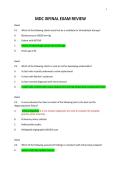
1


MDC IIIFINAL EXAM REVIEW
Quest
#1 Which of the following clients would not be a candidate for thrombolytic therapy?
A Blood pressure 100/60 mm Hg
B Patient with NSTEMI
C History of hemorrhagic stroke one month ago
D Client age of 65


Quest
#2 Which of the following clients is most at risk for developing endocarditis?
A A client who recently underwent a valve replacement
B A client with Marfan’s syndrome
C A client recently diagnosed with mitral stenosis
D A client who recently had a valve replacement and had dental work recently performed


Quest
#3 A nurse educates the client on which of the following tests is the best tool for
diagnosing heart failure?
A Echocardiography is a non-invasive diagnostic test used to evaluate the pumping
function of the ventricles
B Pulmonary artery catheter
C Radionuclide studies
D Multigated angiographic (MUGA) scan


Quest
#4 Which of the following assessment findings is consistent with mitral valve prolapse?
A Systolic click/ late systolic murmur

, 2


B Urinary frequency
C Atrial fibrillation
D Claudication


Quest
#5 Which of the following is a treatment option for a client with infective endocarditis?
A Antimicrobials- An antimicrobial is an agent that kills microorganisms or stops their
growth examples include- penicillin G, procaine penicillin, benzathine penicillin, and
penicillin V.
B Anticoagulants
C Diet modification
D Bedrest


Quest
#6 A 36-year-old male Is being discharged home following a sickle cell pain crisis. What
would be a top priority in your discharge teaching?
 A Increase fluid intake- Get enough oxygen, Avoid getting over-heated or getting
very cold, Avoid getting infections, and quickly treat infections when you do get them
B Decrease fluid intake
C Maintain bed rest
D Follow up with your primary care provider in 2-3 days


Quest
#7 Which of the following is NOT a treatment option for a patient with sickle cell disease?
A Pain management
B Arthrocentesis- Arthrocentesis, commonly known as joint aspiration, is a minor surgical
procedure during which excess synovial fluid (fluid from a joint) is drained with a sterile
needle and syringe.
C Blood transfusion

, 3


D Hematopoietic stem cell transplant
Note
The primary symptom associated with sickling is pain. During sickle cell crisis the pain is quite
severe as a result of tissue ischemia. The back, chest, extremities, and abdomen are most
commonly affected. Pain episodes are accompanied by fever, swelling, tenderness, tachypnea,
hypertension, and nausea and vomiting.
Preventing painful episodes of sickle cell
The main thing you can do to reduce your chances of experiencing a painful episode (sickle cell
crisis) is to try avoiding possible triggers.
i. drink plenty of fluids to avoid dehydration
ii. wear warm clothing to stop you from getting cold
iii. avoid sudden temperature changes, such as swimming in cold water
Quest
#8 Which of the following is not a possible treatment plan for a client diagnosed with
leukemia?
A Induction and consolidation therapy
B Surgical intervention
C Stem cell transplant
D Blood product transfusion


Quest
#9 A nurse is caring for a client recently diagnosed with pericarditis. Which of the following
is a common assessment finding with this disorder?
A ST-segment depression
B Pericardial friction rub
C Elevated troponin
D Heart failure


Quest

, 4


# 10 A nurse is caring for a 19-year-old male recently diagnosed with leukemia. Which of the
following interventions are appropriate for the care of this client? (Select all that apply)
A Strict hand hygiene to prevent infection
B Provide emotional support
C Restrict fluid and dietary intake
D Protect from injury due to thrombocytopenia


10.B The nurse questions which order for a client with thrombocytopenia?
a. Avoid IM injections.
*b. Administer enemas.
c. Apply ice to areas of trauma.
d. Test all urine and stool for the presence of occult blood.
10C. The client has thrombocytopenia. Which client statement indicates that the client
understands the condition?
the self-management of this condition?
a. “I brush and use dental floss every day.”
b. “I chew hard candy for my dry cough.”
c. “I usually put ice on bumps or bruises.”
d. “Nonslip socks are best when I walk.”


Quest
# 11A The nurse is caring for a 55-year-old male presented to his primary physician’s office for
his yearly checkup. Upon the physical assessment, the provider noted enlarged lymph nodes in
the groin and neck region. The provider questioned Joe regarding the possible causes of the
finding. Which of the following diagnosis are consistent with this finding?
A Lymphoma
B Sickle cell anemia
C Leukemia
D Polycythemia Vera


Get to know the seller

Seller avatar
Reputation scores are based on the amount of documents a seller has sold for a fee and the reviews they have received for those documents. There are three levels: Bronze, Silver and Gold. The better the reputation, the more your can rely on the quality of the sellers work.
Bri254 Rasmussen College
View profile
Follow You need to be logged in order to follow users or courses
Sold
896
Member since
5 year
Number of followers
738
Documents
3405
Last sold
3 weeks ago
Best Tutorials, Exam guides, Homework help.

When assignments start weighing you down, take a break. I'm here to create a hassle-free experience by providing up-to-date and recent study materials. Kindly message me if you can't find your tutorial and I will help.

4.0

179 reviews

5
106
4
20
3
25
2
5
1
23

Recently viewed by you

Why students choose Stuvia

Created by fellow students, verified by reviews

Quality you can trust: written by students who passed their tests and reviewed by others who've used these notes.

Didn't get what you expected? Choose another document

No worries! You can instantly pick a different document that better fits what you're looking for.

Pay as you like, start learning right away

No subscription, no commitments. Pay the way you're used to via credit card and download your PDF document instantly.

Student with book image

“Bought, downloaded, and aced it. It really can be that simple.”

Alisha Student

Frequently asked questions
