Ohio Personal Lines (Insurance Exam) – Questions
With Step By Step Solutions
Save
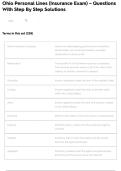
Terms in this set (238)
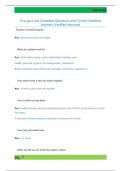
Stock Insurance Company Issues non-participating policies and is owned by
stockholders who received taxable corporate
dividends as a return profit
Reinsurance The transfer of risk between insurance companies.
The reinsurer assumes some or all of the risks of the
ceding, or primary, insurance company
Domestic Insurer organized under the laws of the resident state
Foreign Insurer organized under the laws of another state
within the United States
Alien Insurer oganized under the laws of a country outside
of the United States
Domicile Refers to the state in which an insurer is incorporated
Express Authority that is written into the producers agency
contract
Implied Authority that in which the public and the insurer
assumes the agent possesses
Apparent Authority created when the agent exceeds express
authority and the insurer does not respond
,FCRA Protects consumer privacy by ensuring that any data
collected by an insurer remains confidential, and is
accurate, relevant, and used for a proper and specific
purpose
Risk The uncertainty of a loss
Peril The cause of a loss
Hazard Increases the possibility of a loss
Indemnity Does not allow the insured to profit from a loss;
instead, it restores the insured to the same financial
or economic condition the existed prior to loss
Adhesion One party (the insurer) prepares the contract and
presents it to the second party (the insured), who
must accept it on a "take-it-or-leave-it" basis
Types Of Insurers Stock Insurers, Mutual Insurers, Reciprocal Insurers,
and Self-Insurer
Reduction Minimizing the chance of a loss without eliminating
the risk altogether
Retention Assuming responsibility for a loss
Conditional A contract that requires that both parties perform
certain duties
Acutuary Determines the probability of loss and sets premium
rates
Physical A hazard that occurs when a physical condition
increases the probability of loss; use, condition, or
occupancy of property
, Moral A hazard that occurs when dishonest tendencies
increase the probability of a loss; certain
characteristics and behaviors of people
Morale A hazard that occurs when a persons attitude
increases the probability of a loss
Speculative Risk Situations where there is a chance or possibility for
loss, no loss or gain
Pure Risk Situations where there is no chance for gain, only
loss. The only risk that can be insured
Misreprensentation False statement contained in the insured's application
and does not usually void coverage or the policy
Fraud An intentional deception of the truth in order to
induce another party with something of value or to
surrender a legal right
Concealment The willful holding back or secretion of material facts
pertinent to the issuance of insurance or claim
Reinsurance A contract between the insuring company and the
reinsurer, and does not involve the insured
Underwriter Responsible for the selection of risks and rating that
determines actual policy premium
Underwriting The process of selecting, classifying, and rating a risk
for the purpose of insurance coverage
Waiver Voluntary surrender of a known right, claim or
privilege
Estoppel Prevents the denial of a fact, if the fact was admitted
to be true previously
With Step By Step Solutions
Save
Terms in this set (238)
Stock Insurance Company Issues non-participating policies and is owned by
stockholders who received taxable corporate
dividends as a return profit
Reinsurance The transfer of risk between insurance companies.
The reinsurer assumes some or all of the risks of the
ceding, or primary, insurance company
Domestic Insurer organized under the laws of the resident state
Foreign Insurer organized under the laws of another state
within the United States
Alien Insurer oganized under the laws of a country outside
of the United States
Domicile Refers to the state in which an insurer is incorporated
Express Authority that is written into the producers agency
contract
Implied Authority that in which the public and the insurer
assumes the agent possesses
Apparent Authority created when the agent exceeds express
authority and the insurer does not respond
,FCRA Protects consumer privacy by ensuring that any data
collected by an insurer remains confidential, and is
accurate, relevant, and used for a proper and specific
purpose
Risk The uncertainty of a loss
Peril The cause of a loss
Hazard Increases the possibility of a loss
Indemnity Does not allow the insured to profit from a loss;
instead, it restores the insured to the same financial
or economic condition the existed prior to loss
Adhesion One party (the insurer) prepares the contract and
presents it to the second party (the insured), who
must accept it on a "take-it-or-leave-it" basis
Types Of Insurers Stock Insurers, Mutual Insurers, Reciprocal Insurers,
and Self-Insurer
Reduction Minimizing the chance of a loss without eliminating
the risk altogether
Retention Assuming responsibility for a loss
Conditional A contract that requires that both parties perform
certain duties
Acutuary Determines the probability of loss and sets premium
rates
Physical A hazard that occurs when a physical condition
increases the probability of loss; use, condition, or
occupancy of property
, Moral A hazard that occurs when dishonest tendencies
increase the probability of a loss; certain
characteristics and behaviors of people
Morale A hazard that occurs when a persons attitude
increases the probability of a loss
Speculative Risk Situations where there is a chance or possibility for
loss, no loss or gain
Pure Risk Situations where there is no chance for gain, only
loss. The only risk that can be insured
Misreprensentation False statement contained in the insured's application
and does not usually void coverage or the policy
Fraud An intentional deception of the truth in order to
induce another party with something of value or to
surrender a legal right
Concealment The willful holding back or secretion of material facts
pertinent to the issuance of insurance or claim
Reinsurance A contract between the insuring company and the
reinsurer, and does not involve the insured
Underwriter Responsible for the selection of risks and rating that
determines actual policy premium
Underwriting The process of selecting, classifying, and rating a risk
for the purpose of insurance coverage
Waiver Voluntary surrender of a known right, claim or
privilege
Estoppel Prevents the denial of a fact, if the fact was admitted
to be true previously