Aantekeningen hoorcollege adolescent development
Hoorcollege 1: introduction to the study of adolescent development
What is adolescent? Conceptualisations and definitions
Social relations are important in this timeframe.
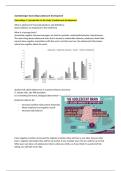
What is a teenage brain?
Somewhat negative, because teenagers are hard to motivate, undesirable behavior, impulsiveness.
The main thing about adolescent brain that is named is undesirable behavior, adolescent think their
parents have negative associations with this word, and that was true, but adolescents themselves
where less negative about the word.
Stanley Hall called adolescence is a period of Storm and stress
G. Stanley Hall, 1ste APA president
It is something hormonal, biological determined = unavoidable
Empirical evidence for:
- Increased conflicts with parents (intensity)
- Mood volativity (and negative mood)
- Increased risk behavior
More negative emotions increased the negative emotions they will have a year later, because they
have a negative stereotype they will live up to that. If you visualize your view you will live up to that.
What your own idea is of adolescence that is what you will do, so if you think it is a period of risk
taking, you will take more risks.
,How would you define adolescence
The period between the onset of sexual maturation (puberty and the attainment of adult roles and
responsibilities
The transition from
- Child status requires adult monitoring
- Adult status self responsibility for behavior
Age boundaries;
- Early adolescence (10-13 years)
- Middle adolescence (14-17 years)
- Late adolescence (18-21 years)
- Young adulthood (22-30 years)
Others:
- First Emerging adulthood (18-25 years) then young adulthood
Three primary changes:
- Biological puberty (body and brain)
o Changes in body’s, so physical changes)
- Cognitive; abstract thinking, executive functions, social cognition
o Understand things like emotions, others
- Social: redefinition of an individual from child to an adult (or non-child)
o In the society you will fulfil different roles when you are a child and when you are
becoming an adolescent/adult
Developmental relevance:
Looked at age and different parts of the body/brain/social things and the changes that are happening
at an age. Showing that in a different domains early age a lot of change but all different.
Al this development occurs in a social environment not in a vacuum, so we need to look at all the
different social interactions they are having.
,
, The beginning of adolescence: puberty
Puberty = maturational process during which primary (testes, ovaries) and secondary (breast, pubic
hair) sex characteristics mature resulting in capacity to reproduce.
Five areas of change:
- Maturation of reproductive organs, secondary sex characteristics
- Nervous and endocrine system
- Skeletal growth
- Body composition, change in distribution of fat and muscle
- Circulatory and respiratory systems
Measuring pubertal development:
- Tanner staging:
o Girls: breast/pubic hair development
o Boys: penis & testes/pubic hair development
o 5 stages where 1 = no development, 2= beginning stages and 5 = adults
- Self report
o Line drawings of tanner stages
o Questionnaires
- Visual inspection by researcher of clothed adolescent
- Hormone levels
These are self regulating,
so they keep the
hormonal levels and they
have a set level, but this
set level changes in
puberty
Hoorcollege 1: introduction to the study of adolescent development
What is adolescent? Conceptualisations and definitions
Social relations are important in this timeframe.
What is a teenage brain?
Somewhat negative, because teenagers are hard to motivate, undesirable behavior, impulsiveness.
The main thing about adolescent brain that is named is undesirable behavior, adolescent think their
parents have negative associations with this word, and that was true, but adolescents themselves
where less negative about the word.
Stanley Hall called adolescence is a period of Storm and stress
G. Stanley Hall, 1ste APA president
It is something hormonal, biological determined = unavoidable
Empirical evidence for:
- Increased conflicts with parents (intensity)
- Mood volativity (and negative mood)
- Increased risk behavior
More negative emotions increased the negative emotions they will have a year later, because they
have a negative stereotype they will live up to that. If you visualize your view you will live up to that.
What your own idea is of adolescence that is what you will do, so if you think it is a period of risk
taking, you will take more risks.
,How would you define adolescence
The period between the onset of sexual maturation (puberty and the attainment of adult roles and
responsibilities
The transition from
- Child status requires adult monitoring
- Adult status self responsibility for behavior
Age boundaries;
- Early adolescence (10-13 years)
- Middle adolescence (14-17 years)
- Late adolescence (18-21 years)
- Young adulthood (22-30 years)
Others:
- First Emerging adulthood (18-25 years) then young adulthood
Three primary changes:
- Biological puberty (body and brain)
o Changes in body’s, so physical changes)
- Cognitive; abstract thinking, executive functions, social cognition
o Understand things like emotions, others
- Social: redefinition of an individual from child to an adult (or non-child)
o In the society you will fulfil different roles when you are a child and when you are
becoming an adolescent/adult
Developmental relevance:
Looked at age and different parts of the body/brain/social things and the changes that are happening
at an age. Showing that in a different domains early age a lot of change but all different.
Al this development occurs in a social environment not in a vacuum, so we need to look at all the
different social interactions they are having.
,
, The beginning of adolescence: puberty
Puberty = maturational process during which primary (testes, ovaries) and secondary (breast, pubic
hair) sex characteristics mature resulting in capacity to reproduce.
Five areas of change:
- Maturation of reproductive organs, secondary sex characteristics
- Nervous and endocrine system
- Skeletal growth
- Body composition, change in distribution of fat and muscle
- Circulatory and respiratory systems
Measuring pubertal development:
- Tanner staging:
o Girls: breast/pubic hair development
o Boys: penis & testes/pubic hair development
o 5 stages where 1 = no development, 2= beginning stages and 5 = adults
- Self report
o Line drawings of tanner stages
o Questionnaires
- Visual inspection by researcher of clothed adolescent
- Hormone levels
These are self regulating,
so they keep the
hormonal levels and they
have a set level, but this
set level changes in
puberty