

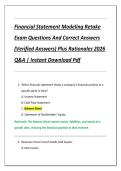
Financial Statement Modeling Retake
Exam Questions And Correct Answers
(Verified Answers) Plus Rationales 2026
Q&A | Instant Download Pdf
1. Which financial statement shows a company’s financial position at a
specific point in time?
A. Income Statement
B. Cash Flow Statement
C. Balance Sheet
D. Statement of Stockholders’ Equity
Rationale: The Balance Sheet reports assets, liabilities, and equity at a
specific date, showing the financial position at that moment.
2. Revenue minus Cost of Goods Sold equals:
A. Net Income
, B. Gross Profit
C. Operating Income
D. EBITDA
Rationale: Gross Profit is calculated as Revenue less COGS and represents
the profitability before operating expenses.
3. Depreciation expense is reported on which financial statements?
A. Income Statement only
B. Balance Sheet only
C. Income Statement and Balance Sheet
D. Cash Flow Statement only
Rationale: Depreciation is an expense on the income statement and
reduces the net book value of assets on the balance sheet.
4. Which section of the cash flow statement reflects purchases of
property, plant, and equipment?
A. Operating Activities
B. Financing Activities
C. Investing Activities
D. None of the above
Rationale: Investing activities include cash flows from acquisition or sale of
long-term assets such as PP&E.
, 5. When forecasting revenue in a financial model, which method is most
commonly used?
A. Direct Cost Method
B. Discounted Cash Flow Method
C. Percentage of Growth Method
D. Comparable Company Analysis
Rationale: Revenue is often projected using historical growth rates or
industry growth projections to estimate future revenue.
6. EBITDA is useful because it:
A. Represents cash available for debt repayment
B. Measures operating performance without non-cash and financing
effects
C. Shows total cash generated
D. Equals net income
Rationale: EBITDA excludes interest, taxes, depreciation, and amortization
to assess operational profitability.
7. In a three-statement model, an increase in Accounts Receivable will:
A. Increase cash flow
B. Decrease cash flow
, C. Decrease cash flow
D. Have no impact on cash flow
Rationale: An increase in accounts receivable represents cash not yet
collected from customers, reducing operating cash flow.
8. Which of the following is a non-cash expense?
A. Interest Expense
B. Depreciation
C. Rent Expense
D. Dividends Paid
Rationale: Depreciation reduces net income but does not involve cash
outflow.
9. The cost of issuing new shares appears in which financial statement?
A. Income Statement
B. Balance Sheet
C. Cash Flow Statement – Financing Activities
D. Statement of Stockholders’ Equity
Rationale: Issuing equity generates cash and is classified under financing
activities.
Exam Questions And Correct Answers
(Verified Answers) Plus Rationales 2026
Q&A | Instant Download Pdf
1. Which financial statement shows a company’s financial position at a
specific point in time?
A. Income Statement
B. Cash Flow Statement
C. Balance Sheet
D. Statement of Stockholders’ Equity
Rationale: The Balance Sheet reports assets, liabilities, and equity at a
specific date, showing the financial position at that moment.
2. Revenue minus Cost of Goods Sold equals:
A. Net Income
, B. Gross Profit
C. Operating Income
D. EBITDA
Rationale: Gross Profit is calculated as Revenue less COGS and represents
the profitability before operating expenses.
3. Depreciation expense is reported on which financial statements?
A. Income Statement only
B. Balance Sheet only
C. Income Statement and Balance Sheet
D. Cash Flow Statement only
Rationale: Depreciation is an expense on the income statement and
reduces the net book value of assets on the balance sheet.
4. Which section of the cash flow statement reflects purchases of
property, plant, and equipment?
A. Operating Activities
B. Financing Activities
C. Investing Activities
D. None of the above
Rationale: Investing activities include cash flows from acquisition or sale of
long-term assets such as PP&E.
, 5. When forecasting revenue in a financial model, which method is most
commonly used?
A. Direct Cost Method
B. Discounted Cash Flow Method
C. Percentage of Growth Method
D. Comparable Company Analysis
Rationale: Revenue is often projected using historical growth rates or
industry growth projections to estimate future revenue.
6. EBITDA is useful because it:
A. Represents cash available for debt repayment
B. Measures operating performance without non-cash and financing
effects
C. Shows total cash generated
D. Equals net income
Rationale: EBITDA excludes interest, taxes, depreciation, and amortization
to assess operational profitability.
7. In a three-statement model, an increase in Accounts Receivable will:
A. Increase cash flow
B. Decrease cash flow
, C. Decrease cash flow
D. Have no impact on cash flow
Rationale: An increase in accounts receivable represents cash not yet
collected from customers, reducing operating cash flow.
8. Which of the following is a non-cash expense?
A. Interest Expense
B. Depreciation
C. Rent Expense
D. Dividends Paid
Rationale: Depreciation reduces net income but does not involve cash
outflow.
9. The cost of issuing new shares appears in which financial statement?
A. Income Statement
B. Balance Sheet
C. Cash Flow Statement – Financing Activities
D. Statement of Stockholders’ Equity
Rationale: Issuing equity generates cash and is classified under financing
activities.


