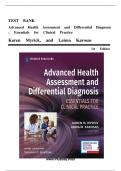
Test bank For Principles of Pediatric Nursing Caring
for Children, 8th Edition by Kay Cowen; Laura
Wisely; Robin Dawson; Chapters 1 – 31
,Principles of Pediatric Nursing: Caring for Children, 8e Jane W. Ball (et al.) Test Bank
Table of contents
Chapter 1: Nurse's Role in Care of the Child: Hospital, Community, and Home
Chapter 2: Family-Centered Care and Cultural Considerations
Chapter 3: Genetic and Genomic Influences
Chapter 4: Growth and Development
Chapter 5: Pediatric Assessment
Chapter 6: Introduction to Health Promotion and Maintenance
Test Bank
Chapter 7: Health for Principles
Promotion of Pediatric
and Maintenance for theNursing:
NewbornCaring for Children, 8th Edition by Kay
and Infant
Cowen, Laura Wisely, Robin Dawson, Jane Ball, and Ruth Bindler
Chapter 8: Health Promotion and Maintenance for the Toddler and Preschooler
Nurture pediatric nursing mastery with this essential test bank for Principles of Pediatric
Nursing:
Chapter 9: Health Caringand
Promotion for Maintenance
Children, 8thforEdition. Authored
the School-Age by and
Child renowned experts Kay Cowen, Laura
Adolescent
Wisely, Robin Dawson, Jane Ball, and Ruth Bindler, it delivers over 2,000 diverse
Chapter 10: Nursing Considerations for the Child in the Community
questions—multiple-choice, growth assessments, family-centered scenarios, and critical
Chapter 11: care cases—across
Nursing Considerations50+ chapters.
for the Explore
Hospitalized lifespan care: neonatal transitions,
Child
Chapter 12: developmental
The Child with a milestones, acute/chronic illnesses (asthma, diabetes, congenital
Chronic Condition
anomalies), immunization strategies, pain management, ethical dilemmas, and cultural
Chapter 13: sensitivity,
The Child withall aupdated for 2026Condition
Life-Threatening with telepediatrics, genomic
and End-of-Life Care screening, and equity-focused
Chapter 14: interventions
Infant, Child, andperAdolescent
AACN Essentials
Nutrition and PNCB standards.
Each question includes verified answers, evidence-based rationales integrating QSEN
Chapter 15: competencies,
Pain Assessment and and Management
remediation in forChildren
holistic judgment. With adaptive quizzes, milestone
trackers, and performance analytics,
Chapter 16: Immunizations and Communicable Diseases this resource equips BSN/PNP students, RN-BC
candidates, and educators for NCLEX-PN/RN or CPN certification. From cradle to
Chapter 17: adolescence,
Social and Environmental Influences on expertise—ace
build compassionate the Child exams, enhance family partnerships,
Chapter 18: and champion
Alterations child
in Fluid, health with
Electrolyte, andCowen
Acid–BaseandBalance
team's visionary guidance!
Chapter 19: Alterations in Eye, Ear, Nose, and Throat Function
Chapter 20: Alterations in Respiratory Function
Chapter 21: Alterations in Cardiovascular Function
Chapter 22: Alterations in Immune Function
Chapter 23: Alterations in Hematologic Function
Chapter 24: The Child with Cancer
Chapter 25: Alterations in Gastrointestinal Function
Chapter 26: Alterations in Genitourinary Function
Chapter 27: Alterations in Neurologic Function
Chapter 28: Alterations in Mental Health and Cognition
Chapter 29: Alterations in Musculoskeletal Function
Chapter 30: Alterations in Endocrine and Metabolic Function
Chapter 31: Alterations in Skin Integrity
,Principles of Pediatric Nursing: Caring for Children, 8e Jane W. Ball (et al.) Chapter 1:
Nurse's Role in Care of the Child: Hospital, Community, and Home
1) Which nursing role is not directly involved when providing family-centered approach to the
pediatric population?
1. Advocacy
2. Case management
3. Patient education
4. Researcher
ANSWER: 4
Explanation: 1. A researcher is not involved in the family-centered approach to patient care of
children and their families. Advocacy, case management, and patient education are all roles
directly involved in the care of children and their families.
2. A researcher is not involved in the family-centered approach to patient care of children and
their families. Advocacy, case management, and patient education are all roles directly involved
in the care of children and their families.
3. A researcher is not involved in the family-centered approach to patient care of children and
their families. Advocacy, case management, and patient education are all roles directly involved
in the care of children and their families.
4. A researcher is not involved in the family-centered approach to patient care of children and
their families. Advocacy, case management, and patient education are all roles directly involved
in the care of children and their families.
Page Ref: 4
Cognitive Level: Analyzing
Client Need &Sub: Safe and Effective Care Environment: Management of Care Standards:
QSEN Competencies: Patient-centered care | AACN Essential Competencies:
Essential II: Basic organizational and systems leadership for quality care and patient safety |
NLN Competencies: Professional identity | Nursing/Integrated Concepts: Nursing Process:
Assessment/Coordination of care
Learning Outcome: LO 1.2 Compare the roles of nurses in child healthcare.
MNL LO: Family-centered care
, 2) A nurse is working with pediatric clients in a research facility. The nurse recognizes that
federal guidelines are in place that delineate which pediatrics clients must give assent for
participation in research trials. Based upon the client's age, the nurse would seek assent from
which children?
Select all that apply.
1. The precocious 4-year-old commencing as a cystic fibrosis research-study participant.
2. The 7-year-old leukemia client electing to receive a newly developed medication, now being
researched.
3. The 10-year-old commencing in an investigative study for clients with precocious puberty.
4. The 13-year-old client commencing participation in a research program for Attention Deficit
Hyperactivity Disorder (ADHD) treatments.
ANSWER: 2, 3, 4
Explanation: 1. Federal guidelines mandate that research participants 7 years old and older must
receive developmentally appropriate information about healthcare procedures and treatments
and give assent.
2. Federal guidelines mandate that research participants 7 years old and older must receive
developmentally appropriate information about healthcare procedures and treatments and
give assent.
3. Federal guidelines mandate that research participants 7 years old and older must receive
developmentally appropriate information about healthcare procedures and treatments and
give assent.
4. Federal guidelines mandate that research participants 7 years old and older must receive
developmentally appropriate information about healthcare procedures and treatments and
give assent.
Page Ref: 11, 12
Cognitive Level: Applying
Client Need &Sub: Psychosocial Integrity
Standards: QSEN Competencies: Patient-centered care | AACN Essential Competencies: Essential
V: Healthcare policy, finance, and regulatory environments | NLN Competencies: Nursing
judgement | Nursing/Integrated Concepts: Nursing Process: Planning/Coordination of care
Learning Outcome: LO 1.6 Examine three unique pediatric legal and ethical issues in pediatric nursing
practice.
MNL LO: Developmentally appropriate care
for Children, 8th Edition by Kay Cowen; Laura
Wisely; Robin Dawson; Chapters 1 – 31
,Principles of Pediatric Nursing: Caring for Children, 8e Jane W. Ball (et al.) Test Bank
Table of contents
Chapter 1: Nurse's Role in Care of the Child: Hospital, Community, and Home
Chapter 2: Family-Centered Care and Cultural Considerations
Chapter 3: Genetic and Genomic Influences
Chapter 4: Growth and Development
Chapter 5: Pediatric Assessment
Chapter 6: Introduction to Health Promotion and Maintenance
Test Bank
Chapter 7: Health for Principles
Promotion of Pediatric
and Maintenance for theNursing:
NewbornCaring for Children, 8th Edition by Kay
and Infant
Cowen, Laura Wisely, Robin Dawson, Jane Ball, and Ruth Bindler
Chapter 8: Health Promotion and Maintenance for the Toddler and Preschooler
Nurture pediatric nursing mastery with this essential test bank for Principles of Pediatric
Nursing:
Chapter 9: Health Caringand
Promotion for Maintenance
Children, 8thforEdition. Authored
the School-Age by and
Child renowned experts Kay Cowen, Laura
Adolescent
Wisely, Robin Dawson, Jane Ball, and Ruth Bindler, it delivers over 2,000 diverse
Chapter 10: Nursing Considerations for the Child in the Community
questions—multiple-choice, growth assessments, family-centered scenarios, and critical
Chapter 11: care cases—across
Nursing Considerations50+ chapters.
for the Explore
Hospitalized lifespan care: neonatal transitions,
Child
Chapter 12: developmental
The Child with a milestones, acute/chronic illnesses (asthma, diabetes, congenital
Chronic Condition
anomalies), immunization strategies, pain management, ethical dilemmas, and cultural
Chapter 13: sensitivity,
The Child withall aupdated for 2026Condition
Life-Threatening with telepediatrics, genomic
and End-of-Life Care screening, and equity-focused
Chapter 14: interventions
Infant, Child, andperAdolescent
AACN Essentials
Nutrition and PNCB standards.
Each question includes verified answers, evidence-based rationales integrating QSEN
Chapter 15: competencies,
Pain Assessment and and Management
remediation in forChildren
holistic judgment. With adaptive quizzes, milestone
trackers, and performance analytics,
Chapter 16: Immunizations and Communicable Diseases this resource equips BSN/PNP students, RN-BC
candidates, and educators for NCLEX-PN/RN or CPN certification. From cradle to
Chapter 17: adolescence,
Social and Environmental Influences on expertise—ace
build compassionate the Child exams, enhance family partnerships,
Chapter 18: and champion
Alterations child
in Fluid, health with
Electrolyte, andCowen
Acid–BaseandBalance
team's visionary guidance!
Chapter 19: Alterations in Eye, Ear, Nose, and Throat Function
Chapter 20: Alterations in Respiratory Function
Chapter 21: Alterations in Cardiovascular Function
Chapter 22: Alterations in Immune Function
Chapter 23: Alterations in Hematologic Function
Chapter 24: The Child with Cancer
Chapter 25: Alterations in Gastrointestinal Function
Chapter 26: Alterations in Genitourinary Function
Chapter 27: Alterations in Neurologic Function
Chapter 28: Alterations in Mental Health and Cognition
Chapter 29: Alterations in Musculoskeletal Function
Chapter 30: Alterations in Endocrine and Metabolic Function
Chapter 31: Alterations in Skin Integrity
,Principles of Pediatric Nursing: Caring for Children, 8e Jane W. Ball (et al.) Chapter 1:
Nurse's Role in Care of the Child: Hospital, Community, and Home
1) Which nursing role is not directly involved when providing family-centered approach to the
pediatric population?
1. Advocacy
2. Case management
3. Patient education
4. Researcher
ANSWER: 4
Explanation: 1. A researcher is not involved in the family-centered approach to patient care of
children and their families. Advocacy, case management, and patient education are all roles
directly involved in the care of children and their families.
2. A researcher is not involved in the family-centered approach to patient care of children and
their families. Advocacy, case management, and patient education are all roles directly involved
in the care of children and their families.
3. A researcher is not involved in the family-centered approach to patient care of children and
their families. Advocacy, case management, and patient education are all roles directly involved
in the care of children and their families.
4. A researcher is not involved in the family-centered approach to patient care of children and
their families. Advocacy, case management, and patient education are all roles directly involved
in the care of children and their families.
Page Ref: 4
Cognitive Level: Analyzing
Client Need &Sub: Safe and Effective Care Environment: Management of Care Standards:
QSEN Competencies: Patient-centered care | AACN Essential Competencies:
Essential II: Basic organizational and systems leadership for quality care and patient safety |
NLN Competencies: Professional identity | Nursing/Integrated Concepts: Nursing Process:
Assessment/Coordination of care
Learning Outcome: LO 1.2 Compare the roles of nurses in child healthcare.
MNL LO: Family-centered care
, 2) A nurse is working with pediatric clients in a research facility. The nurse recognizes that
federal guidelines are in place that delineate which pediatrics clients must give assent for
participation in research trials. Based upon the client's age, the nurse would seek assent from
which children?
Select all that apply.
1. The precocious 4-year-old commencing as a cystic fibrosis research-study participant.
2. The 7-year-old leukemia client electing to receive a newly developed medication, now being
researched.
3. The 10-year-old commencing in an investigative study for clients with precocious puberty.
4. The 13-year-old client commencing participation in a research program for Attention Deficit
Hyperactivity Disorder (ADHD) treatments.
ANSWER: 2, 3, 4
Explanation: 1. Federal guidelines mandate that research participants 7 years old and older must
receive developmentally appropriate information about healthcare procedures and treatments
and give assent.
2. Federal guidelines mandate that research participants 7 years old and older must receive
developmentally appropriate information about healthcare procedures and treatments and
give assent.
3. Federal guidelines mandate that research participants 7 years old and older must receive
developmentally appropriate information about healthcare procedures and treatments and
give assent.
4. Federal guidelines mandate that research participants 7 years old and older must receive
developmentally appropriate information about healthcare procedures and treatments and
give assent.
Page Ref: 11, 12
Cognitive Level: Applying
Client Need &Sub: Psychosocial Integrity
Standards: QSEN Competencies: Patient-centered care | AACN Essential Competencies: Essential
V: Healthcare policy, finance, and regulatory environments | NLN Competencies: Nursing
judgement | Nursing/Integrated Concepts: Nursing Process: Planning/Coordination of care
Learning Outcome: LO 1.6 Examine three unique pediatric legal and ethical issues in pediatric nursing
practice.
MNL LO: Developmentally appropriate care