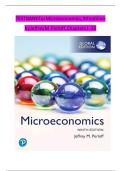
TEST BANK For Microeconomics, 9th edition
by Jeffrey M. Perloff, Chapters 1 - 20
,Table of contents
T T
1. Introduction
2. Supply and Demand
T T
3. Applying the Supply-and-Demand Model
T T T
4. Consumer Choice T
5. Applying Consumer Theory
T T
6. Firms and Production
T T
7. Costs
8. Competitive Firms and Markets T T T
9. Applying the Competitive Model
T T T
10. General Equilibrium and Economic Welfare
T T T T
11. Monopoly
12. Pricing and Advertising T T
13. Oligopoly and Monopolistic Competition T T T
14. Game Theory T
15. Factor Markets T
16. Interest Rates, Investments, and Capital Markets
T T T T T
17. Uncertainty
18. Externalities, Open-Access, and Public Goods T T T T
19. Asymmetric Information T
20. Contracts and Moral Hazards T T T
,ChapterT1 Introduction
1.1 Microeconomics:TTheTAllocationTofTScarceTResources
1) MicroeconomicsTstudiesTtheTallocationTof
A) decisionTmakers.
B) scarceTresources.
C) models.
D) unlimitedTresources.
E) TANSWER: B
Section:
TheTAllocationTofTScarceTResourcesTQu
estionTStatus: Old
AACSB: AnalyticTthinking
2) MicroeconomicsTisToftenTcalled
A) priceTtheory.
B) decisionTscience.
C) scarcity.
D) resourceTtheory.T
ANSWER: A
Section:
TheTAllocationTofTScarceTResourcesTQu
estionTStatus: Old
AACSB: AnalyticTthinking
3) MostTmicroeconomicTmodelsTassumeTthatTdecisionTmakersTwishTto
A) makeTthemselvesTasTwellToffTasTpossible.
B) actTselfishly.
C) makeTothersTasTwellToffTasTpossible.
D) NoneTofTtheTabove.T
ANSWER: A
Section:
TheTAllocationTofTScarceTResourcesTQu
estionTStatus: Old
AACSB: AnalyticTthinking
4) SocietyTfacesTtrade- ‑offsTbecauseTof
A) governmentTregulations.
B) profitTmotive.
C) facelessTbureaucrats.
, D) scarcity.TA
NSWER: D
Section:
TheTAllocationTofTScarceTResourcesTQu
estionTStatus: Old
AACSB: AnalyticTthinking
by Jeffrey M. Perloff, Chapters 1 - 20
,Table of contents
T T
1. Introduction
2. Supply and Demand
T T
3. Applying the Supply-and-Demand Model
T T T
4. Consumer Choice T
5. Applying Consumer Theory
T T
6. Firms and Production
T T
7. Costs
8. Competitive Firms and Markets T T T
9. Applying the Competitive Model
T T T
10. General Equilibrium and Economic Welfare
T T T T
11. Monopoly
12. Pricing and Advertising T T
13. Oligopoly and Monopolistic Competition T T T
14. Game Theory T
15. Factor Markets T
16. Interest Rates, Investments, and Capital Markets
T T T T T
17. Uncertainty
18. Externalities, Open-Access, and Public Goods T T T T
19. Asymmetric Information T
20. Contracts and Moral Hazards T T T
,ChapterT1 Introduction
1.1 Microeconomics:TTheTAllocationTofTScarceTResources
1) MicroeconomicsTstudiesTtheTallocationTof
A) decisionTmakers.
B) scarceTresources.
C) models.
D) unlimitedTresources.
E) TANSWER: B
Section:
TheTAllocationTofTScarceTResourcesTQu
estionTStatus: Old
AACSB: AnalyticTthinking
2) MicroeconomicsTisToftenTcalled
A) priceTtheory.
B) decisionTscience.
C) scarcity.
D) resourceTtheory.T
ANSWER: A
Section:
TheTAllocationTofTScarceTResourcesTQu
estionTStatus: Old
AACSB: AnalyticTthinking
3) MostTmicroeconomicTmodelsTassumeTthatTdecisionTmakersTwishTto
A) makeTthemselvesTasTwellToffTasTpossible.
B) actTselfishly.
C) makeTothersTasTwellToffTasTpossible.
D) NoneTofTtheTabove.T
ANSWER: A
Section:
TheTAllocationTofTScarceTResourcesTQu
estionTStatus: Old
AACSB: AnalyticTthinking
4) SocietyTfacesTtrade- ‑offsTbecauseTof
A) governmentTregulations.
B) profitTmotive.
C) facelessTbureaucrats.
, D) scarcity.TA
NSWER: D
Section:
TheTAllocationTofTScarceTResourcesTQu
estionTStatus: Old
AACSB: AnalyticTthinking