1|Page
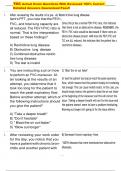
NURS 480 EXAM 3 ACTUAL EXAM QUESTIONS
AND ANSWERS| LATEST UPDATED VERSION
WITH VERIFIED SOLUTIONS - ASSURED PASS
In planning for discharge planning for a client with bacterial meningitis, the nurse
will be sure to include which instruction?
1. Keep all family and visitors from visiting your room for protective isolation.
2. Make sure you eat high protein diet with plenty of fluids
3. Take all of the antibiotics until gone.
4. Incorporate regular exercise with an active range of motion. - ANSWER: 3.
Take all of the antibiotics until gone.
The client should be instructed to complete all antibiotics until they are completely
gone. Failure to complete antibiotics may lead to re-infection and may spread
causing endocarditis and other infections in the body, especially if the bacteria
were from streptococci. While the client may be in isolation while in the hospital,
family may not need to quarantine the client when at home. Some family members
receive prophylactic antibiotics, but will be ordered according to the bacterial
strain and health care provider (HCP) recommendations. It is important to eat a
good diet, but the most important will be taking prescribed antibiotics. While
returning to exercise is important, gradual increase should be performed, and the
answer selection for exercise was not as important as prescribed antibiotics.
The nurse is assessing the central stimulus function of an unconscious client in the
intensive care unit. The nurse should plan to use which technique to test the client's
central response to stimuli?
1. Supraorbital ridge pressure.
2. Sternal rub.
3. Pressure on the nail bed.
4. Calling out loudly close to the client's ear. - ANSWER: 1. Supraorbital
ridge pressure.
,2|Page
Central stimulus is applied to cranial nerves not peripheral nerves. Supraorbital
ridge pressure by applying pressure on the orbital rim is indicated for central
stimulus assessment. Sternal rub is usually not indicated via best practices.
Pressure on the nail bed represents testing painful stimuli for motor testing on
peripheral nerves. Calling out loudly is not an assessment technique for central
stimulus function. There are two anatomic locations for pain stimulus: centrally
and peripherally. Central involves trapezious pinch or supraorbital pressure
whereas peripheral stimuli are applied to extremities. Responses may infer damage
to the brain or specific brain areas.
A client is admitted for observation following a motor vehicle accident that
occurred on the way to the client's daughter's wedding. The next morning, instead
of asking about the wedding, the client tells the nurse "I have to leave now since
the wedding is in a few minutes." The client then becomes agitated when the nurse
re-orients and states the actual date (which is the day following the wedding).
What should the nurse do next?
1. Change the date on the hospital room whiteboard to yesterday's date.
2. Perform neurological assessment and assess pupillary response.
3. Administer Valium 40 mg IV since the client is about to have a seizure.
4. Call the family to see if the wedding can be repeated - ANSWER: 2.
Perform neurological assessment and assess pupillary response.
The nurse needs to perform a neuro assessment to determine pupillary response,
ask if a headache is present, take vital signs, and contact the health care provider.
The client may be exhibiting subtle signs of increased intracranial pressure which
includes restlessness, agitation, headache, and pupil changes.
,3|Page
A client is taking felbamate (Felbatol) for seizures and displays symptoms of
pancytopenia based on which assessment findings? (Select all that apply)
1. Sore throat
2. Epistaxis
3. Skin rash
4. Gingival hyperplasia - ANSWER: 1. Sore throat
2. Epistaxis
Pancytopenia symptoms while taking felbamate include fever, sore throat, flu-like
feeling, and may exhibit increased bleeding with reduced platelet count (epitaxis).
Skin rash may not indicate pancytopenia. Gingival hyperplasia is an adverse affect
of anticonvulsants like phenytoin, but is not a symptom of pancytopenia.
Pancytopenia affects red cells, white cells, and platelets and represents bone
marrow's response to on-hematologic conditions such as drugs.
A client is being discharged with a new prescription of phenytoin sodium
(dilantin). Which instruction by the nurse is most important to include?
1. If stopped abruptly, status epilepticus may occur.
2. Sulfonamides like Bactrim will decrease phenytoin levels in the blood.
3. Take the medication with antacids to reduce gastric upset.
4. Dilantin will not affect contraceptive effectiveness. - ANSWER: 1. If
stopped abruptly, status epilepticus may occur.
It is important to instruct not to suddenly stop taking phenytoin sodium (Dilantin)
as doing so may present a risk for return of life-threatening seizure activity.
Sulfonamides will increase phenytoin levels. The drug should not be taken with
antacids and will lower phenytoin absorption. Clients on contraceptive hormone
therapy may need to use alternative forms of non-hormonal contraceptives while
on phenytoin sodium (Dilantin).
, 4|Page
The nurse is caring for a client who is unconscious who requires enteral feedings
through a nasogastric tube. Which action takes priority when managing enteral
feedings?
1. Weigh the client daily at the same time.
2. Make sure sterile water and sterile gavage system is changed every 24 hours.
3. Keep the client in semi-fowlers position.
4. Keep the formula warm by setting in hot water 30 minutes prior to
administration. - ANSWER: 3. Keep the client in semi-fowlers position.
It is most important to maintain a semi-flowlers position with nasogastric feedings
to prevent aspiration. While daily weights may be important, protecting the airway
and lungs from aspiration is more important. Having sterile water and supplies are
not necessary since the management is with clean not sterile procedure. The
formula should be room temperature and should never be heated prior to
administration.
The nurse will collaborate with the interdisciplinary team on communication assist
with a client with expressive aphasia. The team decided on which intervention to
help with communication?
1. Make sure all staff know to speak slowly and in short sentences.
2. Make sure all staff speak loudly for the client to hear.
3. Make sure all staff write on a clipboard for the client to read communication.
4. Make sure all staff assist the client with use of a picture board which is client
driven. - ANSWER: 4. Make sure all staff assist the client with use of a picture
board which is client driven.
Expressive aphasia clients may understand what is heard or written, but they may
not be able to verbally communicate their needs. A picture or communication
board helps the client as the client can point to or direct others towards objects on
the board for wants and needs. Speaking loudly or slowly is not therapeutic for
NURS 480 EXAM 3 ACTUAL EXAM QUESTIONS
AND ANSWERS| LATEST UPDATED VERSION
WITH VERIFIED SOLUTIONS - ASSURED PASS
In planning for discharge planning for a client with bacterial meningitis, the nurse
will be sure to include which instruction?
1. Keep all family and visitors from visiting your room for protective isolation.
2. Make sure you eat high protein diet with plenty of fluids
3. Take all of the antibiotics until gone.
4. Incorporate regular exercise with an active range of motion. - ANSWER: 3.
Take all of the antibiotics until gone.
The client should be instructed to complete all antibiotics until they are completely
gone. Failure to complete antibiotics may lead to re-infection and may spread
causing endocarditis and other infections in the body, especially if the bacteria
were from streptococci. While the client may be in isolation while in the hospital,
family may not need to quarantine the client when at home. Some family members
receive prophylactic antibiotics, but will be ordered according to the bacterial
strain and health care provider (HCP) recommendations. It is important to eat a
good diet, but the most important will be taking prescribed antibiotics. While
returning to exercise is important, gradual increase should be performed, and the
answer selection for exercise was not as important as prescribed antibiotics.
The nurse is assessing the central stimulus function of an unconscious client in the
intensive care unit. The nurse should plan to use which technique to test the client's
central response to stimuli?
1. Supraorbital ridge pressure.
2. Sternal rub.
3. Pressure on the nail bed.
4. Calling out loudly close to the client's ear. - ANSWER: 1. Supraorbital
ridge pressure.
,2|Page
Central stimulus is applied to cranial nerves not peripheral nerves. Supraorbital
ridge pressure by applying pressure on the orbital rim is indicated for central
stimulus assessment. Sternal rub is usually not indicated via best practices.
Pressure on the nail bed represents testing painful stimuli for motor testing on
peripheral nerves. Calling out loudly is not an assessment technique for central
stimulus function. There are two anatomic locations for pain stimulus: centrally
and peripherally. Central involves trapezious pinch or supraorbital pressure
whereas peripheral stimuli are applied to extremities. Responses may infer damage
to the brain or specific brain areas.
A client is admitted for observation following a motor vehicle accident that
occurred on the way to the client's daughter's wedding. The next morning, instead
of asking about the wedding, the client tells the nurse "I have to leave now since
the wedding is in a few minutes." The client then becomes agitated when the nurse
re-orients and states the actual date (which is the day following the wedding).
What should the nurse do next?
1. Change the date on the hospital room whiteboard to yesterday's date.
2. Perform neurological assessment and assess pupillary response.
3. Administer Valium 40 mg IV since the client is about to have a seizure.
4. Call the family to see if the wedding can be repeated - ANSWER: 2.
Perform neurological assessment and assess pupillary response.
The nurse needs to perform a neuro assessment to determine pupillary response,
ask if a headache is present, take vital signs, and contact the health care provider.
The client may be exhibiting subtle signs of increased intracranial pressure which
includes restlessness, agitation, headache, and pupil changes.
,3|Page
A client is taking felbamate (Felbatol) for seizures and displays symptoms of
pancytopenia based on which assessment findings? (Select all that apply)
1. Sore throat
2. Epistaxis
3. Skin rash
4. Gingival hyperplasia - ANSWER: 1. Sore throat
2. Epistaxis
Pancytopenia symptoms while taking felbamate include fever, sore throat, flu-like
feeling, and may exhibit increased bleeding with reduced platelet count (epitaxis).
Skin rash may not indicate pancytopenia. Gingival hyperplasia is an adverse affect
of anticonvulsants like phenytoin, but is not a symptom of pancytopenia.
Pancytopenia affects red cells, white cells, and platelets and represents bone
marrow's response to on-hematologic conditions such as drugs.
A client is being discharged with a new prescription of phenytoin sodium
(dilantin). Which instruction by the nurse is most important to include?
1. If stopped abruptly, status epilepticus may occur.
2. Sulfonamides like Bactrim will decrease phenytoin levels in the blood.
3. Take the medication with antacids to reduce gastric upset.
4. Dilantin will not affect contraceptive effectiveness. - ANSWER: 1. If
stopped abruptly, status epilepticus may occur.
It is important to instruct not to suddenly stop taking phenytoin sodium (Dilantin)
as doing so may present a risk for return of life-threatening seizure activity.
Sulfonamides will increase phenytoin levels. The drug should not be taken with
antacids and will lower phenytoin absorption. Clients on contraceptive hormone
therapy may need to use alternative forms of non-hormonal contraceptives while
on phenytoin sodium (Dilantin).
, 4|Page
The nurse is caring for a client who is unconscious who requires enteral feedings
through a nasogastric tube. Which action takes priority when managing enteral
feedings?
1. Weigh the client daily at the same time.
2. Make sure sterile water and sterile gavage system is changed every 24 hours.
3. Keep the client in semi-fowlers position.
4. Keep the formula warm by setting in hot water 30 minutes prior to
administration. - ANSWER: 3. Keep the client in semi-fowlers position.
It is most important to maintain a semi-flowlers position with nasogastric feedings
to prevent aspiration. While daily weights may be important, protecting the airway
and lungs from aspiration is more important. Having sterile water and supplies are
not necessary since the management is with clean not sterile procedure. The
formula should be room temperature and should never be heated prior to
administration.
The nurse will collaborate with the interdisciplinary team on communication assist
with a client with expressive aphasia. The team decided on which intervention to
help with communication?
1. Make sure all staff know to speak slowly and in short sentences.
2. Make sure all staff speak loudly for the client to hear.
3. Make sure all staff write on a clipboard for the client to read communication.
4. Make sure all staff assist the client with use of a picture board which is client
driven. - ANSWER: 4. Make sure all staff assist the client with use of a picture
board which is client driven.
Expressive aphasia clients may understand what is heard or written, but they may
not be able to verbally communicate their needs. A picture or communication
board helps the client as the client can point to or direct others towards objects on
the board for wants and needs. Speaking loudly or slowly is not therapeutic for