

BIOL251 – Human Anatomy & Physiology I w/ Lab (Module 1) | Exam
Review – 90+ QuestionsHigh-Yield Review for LockDown Browser /
Portage Learning 2026| PDF
including a diagram-based question to test practical lab skills.
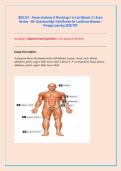
Image Description
A diagram shows the human body with labeled regions: head, neck, thorax,
abdomen, pelvis, upper limb, lower limb. Labels A–F correspond to head, thorax,
abdomen, pelvis, upper limb, lower limb.
,1. Label A corresponds to which body region?
Answer: Head
Explanation: High-yield body region identification.
2. Label B corresponds to which cavity?
Answer: Thoracic cavity
Explanation: Thoracic cavity contains lungs and heart.
3. Label C corresponds to which cavity?
Answer: Abdominal cavity
Explanation: Houses digestive organs; high-yield for practicals.
4. Label D corresponds to which region?
Answer: Pelvis
Explanation: Includes reproductive and urinary structures.
5. Label E corresponds to which limb?
Answer: Upper limb
Explanation: Lab identification; commonly tested.
6 The study of body function is called:
Answer: Physiology
Explanation: Physiology focuses on how structures work; anatomy is the study of
structure.
7. The study of body structure is called:
Answer: Anatomy
, Explanation: Includes gross anatomy, microscopic anatomy, and developmental
anatomy.
8. The human body is organized into levels. The simplest level is:
Answer: Chemical (atoms and molecules)
Explanation: Molecules combine to form cells, tissues, organs, and organ
systems.
9. Cells that perform the same function group together to form:
Answer: Tissue
Explanation: Tissue → Organ → Organ system → Organism; fundamental body
organization.
10. Which body system is primarily responsible for transporting oxygen and
nutrients?
Answer: Cardiovascular system
Explanation: Heart, blood, and vessels distribute substances throughout the body.
11. Homeostasis refers to:
Answer: Maintaining a stable internal environment
Explanation: High-yield exam concept; includes temperature, pH, and electrolyte
balance.
12. A receptor, control center, and effector are components of:
Answer: Negative feedback mechanism
Explanation: Classic physiology principle; most homeostatic control.
13. A process in which the body amplifies a change from the set point, such as
labor contractions, is called:
Review – 90+ QuestionsHigh-Yield Review for LockDown Browser /
Portage Learning 2026| PDF
including a diagram-based question to test practical lab skills.
Image Description
A diagram shows the human body with labeled regions: head, neck, thorax,
abdomen, pelvis, upper limb, lower limb. Labels A–F correspond to head, thorax,
abdomen, pelvis, upper limb, lower limb.
,1. Label A corresponds to which body region?
Answer: Head
Explanation: High-yield body region identification.
2. Label B corresponds to which cavity?
Answer: Thoracic cavity
Explanation: Thoracic cavity contains lungs and heart.
3. Label C corresponds to which cavity?
Answer: Abdominal cavity
Explanation: Houses digestive organs; high-yield for practicals.
4. Label D corresponds to which region?
Answer: Pelvis
Explanation: Includes reproductive and urinary structures.
5. Label E corresponds to which limb?
Answer: Upper limb
Explanation: Lab identification; commonly tested.
6 The study of body function is called:
Answer: Physiology
Explanation: Physiology focuses on how structures work; anatomy is the study of
structure.
7. The study of body structure is called:
Answer: Anatomy
, Explanation: Includes gross anatomy, microscopic anatomy, and developmental
anatomy.
8. The human body is organized into levels. The simplest level is:
Answer: Chemical (atoms and molecules)
Explanation: Molecules combine to form cells, tissues, organs, and organ
systems.
9. Cells that perform the same function group together to form:
Answer: Tissue
Explanation: Tissue → Organ → Organ system → Organism; fundamental body
organization.
10. Which body system is primarily responsible for transporting oxygen and
nutrients?
Answer: Cardiovascular system
Explanation: Heart, blood, and vessels distribute substances throughout the body.
11. Homeostasis refers to:
Answer: Maintaining a stable internal environment
Explanation: High-yield exam concept; includes temperature, pH, and electrolyte
balance.
12. A receptor, control center, and effector are components of:
Answer: Negative feedback mechanism
Explanation: Classic physiology principle; most homeostatic control.
13. A process in which the body amplifies a change from the set point, such as
labor contractions, is called:


