

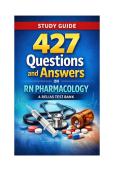
,RN Pharmacology A - Relias Learning Questions & Answers
1. Fundamental Pharmacology Concepts
Q1: What is pharmacology?
A: Pharmacology is the scientific study of drugs and their effects on living systems, including
drug composition, properties, interactions, toxicology, and therapeutic applications.
Q2: Define pharmacokinetics.
A: Pharmacokinetics describes what the body does to a drug, including the processes of
absorption, distribution, metabolism, and elimination (ADME).
Q3: Define pharmacodynamics.
A: Pharmacodynamics describes what the drug does to the body, including its mechanism of
action, effects, and interactions with receptor sites.
Q4: What is bioavailability?
A: Bioavailability is the percentage of an administered drug dose that reaches systemic
circulation in active form.
Q5: What factors affect drug absorption?
A: Drug form, route of administration, gastrointestinal pH, blood flow, food intake, and gastric
emptying time.
2. Drug Routes & Administration
Q6: List the main routes of drug administration.
A:
Oral (PO)
Intravenous (IV)
Intramuscular (IM)
Subcutaneous (SC)
Transdermal
Inhalation
Rectal
Topical
Sublingual (SL)
Q7: Which route provides the fastest drug action?
A: Intravenous (IV) administration provides the fastest action as it bypasses absorption and
enters directly into systemic circulation.
,Q8: What is the advantage of sublingual administration?
A: Sublingual drugs bypass first-pass metabolism in the liver, allowing for faster onset and better
bioavailability with smaller doses.
Q9: Name two advantages of transdermal delivery.
A: Maintains steady drug levels, improves medication adherence, and avoids gastrointestinal
issues.
Q10: What does IM absorption depend on?
A: Muscle blood flow, drug solubility, and the specific injection site.
3. Drug Distribution
Q11: What is drug distribution?
A: The process by which drugs move from the bloodstream to various body tissues and organs.
Q12: What is protein binding in pharmacokinetics?
A: When drugs bind to plasma proteins (like albumin), only the unbound (free) drug is active and
can produce therapeutic effects.
Q13: What does the blood-brain barrier prevent?
A: Most polar, water-soluble, and highly protein-bound drugs; lipid-soluble drugs cross more
easily.
Q14: Define volume of distribution (Vd).
A: A theoretical volume that relates the amount of drug in the body to its plasma concentration;
indicates how widely distributed a drug is throughout the body.
Q15: How does pregnancy affect drug distribution?
A: Increased blood volume, changes in body composition, and altered protein binding can affect
drug distribution during pregnancy.
4. Drug Metabolism
Q16: Where does most drug metabolism occur?
A: The liver, via hepatic metabolism (Phase I, II, and III reactions).
Q17: What are Phase I metabolic reactions?
A: Oxidation, reduction, and hydrolysis reactions that modify drugs through cytochrome P450
enzymes.
Q18: What are Phase II metabolic reactions?
A: Conjugation reactions (glucuronidation, sulfation, acetylation) that make drugs more water-
soluble for excretion.
Q19: What are Phase III reactions?
A: Active transport of drug metabolites, facilitated by carrier proteins.
, Q20: Define first-pass metabolism.
A: Metabolism of an orally administered drug by the liver before it reaches systemic circulation,
reducing bioavailability.
5. Drug Elimination
Q21: What is the primary organ for drug elimination?
A: The kidneys, which excrete drugs through glomerular filtration, tubular secretion, and tubular
reabsorption.
Q22: Define drug half-life (t½).
A: The time required for the plasma concentration of a drug to decrease to half its original level.
Q23: How does renal impairment affect drug elimination?
A: Decreased elimination leads to drug accumulation and increased risk of toxicity; dosages
must be adjusted.
Q24: Name three organs involved in drug elimination.
A: Kidneys, liver, lungs, and skin.
Q25: What is steady-state concentration?
A: When the rate of drug intake equals the rate of elimination, resulting in constant plasma drug
levels with repeated dosing.
6. Pharmacokinetics Calculations
Q26: What is the formula for calculating half-life?
A: t1/2=0.693kt1/2=k0.693 where k is the elimination rate constant.
Q27: How many half-lives does it take to achieve steady state?
A: Approximately 5 half-lives.
Q28: What is the relationship between clearance and half-life?
A: Cl=0.693×Vdt1/2Cl=t1/20.693×Vd (Clearance is the volume of plasma from which drug is
removed per unit time)
Q29: Define therapeutic drug level.
A: The plasma drug concentration range that produces desired therapeutic effects without
excessive toxicity.
Q30: What is the margin between therapeutic and toxic doses?
A: The therapeutic index (ratio of toxic dose to therapeutic dose); narrow indices require more
careful monitoring.
7. Drug Interactions
Q31: What is a drug-drug interaction?
A: When one drug affects the pharmacokinetics or pharmacodynamics of another drug,
potentially increasing or decreasing effects.
1. Fundamental Pharmacology Concepts
Q1: What is pharmacology?
A: Pharmacology is the scientific study of drugs and their effects on living systems, including
drug composition, properties, interactions, toxicology, and therapeutic applications.
Q2: Define pharmacokinetics.
A: Pharmacokinetics describes what the body does to a drug, including the processes of
absorption, distribution, metabolism, and elimination (ADME).
Q3: Define pharmacodynamics.
A: Pharmacodynamics describes what the drug does to the body, including its mechanism of
action, effects, and interactions with receptor sites.
Q4: What is bioavailability?
A: Bioavailability is the percentage of an administered drug dose that reaches systemic
circulation in active form.
Q5: What factors affect drug absorption?
A: Drug form, route of administration, gastrointestinal pH, blood flow, food intake, and gastric
emptying time.
2. Drug Routes & Administration
Q6: List the main routes of drug administration.
A:
Oral (PO)
Intravenous (IV)
Intramuscular (IM)
Subcutaneous (SC)
Transdermal
Inhalation
Rectal
Topical
Sublingual (SL)
Q7: Which route provides the fastest drug action?
A: Intravenous (IV) administration provides the fastest action as it bypasses absorption and
enters directly into systemic circulation.
,Q8: What is the advantage of sublingual administration?
A: Sublingual drugs bypass first-pass metabolism in the liver, allowing for faster onset and better
bioavailability with smaller doses.
Q9: Name two advantages of transdermal delivery.
A: Maintains steady drug levels, improves medication adherence, and avoids gastrointestinal
issues.
Q10: What does IM absorption depend on?
A: Muscle blood flow, drug solubility, and the specific injection site.
3. Drug Distribution
Q11: What is drug distribution?
A: The process by which drugs move from the bloodstream to various body tissues and organs.
Q12: What is protein binding in pharmacokinetics?
A: When drugs bind to plasma proteins (like albumin), only the unbound (free) drug is active and
can produce therapeutic effects.
Q13: What does the blood-brain barrier prevent?
A: Most polar, water-soluble, and highly protein-bound drugs; lipid-soluble drugs cross more
easily.
Q14: Define volume of distribution (Vd).
A: A theoretical volume that relates the amount of drug in the body to its plasma concentration;
indicates how widely distributed a drug is throughout the body.
Q15: How does pregnancy affect drug distribution?
A: Increased blood volume, changes in body composition, and altered protein binding can affect
drug distribution during pregnancy.
4. Drug Metabolism
Q16: Where does most drug metabolism occur?
A: The liver, via hepatic metabolism (Phase I, II, and III reactions).
Q17: What are Phase I metabolic reactions?
A: Oxidation, reduction, and hydrolysis reactions that modify drugs through cytochrome P450
enzymes.
Q18: What are Phase II metabolic reactions?
A: Conjugation reactions (glucuronidation, sulfation, acetylation) that make drugs more water-
soluble for excretion.
Q19: What are Phase III reactions?
A: Active transport of drug metabolites, facilitated by carrier proteins.
, Q20: Define first-pass metabolism.
A: Metabolism of an orally administered drug by the liver before it reaches systemic circulation,
reducing bioavailability.
5. Drug Elimination
Q21: What is the primary organ for drug elimination?
A: The kidneys, which excrete drugs through glomerular filtration, tubular secretion, and tubular
reabsorption.
Q22: Define drug half-life (t½).
A: The time required for the plasma concentration of a drug to decrease to half its original level.
Q23: How does renal impairment affect drug elimination?
A: Decreased elimination leads to drug accumulation and increased risk of toxicity; dosages
must be adjusted.
Q24: Name three organs involved in drug elimination.
A: Kidneys, liver, lungs, and skin.
Q25: What is steady-state concentration?
A: When the rate of drug intake equals the rate of elimination, resulting in constant plasma drug
levels with repeated dosing.
6. Pharmacokinetics Calculations
Q26: What is the formula for calculating half-life?
A: t1/2=0.693kt1/2=k0.693 where k is the elimination rate constant.
Q27: How many half-lives does it take to achieve steady state?
A: Approximately 5 half-lives.
Q28: What is the relationship between clearance and half-life?
A: Cl=0.693×Vdt1/2Cl=t1/20.693×Vd (Clearance is the volume of plasma from which drug is
removed per unit time)
Q29: Define therapeutic drug level.
A: The plasma drug concentration range that produces desired therapeutic effects without
excessive toxicity.
Q30: What is the margin between therapeutic and toxic doses?
A: The therapeutic index (ratio of toxic dose to therapeutic dose); narrow indices require more
careful monitoring.
7. Drug Interactions
Q31: What is a drug-drug interaction?
A: When one drug affects the pharmacokinetics or pharmacodynamics of another drug,
potentially increasing or decreasing effects.


