

CHEM233 C001 Winter 2025
Melting Points
Final Report
Student Name
Student ID
Lesson
Institution
Session
Course
Instructor
Test Your Knowledge
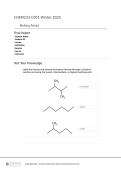
Label the hexane and hexane derivatives formed through a chemical
reaction as having the lowest, intermediate, or highest melting point.
1 Intermediate
2 Highest
3 Lowest
Copyright 2025 - Science Interactive | https://scienceinteractive.com
, Match each term with the best description.
A measure of the ability of an
atom to attract electrons in a 1 Electronegativity
chemical bond
Ease with which the electron
cloud of an atom or molecule
2 Polarizability
is distorted, producing
temporary dipoles
A molecule with a positively
3 Dipole
and a negatively charged end
The lowest temperature at
which a mixture of two pure
4 Eutectic temperature
compounds will begin to
liquefy
Temperature at which the
solid and liquid phases of a 5 Melting Point
substance are in equilibrium
Categorize the compounds as being held together by hydrogen bonds,
dipole-dipole interactions, or London dispersion forces.
Hydrogen Bonds Dipole-Dipole London Dispersion
1 CH3NH2 2 3 Cl2
Alkyl halides
HF H2O He
Ketones
HCl
Exploration
Copyright 2025 - Science Interactive | https://scienceinteractive.com
, As the strength of intermolecular forces increase, the amount of energy
required to disrupt the forces increases.
True
False
London dispersion forces are permanent dipole moments because the
movement of electrons is continuously changing.
True
False
Dipole-dipole forces are present in all molecular liquids and solids, but are
of lower significance if other intermolecular forces are present.
True
False
When comparing similarly sized molecules, _____ are the strongest
intermolecular forces.
dipole-dipole forces
hydrogen bonds
London dispersion forces
High melting points indicate weak intermolecular forces.
True
False
Copyright 2025 - Science Interactive | https://scienceinteractive.com
Melting Points
Final Report
Student Name
Student ID
Lesson
Institution
Session
Course
Instructor
Test Your Knowledge
Label the hexane and hexane derivatives formed through a chemical
reaction as having the lowest, intermediate, or highest melting point.
1 Intermediate
2 Highest
3 Lowest
Copyright 2025 - Science Interactive | https://scienceinteractive.com
, Match each term with the best description.
A measure of the ability of an
atom to attract electrons in a 1 Electronegativity
chemical bond
Ease with which the electron
cloud of an atom or molecule
2 Polarizability
is distorted, producing
temporary dipoles
A molecule with a positively
3 Dipole
and a negatively charged end
The lowest temperature at
which a mixture of two pure
4 Eutectic temperature
compounds will begin to
liquefy
Temperature at which the
solid and liquid phases of a 5 Melting Point
substance are in equilibrium
Categorize the compounds as being held together by hydrogen bonds,
dipole-dipole interactions, or London dispersion forces.
Hydrogen Bonds Dipole-Dipole London Dispersion
1 CH3NH2 2 3 Cl2
Alkyl halides
HF H2O He
Ketones
HCl
Exploration
Copyright 2025 - Science Interactive | https://scienceinteractive.com
, As the strength of intermolecular forces increase, the amount of energy
required to disrupt the forces increases.
True
False
London dispersion forces are permanent dipole moments because the
movement of electrons is continuously changing.
True
False
Dipole-dipole forces are present in all molecular liquids and solids, but are
of lower significance if other intermolecular forces are present.
True
False
When comparing similarly sized molecules, _____ are the strongest
intermolecular forces.
dipole-dipole forces
hydrogen bonds
London dispersion forces
High melting points indicate weak intermolecular forces.
True
False
Copyright 2025 - Science Interactive | https://scienceinteractive.com


