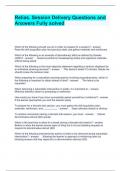
WGU D684
WGU D684 INTRODUCTION TO
COMPUTER SCIENCE CHAPTER 1
QUESTIONS AND ANSWERS 2026
Which value is stored as an integer in computer programming?
- "0"
- true
- -306.5
- 21 - Correct Answer-21
Which coding construct repeats a task while a condition is true?
- Iteration
- Input/output
- Selection
- Assignment - Correct Answer-Iteration :
The iteration construct, or the looping construct, uses a while statement to perform the
same task over and over again as long as a condition is true.
How are items accessed in a stack?
- The item removed is the one that has been in the longest time.
- All items can be added to or removed from any location.
- The last item to be added becomes the first item removed.
- All items can be accessed or changed but not easily inserted or removed. - Correct
Answer-The last item to be added becomes the first item removed.
A web browser puts websites into a viewing history log and accesses the most recent
one when the back button is clicked. Which data structure would be appropriate for this
situation?
- Record
- List
- Queue
- Stack - Correct Answer-Stack
What is the relationship between a parameter and an argument?
- A parameter is passed to a function by reference, whereas an argument is passed by
value.
- A parameter is a temporary variable in a function that receives the actual value of an
argument.
- An argument is an identifier in a function that receives the value called the parameter.
WGU D684
, WGU D684
- An argument is a value set in the code by a calculation, whereas a parameter is set by
user input. - Correct Answer-A parameter is a temporary variable in a function that
receives the actual value of an argument.
Which programming language is considered to be a declarative language?
- Smalltalk
- BASIC
- Lisp
- Java - Correct Answer-Lisp:
The declarative programming paradigm is a model in which the results are described,
but the steps to accomplish the results are not stated. There are two basic models
within this paradigm, functional and logic. Lisp is an example of a declarative language
Analog data
Data represented in a continuous and variable form
American standard code for information interchange (ASCII)
A standard encoding system for text characters that uses numeric values to represent
letters, numbers, and symbols
Bandwidth
The maximum rate of data transfer across a network or communication channel, usually
measured in bits per second
Binary
A numerical system that uses only two digits, zero and one, to represent data in
computing
Boolean expression
A logical statement that can only be true or false and uses operators like and, or, and
not
Character
A single letter, digit, or symbol used in writing text
Character set
A collection of characters that a computer can recognize and process, like ascii or
unicode compression ratio: the ratio of the original data size to the compressed data
size, indicating how much the data has been reduced
Control structure
Constructs in programming that control the flow of execution, such as loops and
conditional statements
Data
Raw facts and figures that can be processed to produce meaningful information
Data compression
The process of reducing the size of data to save space or transmission time
Data types
WGU D684
WGU D684 INTRODUCTION TO
COMPUTER SCIENCE CHAPTER 1
QUESTIONS AND ANSWERS 2026
Which value is stored as an integer in computer programming?
- "0"
- true
- -306.5
- 21 - Correct Answer-21
Which coding construct repeats a task while a condition is true?
- Iteration
- Input/output
- Selection
- Assignment - Correct Answer-Iteration :
The iteration construct, or the looping construct, uses a while statement to perform the
same task over and over again as long as a condition is true.
How are items accessed in a stack?
- The item removed is the one that has been in the longest time.
- All items can be added to or removed from any location.
- The last item to be added becomes the first item removed.
- All items can be accessed or changed but not easily inserted or removed. - Correct
Answer-The last item to be added becomes the first item removed.
A web browser puts websites into a viewing history log and accesses the most recent
one when the back button is clicked. Which data structure would be appropriate for this
situation?
- Record
- List
- Queue
- Stack - Correct Answer-Stack
What is the relationship between a parameter and an argument?
- A parameter is passed to a function by reference, whereas an argument is passed by
value.
- A parameter is a temporary variable in a function that receives the actual value of an
argument.
- An argument is an identifier in a function that receives the value called the parameter.
WGU D684
, WGU D684
- An argument is a value set in the code by a calculation, whereas a parameter is set by
user input. - Correct Answer-A parameter is a temporary variable in a function that
receives the actual value of an argument.
Which programming language is considered to be a declarative language?
- Smalltalk
- BASIC
- Lisp
- Java - Correct Answer-Lisp:
The declarative programming paradigm is a model in which the results are described,
but the steps to accomplish the results are not stated. There are two basic models
within this paradigm, functional and logic. Lisp is an example of a declarative language
Analog data
Data represented in a continuous and variable form
American standard code for information interchange (ASCII)
A standard encoding system for text characters that uses numeric values to represent
letters, numbers, and symbols
Bandwidth
The maximum rate of data transfer across a network or communication channel, usually
measured in bits per second
Binary
A numerical system that uses only two digits, zero and one, to represent data in
computing
Boolean expression
A logical statement that can only be true or false and uses operators like and, or, and
not
Character
A single letter, digit, or symbol used in writing text
Character set
A collection of characters that a computer can recognize and process, like ascii or
unicode compression ratio: the ratio of the original data size to the compressed data
size, indicating how much the data has been reduced
Control structure
Constructs in programming that control the flow of execution, such as loops and
conditional statements
Data
Raw facts and figures that can be processed to produce meaningful information
Data compression
The process of reducing the size of data to save space or transmission time
Data types
WGU D684