Cell-cell junction and cell polarisation
Recap
• Cytoskeleton
- microtubule, actin, IF are vital for cell polarisation (apical and basal) but also polarisation of flat cells (back to
front)
Learning objectives:
1. Cell-cell junctions
2. Anchoring junctions (adherens, desmosomes)
3. Occluding junctions (tight)
4. Channel forming junctions (Gap)
5. EMT
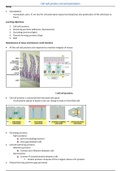
Maintenance of tissue architecture: small intestine
• All the cell-cell junctions are important to maintain integrity of tissues
I-cell-cell junctions
• Cell-cell junction is concerned with the basal and apical
- If cell polarity (apical to basal) is lost can change to back to front (flat cell)
• Occluding junctions
- Tight junctions:
part of occluding junctions
seize gap between cells
• cell-cell anchoring junctions
- Adherent junctions
Connect actin filament between cells
- Desmosomes
Connect IF (mostly keratin) between cells
▪ Keratin proteins comprise of the 2 largest classes of IF proteins
• Channel forming junctions (gap junctions)
, - Allow the passage of small water-soluble molecules from cell to cell
- No cytoskeleton attached
• Cell-cell matrix adhesion
- Also called actin-linked cell-matrix adhesion or focal adhesion
- Anchors actin filaments in cell to extracellular matrix.
• Hemidesmosomes
- Half a desmosome
- Hemidesmosomes are cell-matrix junctions
• Table showing all the cell cell junctions
• Memorise the table
Recap
• Cytoskeleton
- microtubule, actin, IF are vital for cell polarisation (apical and basal) but also polarisation of flat cells (back to
front)
Learning objectives:
1. Cell-cell junctions
2. Anchoring junctions (adherens, desmosomes)
3. Occluding junctions (tight)
4. Channel forming junctions (Gap)
5. EMT
Maintenance of tissue architecture: small intestine
• All the cell-cell junctions are important to maintain integrity of tissues
I-cell-cell junctions
• Cell-cell junction is concerned with the basal and apical
- If cell polarity (apical to basal) is lost can change to back to front (flat cell)
• Occluding junctions
- Tight junctions:
part of occluding junctions
seize gap between cells
• cell-cell anchoring junctions
- Adherent junctions
Connect actin filament between cells
- Desmosomes
Connect IF (mostly keratin) between cells
▪ Keratin proteins comprise of the 2 largest classes of IF proteins
• Channel forming junctions (gap junctions)
, - Allow the passage of small water-soluble molecules from cell to cell
- No cytoskeleton attached
• Cell-cell matrix adhesion
- Also called actin-linked cell-matrix adhesion or focal adhesion
- Anchors actin filaments in cell to extracellular matrix.
• Hemidesmosomes
- Half a desmosome
- Hemidesmosomes are cell-matrix junctions
• Table showing all the cell cell junctions
• Memorise the table