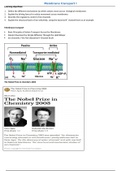
Membrane transport I
Learning objectives:
1. Define the different mechanisms by which solutes move across biological membranes
2. Explain the driving forces for solute movement across membranes
3. Describe the regulatory control of ion channels
4. Explain the structural basis of ion selectivity, using the bacterial K + channel KcsA as an example
Membrane transport
Basic Principles of Solute Transport Across the Membrane
Solute Movement by Simple Diffusion Through the Lipid Bilayer
Ion Channels, First Part (Bacterial K + Channel KcsA)
The Nobel Prize in chemistry 2003
, The Movement of Substances across Cell membrane
Biological membranes show selective permeability
- For many processes selective permeability is under regulatory control
Overall movement of ions or molecules through a membrane can be described by its net flux:
- Net flux is the difference between influx and efflux.
- Overall movement takes place if the net flux is not zero, i.e. influx and efflux are not balanced
- Movement of materials can occur by:
- Passive diffusion
- Active transport
Basic Mechanisms of Solute Movement across Membranes
The energetics of solute movement across membranes
Diffusion is exergonic. If concentrations of a particular solute across a membrane are different, there is potential
energy to reach equilibrium (Gibbs free energy, ΔG)
Chemical potential of an uncharged solute
- For the solute (C) ΔG is:
ΔG = 2.3 RT log10([C]i/[C]o)
o ΔG is the chemical potential difference
o [C]i and [C]o are the concentrations of the solute inside
o and outside (o) the membrane
o R = gas constant
o T= temperature.
Example, if the concentration is 10 times higher outside – what is the potential energy for influx?
- ΔG = 2.3 RT log10(1/10)
- ΔG = -1.4 kcal / mol
If the solute is ionic, there may be potential energy in the charge difference over the membrane, ΔѰ(membrane
potential)
Learning objectives:
1. Define the different mechanisms by which solutes move across biological membranes
2. Explain the driving forces for solute movement across membranes
3. Describe the regulatory control of ion channels
4. Explain the structural basis of ion selectivity, using the bacterial K + channel KcsA as an example
Membrane transport
Basic Principles of Solute Transport Across the Membrane
Solute Movement by Simple Diffusion Through the Lipid Bilayer
Ion Channels, First Part (Bacterial K + Channel KcsA)
The Nobel Prize in chemistry 2003
, The Movement of Substances across Cell membrane
Biological membranes show selective permeability
- For many processes selective permeability is under regulatory control
Overall movement of ions or molecules through a membrane can be described by its net flux:
- Net flux is the difference between influx and efflux.
- Overall movement takes place if the net flux is not zero, i.e. influx and efflux are not balanced
- Movement of materials can occur by:
- Passive diffusion
- Active transport
Basic Mechanisms of Solute Movement across Membranes
The energetics of solute movement across membranes
Diffusion is exergonic. If concentrations of a particular solute across a membrane are different, there is potential
energy to reach equilibrium (Gibbs free energy, ΔG)
Chemical potential of an uncharged solute
- For the solute (C) ΔG is:
ΔG = 2.3 RT log10([C]i/[C]o)
o ΔG is the chemical potential difference
o [C]i and [C]o are the concentrations of the solute inside
o and outside (o) the membrane
o R = gas constant
o T= temperature.
Example, if the concentration is 10 times higher outside – what is the potential energy for influx?
- ΔG = 2.3 RT log10(1/10)
- ΔG = -1.4 kcal / mol
If the solute is ionic, there may be potential energy in the charge difference over the membrane, ΔѰ(membrane
potential)