Mechanism for mitochondrial respiratory chain & evidence for the chemiosmosis hypothesis
Learning objectives:
1. Explain the difference between the 2 mechanism of proton translocation across the IMM
2. Explain how experiments using thylakoid membrane and liposomes containing ATP synthase and bacteriorhodopsin
provided evidence for the chemiosmosis hypothesis.
3. Define proton motive force (means the force that pushes protons)
4. Explain the basic features of respiratory control
5. Explain the modes of action of uncouplers and uncoupling proteins and how these are consistent with the chemiosmotic
hypothesis. (short circuits)
Energy transduction and chemiosmotic theory
• Take high energy electrons that are derived from glucose and convert the electrons into potential energy in the form of a
proton
• The proton gradient can be used to make chemical energy in the form of ATP
• Can store energy in a concentration gradient-chemiosmotic hypothesis
• Proton gradient drives ATP synthesis
• Electricity
- Use electrons to light up a bulb
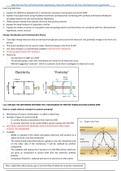
- The proton pump in the inner membrane are similar to an electrical circuit
- Mitchell suggested ‘’proticity’’ which is a proton circuit that is analogous to electrical circuit.
LO1. EXPLAIN THE DIFFERENCE BETWEEN THE 2 MECHANISM OF PROTON TRANSLOCATION ACROSS IMM
How to couple electron transport to proton pumping?
• Mechanism of proton translocation: is called a redox loop
• Involves 2 types of carriers (A & B)
- A: carries electrons and protons from matrix to IMS
- B: recycles electrons to the matrix before proton release into the IMS
• ELECTRON AND PROTON TRANSFER OCCUR IN OPPOSITE DIRECTIONS
ACROSS THE MEMBRANE
• Example:
- NADH is reduced in the matrix and passes electrons and protons to a
specie that can cross the membrane
- The reduced and protonated specie is going to cross the membrane and
on the other side of the membrane, it will be oxidised by another
component.
- The oxidation will release the 2 protons in to the IMS and the electrons
are gone as component A cannot hold onto the electrons without
protons.
- Component B which is reduced will return its electrons to the matrix.
This is called the redox loop (a way to connect flow of electrons to proton movement)
, • Start off with NADH
• Reduce the FMN and protonate the FMN to FMNH2
• FMNH2 on the other side of the membrane is oxidised by the Fe-S cluster in complex 1 and the protons are released
• FMN can go back and reduce the Fe-S cluster , which then reduced ubiquinone
• Ubiquinone is then protonated and then crosses the membrane and oxidised by the heme in complex 3 and the protons
are released here and the reduced heme can return to the other side of the membrane
• X is unknown but perhaps the X oxidises the heme and picks up 2 protons and then shuttle the electrons and protons
across to the IMS, which reduce cytochrome c
• Cytochrome c can move into the IMS into the protein complex 4 and then reduces specie a
• Finally get production of water
- If measure how many protons are pumped we find out that, it is all wrong except the ubiquinone cycle (where
electron are shuttled across in a redox loop).
- The redox loop alone does not reflect the observed stoichiometry of the respiratory electron transfer chain. There has
to be proton-pumping, redox loops are not enough.
Begin with 2 electrons
pump 2 protons in complex 1
pump 4 protons in complex 3
pump 0 protons in complex 4
6 protons pumped per 2 electrons
Actually 12 protons pumped per 2 electrons
Mechanism of proton translocation: proton pump
• This occurs in complex 1
- Protein with a channel for the proton
- On the matrix side, the protein channel is open
- Negatively charged residues within protein are protonated
- Reduction of the protein causes a conformational change that closes the channel facing the matrix and opens the
channel in the protein facing the IMS and releases protons. This can occur because:
Decrease the pKa values (capacity to bind to protons) of specific AA side chains = proton dissociation
Exposes these side chains to the IMS, resulting in release of protons
- Reoxidation results in the protein returning to its original conformation
Learning objectives:
1. Explain the difference between the 2 mechanism of proton translocation across the IMM
2. Explain how experiments using thylakoid membrane and liposomes containing ATP synthase and bacteriorhodopsin
provided evidence for the chemiosmosis hypothesis.
3. Define proton motive force (means the force that pushes protons)
4. Explain the basic features of respiratory control
5. Explain the modes of action of uncouplers and uncoupling proteins and how these are consistent with the chemiosmotic
hypothesis. (short circuits)
Energy transduction and chemiosmotic theory
• Take high energy electrons that are derived from glucose and convert the electrons into potential energy in the form of a
proton
• The proton gradient can be used to make chemical energy in the form of ATP
• Can store energy in a concentration gradient-chemiosmotic hypothesis
• Proton gradient drives ATP synthesis
• Electricity
- Use electrons to light up a bulb
- The proton pump in the inner membrane are similar to an electrical circuit
- Mitchell suggested ‘’proticity’’ which is a proton circuit that is analogous to electrical circuit.
LO1. EXPLAIN THE DIFFERENCE BETWEEN THE 2 MECHANISM OF PROTON TRANSLOCATION ACROSS IMM
How to couple electron transport to proton pumping?
• Mechanism of proton translocation: is called a redox loop
• Involves 2 types of carriers (A & B)
- A: carries electrons and protons from matrix to IMS
- B: recycles electrons to the matrix before proton release into the IMS
• ELECTRON AND PROTON TRANSFER OCCUR IN OPPOSITE DIRECTIONS
ACROSS THE MEMBRANE
• Example:
- NADH is reduced in the matrix and passes electrons and protons to a
specie that can cross the membrane
- The reduced and protonated specie is going to cross the membrane and
on the other side of the membrane, it will be oxidised by another
component.
- The oxidation will release the 2 protons in to the IMS and the electrons
are gone as component A cannot hold onto the electrons without
protons.
- Component B which is reduced will return its electrons to the matrix.
This is called the redox loop (a way to connect flow of electrons to proton movement)
, • Start off with NADH
• Reduce the FMN and protonate the FMN to FMNH2
• FMNH2 on the other side of the membrane is oxidised by the Fe-S cluster in complex 1 and the protons are released
• FMN can go back and reduce the Fe-S cluster , which then reduced ubiquinone
• Ubiquinone is then protonated and then crosses the membrane and oxidised by the heme in complex 3 and the protons
are released here and the reduced heme can return to the other side of the membrane
• X is unknown but perhaps the X oxidises the heme and picks up 2 protons and then shuttle the electrons and protons
across to the IMS, which reduce cytochrome c
• Cytochrome c can move into the IMS into the protein complex 4 and then reduces specie a
• Finally get production of water
- If measure how many protons are pumped we find out that, it is all wrong except the ubiquinone cycle (where
electron are shuttled across in a redox loop).
- The redox loop alone does not reflect the observed stoichiometry of the respiratory electron transfer chain. There has
to be proton-pumping, redox loops are not enough.
Begin with 2 electrons
pump 2 protons in complex 1
pump 4 protons in complex 3
pump 0 protons in complex 4
6 protons pumped per 2 electrons
Actually 12 protons pumped per 2 electrons
Mechanism of proton translocation: proton pump
• This occurs in complex 1
- Protein with a channel for the proton
- On the matrix side, the protein channel is open
- Negatively charged residues within protein are protonated
- Reduction of the protein causes a conformational change that closes the channel facing the matrix and opens the
channel in the protein facing the IMS and releases protons. This can occur because:
Decrease the pKa values (capacity to bind to protons) of specific AA side chains = proton dissociation
Exposes these side chains to the IMS, resulting in release of protons
- Reoxidation results in the protein returning to its original conformation