Glycogen metabolism
Learning objectives:
1. Glycogen structure
2. Importance of glycogen as storage molecule
3. Sites of storage
4. Describe and explain in detail glycogen breakdown(with committed and irreversible steps)
5. Describe metabolic fat of G6P- don’t know where to place?
6. Detailed description of glycogen synthesis (with reference to committed step)
7. Describe and explain the glycogenin
8. Describe and explain the regulation of these 2 pathways
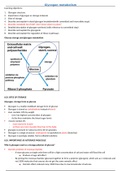
Glucose storage and glycogen metabolism
LO3. SITES OF STORAGE
Glycogen- storage form as glucose
Glycogen is a readily mobilised storage form of glucose
Glycogen is stored as carbohydrate instead of starch
Liver contains 10% by weight
- Liver has highest concentration of glycogen
- As the liver maintains the blood sugar levels
muscle contain 2%
- more stored in muscle
- as there are more muscles than liver in the body
glycogen is present in cytosol as 10 to 40 nm granules
Glycogen is a single structure- amylopectin is equivalent in plants (branches)
Glycogen is sparingly soluble- forms colloidal solutions
LO2. IMPORTANCE AS ASTORAGE MOLECULE
Why is glycogen used as a storage polymer of glucose?
Osmotic problem of monosaccharides
- If store glucose as single units there will be a high concentration of salt and water will flood the cell
Produce a huge salt effect
- By joining the monosaccharides (glucose) together to form a polymer (glycogen), which acts as 1 molecule and
not 1000 molecules that ensures do not get the same osmotic effect
Osmotic effect reduced many 1000 times due to macromolecular structures.
, Rapid mobilisation
- Not as reduced as fats therefore not as energy rich but glycogen can be easily broken down into glucose (great
for sudden strenuous activity)-mobilised and transported from adipose cells
- Glycogen is broken down to glucose-1-phosphate can be further metabolised to G-6-P to glycolysis
Use G6P to make glycogen but glycogen is broken down into G1Pbecause G1P is already
phosphorylated it does not escape from the cell and can be readily interconverted into G6P.
- Glucose unlike fats can be degraded both aerobically & anaerobically
- Muscles need to function aerobically and anaerobically and require rapid and constant supply of energy
Why is fat not a storage polymer
More abundant in body
Fat has a higher calorific (amount of energy) content than glycogen
But
- Only aerobic metabolism
- Muscles cannot mobilise fats very rapidly
- Fats cannot be converted to glucose
- Cannot therefore contribute to blood sugar levels
- Fat is a long term fuel and storage molecules
- Core requirements - unable to supply fuel in times of high requirement
- Function of glucose
LO1. GLYCOGEN STRUCTURE
Glycogen molecular structure
Glycogen is a polymer of glucose linked by
- α-1,4- glyosidic bonds mainly
- α-1,6-glycosidic bonds, at branch points
glycogen chains & branches are longer than shown
below is 2 outer branches of a glycogen molecule
glucose residues at the end are called non-reducing ends (in red)
the residue that starts a branch is shown in green
rest of the molecule is R
there is a protein in the middle of the glycogen called glycogenin
Glycogen metabolism- regulated release and storage of glucose
synthesis and degradation are biochemical processes
- it provides reservoir of glucose fuel for production of ATP within tissue (e.g muscles) & regulates blood glucose
levels (e.g. release through liver )
occurs by different reaction pathways
glycogen degradation 3 step process:
1. release of glucose-1-phosphate from glycogen
Learning objectives:
1. Glycogen structure
2. Importance of glycogen as storage molecule
3. Sites of storage
4. Describe and explain in detail glycogen breakdown(with committed and irreversible steps)
5. Describe metabolic fat of G6P- don’t know where to place?
6. Detailed description of glycogen synthesis (with reference to committed step)
7. Describe and explain the glycogenin
8. Describe and explain the regulation of these 2 pathways
Glucose storage and glycogen metabolism
LO3. SITES OF STORAGE
Glycogen- storage form as glucose
Glycogen is a readily mobilised storage form of glucose
Glycogen is stored as carbohydrate instead of starch
Liver contains 10% by weight
- Liver has highest concentration of glycogen
- As the liver maintains the blood sugar levels
muscle contain 2%
- more stored in muscle
- as there are more muscles than liver in the body
glycogen is present in cytosol as 10 to 40 nm granules
Glycogen is a single structure- amylopectin is equivalent in plants (branches)
Glycogen is sparingly soluble- forms colloidal solutions
LO2. IMPORTANCE AS ASTORAGE MOLECULE
Why is glycogen used as a storage polymer of glucose?
Osmotic problem of monosaccharides
- If store glucose as single units there will be a high concentration of salt and water will flood the cell
Produce a huge salt effect
- By joining the monosaccharides (glucose) together to form a polymer (glycogen), which acts as 1 molecule and
not 1000 molecules that ensures do not get the same osmotic effect
Osmotic effect reduced many 1000 times due to macromolecular structures.
, Rapid mobilisation
- Not as reduced as fats therefore not as energy rich but glycogen can be easily broken down into glucose (great
for sudden strenuous activity)-mobilised and transported from adipose cells
- Glycogen is broken down to glucose-1-phosphate can be further metabolised to G-6-P to glycolysis
Use G6P to make glycogen but glycogen is broken down into G1Pbecause G1P is already
phosphorylated it does not escape from the cell and can be readily interconverted into G6P.
- Glucose unlike fats can be degraded both aerobically & anaerobically
- Muscles need to function aerobically and anaerobically and require rapid and constant supply of energy
Why is fat not a storage polymer
More abundant in body
Fat has a higher calorific (amount of energy) content than glycogen
But
- Only aerobic metabolism
- Muscles cannot mobilise fats very rapidly
- Fats cannot be converted to glucose
- Cannot therefore contribute to blood sugar levels
- Fat is a long term fuel and storage molecules
- Core requirements - unable to supply fuel in times of high requirement
- Function of glucose
LO1. GLYCOGEN STRUCTURE
Glycogen molecular structure
Glycogen is a polymer of glucose linked by
- α-1,4- glyosidic bonds mainly
- α-1,6-glycosidic bonds, at branch points
glycogen chains & branches are longer than shown
below is 2 outer branches of a glycogen molecule
glucose residues at the end are called non-reducing ends (in red)
the residue that starts a branch is shown in green
rest of the molecule is R
there is a protein in the middle of the glycogen called glycogenin
Glycogen metabolism- regulated release and storage of glucose
synthesis and degradation are biochemical processes
- it provides reservoir of glucose fuel for production of ATP within tissue (e.g muscles) & regulates blood glucose
levels (e.g. release through liver )
occurs by different reaction pathways
glycogen degradation 3 step process:
1. release of glucose-1-phosphate from glycogen