Glycolysis
Learning objectives:
1. Describe in general glycolysis
2. Describe and explain in detail the regulation of glycolysis (i.e. irreversible steps)
3. Identify reactions producing ATP, NADH, FADH 2
Why is glucose so important?
Only fuel that the brain uses under non-starvation condition
- Under starvation conditions, ketone bodies are used
Only fuel RBC use at all
There are many other carbohydrates, so why glucose?
- Can speculate that glucose is formed from formaldehyde under prebiotic (occurring before emergence of
life) conditions so first fuel source for primitive (early stage of evolution) biochemical systems?
- Low tendency (relative to other monosaccharides) to non-enzymatically glycosylate proteins (due to liking in
a ring instead of open chain)
Glycolysis
Anaerobic (no oxygen) metabolism of glucose (provides energy for short, intense exercise)
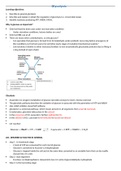
The glycolytic pathway describes the oxidation of glucose to pyruvate with the generation of ATP and NADH
also called embden-meyerholf pathway
glycolysis is a universal pathway, which means present in all organisms from yeast to mammals
in eukaryotes, glycolysis takes place in the cytosol
in the prescence of O2, pyruvate is further oxidised to CO2
in the absence of O2 , pyruvate is fermentated to lactate or ethanol
net reaction:
LO1. DESCRIBE GLYCOLYSIS IN GENERAL
step 1 : is investment stage
- 2 mols of ATP are consumed for each mol of glucose
- Glucose is converted to fructose-1,6-bisphosphate
- Glucose is trapped inside the cell and at the same time converted to an unstable form that can be readily
cleaved into 3-C units
Step 2: rearrangement
- Fructose-1,6-bisphosphate is cleaved into two 3-C units of glyceraldehyde-3-phosphate
Step 3: is the harvesting stage
, - 4 mols of ATP and 2 mols of NADH are gained from each initial mol of glucose
- This ATP is a result of substrate-level phosphorylation
- Glyceraldehyde-3-phosphate is oxidised to pyruvate
LO2. DESCRIBE & EXPLAIN IN DETAIL THE REGULATION OF GLYCOLYSIS (I.E. IRREVERSILBLE STEPS IN GLYCOLYSIS)
LO3. IDENTIFY REACTIONS PRODUCING ATP, NADH, FADH2
Glycolysis- stage 1 trapped & destabilised
Reaction 1
- Phosphorylation of glucose to glucose-6 phosphate
- Requires energy so coupled to hydrolysis of ATP to ADP + Pi
- Enzymes: hexokinase (via induced fit)
Has a low Km for glucose thus once glucose enters it gets phosphorylated
This step is irreversible
So glucose gets trapped inside cell
glucose transporters transport only free glucose, not phosphorylated glucose
Stage 1 reaction 2
Isomerisation of glucose-6-phosphate to fructose 6-phosphate
aldose sugar is converted into the keto isoform
Enzyme: phosphoglucose isomerase
Reversible reaction
fructose-6-phosphate is quickly consumed and forward reaction is favoured.
Stage 1 reaction 3
Another kinase reaction
Phosphorylation of the hydroxyl group on C1 forming fructose-1,6-bisphosphate
Enzyme: phosphofructokinase
This allosteric enzyme regulates the pace of glycolysis
Reaction is coupled to the hydrolysis of an ATP to ADP and Pi
second irreversible reaction
Learning objectives:
1. Describe in general glycolysis
2. Describe and explain in detail the regulation of glycolysis (i.e. irreversible steps)
3. Identify reactions producing ATP, NADH, FADH 2
Why is glucose so important?
Only fuel that the brain uses under non-starvation condition
- Under starvation conditions, ketone bodies are used
Only fuel RBC use at all
There are many other carbohydrates, so why glucose?
- Can speculate that glucose is formed from formaldehyde under prebiotic (occurring before emergence of
life) conditions so first fuel source for primitive (early stage of evolution) biochemical systems?
- Low tendency (relative to other monosaccharides) to non-enzymatically glycosylate proteins (due to liking in
a ring instead of open chain)
Glycolysis
Anaerobic (no oxygen) metabolism of glucose (provides energy for short, intense exercise)
The glycolytic pathway describes the oxidation of glucose to pyruvate with the generation of ATP and NADH
also called embden-meyerholf pathway
glycolysis is a universal pathway, which means present in all organisms from yeast to mammals
in eukaryotes, glycolysis takes place in the cytosol
in the prescence of O2, pyruvate is further oxidised to CO2
in the absence of O2 , pyruvate is fermentated to lactate or ethanol
net reaction:
LO1. DESCRIBE GLYCOLYSIS IN GENERAL
step 1 : is investment stage
- 2 mols of ATP are consumed for each mol of glucose
- Glucose is converted to fructose-1,6-bisphosphate
- Glucose is trapped inside the cell and at the same time converted to an unstable form that can be readily
cleaved into 3-C units
Step 2: rearrangement
- Fructose-1,6-bisphosphate is cleaved into two 3-C units of glyceraldehyde-3-phosphate
Step 3: is the harvesting stage
, - 4 mols of ATP and 2 mols of NADH are gained from each initial mol of glucose
- This ATP is a result of substrate-level phosphorylation
- Glyceraldehyde-3-phosphate is oxidised to pyruvate
LO2. DESCRIBE & EXPLAIN IN DETAIL THE REGULATION OF GLYCOLYSIS (I.E. IRREVERSILBLE STEPS IN GLYCOLYSIS)
LO3. IDENTIFY REACTIONS PRODUCING ATP, NADH, FADH2
Glycolysis- stage 1 trapped & destabilised
Reaction 1
- Phosphorylation of glucose to glucose-6 phosphate
- Requires energy so coupled to hydrolysis of ATP to ADP + Pi
- Enzymes: hexokinase (via induced fit)
Has a low Km for glucose thus once glucose enters it gets phosphorylated
This step is irreversible
So glucose gets trapped inside cell
glucose transporters transport only free glucose, not phosphorylated glucose
Stage 1 reaction 2
Isomerisation of glucose-6-phosphate to fructose 6-phosphate
aldose sugar is converted into the keto isoform
Enzyme: phosphoglucose isomerase
Reversible reaction
fructose-6-phosphate is quickly consumed and forward reaction is favoured.
Stage 1 reaction 3
Another kinase reaction
Phosphorylation of the hydroxyl group on C1 forming fructose-1,6-bisphosphate
Enzyme: phosphofructokinase
This allosteric enzyme regulates the pace of glycolysis
Reaction is coupled to the hydrolysis of an ATP to ADP and Pi
second irreversible reaction