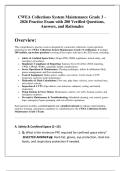
CWEA Collections System Maintenance Grade 3 –
2026 Practice Exam with 200 Verified Questions,
Answers, and Rationales
Overview:
This comprehensive practice exam is designed for wastewater collections system operators
preparing for the CWEA Collections System Maintenance Grade 3 Certification. It includes
200 realistic, up-to-date questions covering all key topics relevant to the 2026 exam, including:
Safety & Confined Space Entry: Proper PPE, OSHA regulations, trench safety, and
emergency procedures.
Regulatory Compliance & Reporting: Sanitary Sewer Overflow (SSO) reporting,
CWIS, CIWQS, WDRs, and public health considerations.
Sewer Operations & Maintenance: Cleaning techniques, inflow & infiltration (I&I),
grease management, and flow monitoring.
Tools & Equipment: Hydro-jetters, rodders, root cutters, Vactor trucks, CCTV
inspection, and force main maintenance.
Hydraulics & Math Calculations: Flow rate, pipe slope, velocity, cross-sectional area,
and critical velocity.
Inspection & CCTV: Pipe defects, root intrusion, sediment, scaling, and lateral
inspections.
Pump Stations & Force Mains: Maintenance, alarms, wet wells, backup systems, and
emergency response.
Preventive Maintenance & Troubleshooting: Scheduled cleaning, root control, grease
traps, emergency bypass pumping, and cost-effective operations.
Each question includes a correct answer and a detailed rationale to enhance understanding,
reinforce learning, and prepare candidates to confidently pass the CWEA Collections System
Maintenance Grade 3 Exam.
A. Safety & Confined Space (1–15)
1. Q: What is the minimum PPE required for confined space entry?
SELECTED ANSWER 👀 Hard hat, gloves, eye protection, steel-toe
boots, and respiratory protection if needed.
, Rationale: Confined spaces have hazards including falling objects,
toxic gases, and physical injury; full PPE minimizes risk.
2. Q: True or False: A confined space permit is required before entry.
SELECTED ANSWER 👀 True
Rationale: OSHA mandates a permit for entry into permit-
required confined spaces.
3. Q: A trench deeper than ___ feet must have a protective system.
SELECTED ANSWER 👀 5 ft
Rationale: OSHA requires protective systems (shoring, sloping, or
trench boxes) for trenches ≥5 ft.
4. Q: Unsafe oxygen levels are defined as ___?
SELECTED ANSWER 👀 <19.5% or >23.5% oxygen
Rationale: Oxygen-deficient (<19.5%) or enriched (>23.5%)
atmospheres are hazardous.
5. Q: Who must authorize a confined space entry?
SELECTED ANSWER 👀 Authorized entry supervisor
Rationale: Only trained supervisors ensure all hazards are
evaluated and permits are valid.
6. Q: What is the first step before entering a manhole?
SELECTED ANSWER 👀 Test atmosphere for hazardous gases.
Rationale: Gases such as H₂S, methane, or CO₂ may be present;
testing prevents injury.
7. Q: LOTO stands for ___?
SELECTED ANSWER 👀 Lockout/Tagout
Rationale: Prevents accidental equipment start-up during
maintenance.
,8. Q: True/False: Safety data sheets (SDS) must be available on site.
SELECTED ANSWER 👀 True
Rationale: OSHA requires SDS for all chemicals handled by
employees.
9. Q: Flashing lights are required when working within ___ feet of a
roadway.
SELECTED ANSWER 👀 10 ft
Rationale: OSHA traffic control regulations protect workers near
roadways.
10. Q: Primary hazard in wastewater confined spaces?
SELECTED ANSWER 👀 Hazardous atmosphere (toxic or
flammable gases)
Rationale: These spaces may contain dangerous gases or low
oxygen.
11. Q: What does the “buddy system” mean?
SELECTED ANSWER 👀 Two workers enter; one monitors outside
Rationale: Ensures immediate help if an emergency occurs.
12. Q: A trench box protects against ___?
SELECTED ANSWER 👀 Cave-ins
Rationale: Supports trench walls and prevents collapses.
13. Q: True/False: Fall protection is required for holes >6 ft
deep.
SELECTED ANSWER 👀 True
Rationale: Protects workers from falls into open excavations.
14. Q: Ventilation is required before confined space entry when
___?
SELECTED ANSWER 👀 Hazardous gases are present
, Rationale: Ensures oxygen levels are safe and contaminant
concentrations are minimized.
15. Q: Hearing protection is required above ___ dB.
SELECTED ANSWER 👀 85 dB
Rationale: OSHA noise regulations protect workers from hearing
loss.
B. Regulatory & Reporting (16–25)
16. Q: SSO stands for ___?
SELECTED ANSWER 👀 Sanitary Sewer Overflow
Rationale: Discharge of untreated sewage; critical to report for
public health.
17. Q: An SSO release to surface waters must be reported within
___ hours.
SELECTED ANSWER 👀 2 hours
Rationale: California regulations mandate immediate notification
to prevent environmental hazards.
18. Q: True/False: All SSOs must be reported to regulatory
agencies.
SELECTED ANSWER 👀 True
Rationale: Reporting ensures compliance and helps prevent
future incidents.
19. Q: CWIS stands for ___?
SELECTED ANSWER 👀 California Water Information System
Rationale: Online system for water quality and permit tracking.
2026 Practice Exam with 200 Verified Questions,
Answers, and Rationales
Overview:
This comprehensive practice exam is designed for wastewater collections system operators
preparing for the CWEA Collections System Maintenance Grade 3 Certification. It includes
200 realistic, up-to-date questions covering all key topics relevant to the 2026 exam, including:
Safety & Confined Space Entry: Proper PPE, OSHA regulations, trench safety, and
emergency procedures.
Regulatory Compliance & Reporting: Sanitary Sewer Overflow (SSO) reporting,
CWIS, CIWQS, WDRs, and public health considerations.
Sewer Operations & Maintenance: Cleaning techniques, inflow & infiltration (I&I),
grease management, and flow monitoring.
Tools & Equipment: Hydro-jetters, rodders, root cutters, Vactor trucks, CCTV
inspection, and force main maintenance.
Hydraulics & Math Calculations: Flow rate, pipe slope, velocity, cross-sectional area,
and critical velocity.
Inspection & CCTV: Pipe defects, root intrusion, sediment, scaling, and lateral
inspections.
Pump Stations & Force Mains: Maintenance, alarms, wet wells, backup systems, and
emergency response.
Preventive Maintenance & Troubleshooting: Scheduled cleaning, root control, grease
traps, emergency bypass pumping, and cost-effective operations.
Each question includes a correct answer and a detailed rationale to enhance understanding,
reinforce learning, and prepare candidates to confidently pass the CWEA Collections System
Maintenance Grade 3 Exam.
A. Safety & Confined Space (1–15)
1. Q: What is the minimum PPE required for confined space entry?
SELECTED ANSWER 👀 Hard hat, gloves, eye protection, steel-toe
boots, and respiratory protection if needed.
, Rationale: Confined spaces have hazards including falling objects,
toxic gases, and physical injury; full PPE minimizes risk.
2. Q: True or False: A confined space permit is required before entry.
SELECTED ANSWER 👀 True
Rationale: OSHA mandates a permit for entry into permit-
required confined spaces.
3. Q: A trench deeper than ___ feet must have a protective system.
SELECTED ANSWER 👀 5 ft
Rationale: OSHA requires protective systems (shoring, sloping, or
trench boxes) for trenches ≥5 ft.
4. Q: Unsafe oxygen levels are defined as ___?
SELECTED ANSWER 👀 <19.5% or >23.5% oxygen
Rationale: Oxygen-deficient (<19.5%) or enriched (>23.5%)
atmospheres are hazardous.
5. Q: Who must authorize a confined space entry?
SELECTED ANSWER 👀 Authorized entry supervisor
Rationale: Only trained supervisors ensure all hazards are
evaluated and permits are valid.
6. Q: What is the first step before entering a manhole?
SELECTED ANSWER 👀 Test atmosphere for hazardous gases.
Rationale: Gases such as H₂S, methane, or CO₂ may be present;
testing prevents injury.
7. Q: LOTO stands for ___?
SELECTED ANSWER 👀 Lockout/Tagout
Rationale: Prevents accidental equipment start-up during
maintenance.
,8. Q: True/False: Safety data sheets (SDS) must be available on site.
SELECTED ANSWER 👀 True
Rationale: OSHA requires SDS for all chemicals handled by
employees.
9. Q: Flashing lights are required when working within ___ feet of a
roadway.
SELECTED ANSWER 👀 10 ft
Rationale: OSHA traffic control regulations protect workers near
roadways.
10. Q: Primary hazard in wastewater confined spaces?
SELECTED ANSWER 👀 Hazardous atmosphere (toxic or
flammable gases)
Rationale: These spaces may contain dangerous gases or low
oxygen.
11. Q: What does the “buddy system” mean?
SELECTED ANSWER 👀 Two workers enter; one monitors outside
Rationale: Ensures immediate help if an emergency occurs.
12. Q: A trench box protects against ___?
SELECTED ANSWER 👀 Cave-ins
Rationale: Supports trench walls and prevents collapses.
13. Q: True/False: Fall protection is required for holes >6 ft
deep.
SELECTED ANSWER 👀 True
Rationale: Protects workers from falls into open excavations.
14. Q: Ventilation is required before confined space entry when
___?
SELECTED ANSWER 👀 Hazardous gases are present
, Rationale: Ensures oxygen levels are safe and contaminant
concentrations are minimized.
15. Q: Hearing protection is required above ___ dB.
SELECTED ANSWER 👀 85 dB
Rationale: OSHA noise regulations protect workers from hearing
loss.
B. Regulatory & Reporting (16–25)
16. Q: SSO stands for ___?
SELECTED ANSWER 👀 Sanitary Sewer Overflow
Rationale: Discharge of untreated sewage; critical to report for
public health.
17. Q: An SSO release to surface waters must be reported within
___ hours.
SELECTED ANSWER 👀 2 hours
Rationale: California regulations mandate immediate notification
to prevent environmental hazards.
18. Q: True/False: All SSOs must be reported to regulatory
agencies.
SELECTED ANSWER 👀 True
Rationale: Reporting ensures compliance and helps prevent
future incidents.
19. Q: CWIS stands for ___?
SELECTED ANSWER 👀 California Water Information System
Rationale: Online system for water quality and permit tracking.