

Terms in this set (83)
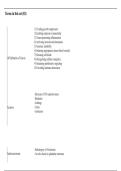
1) Evading growth suppressors
2) Enabling replicative immortality
3) Tumor-promoting inflammation
4) Activating invasion and metastasis
5) Genomic instability
6) Inducing angiogenesis (more blood vessels)
7) Resisting cell death
10 Hallmarks of Cancer 8) Deregulating cellular energetics
9) Sustaining proliferative signaling
10) Avoiding immune destruction
-Decreases CNS responsiveness
-Headache
-Lethargy
Acidosis -Coma
-Confusion
-Subcategory of Carcinoma
Adenocarcinoma - Involve ductal or glandular structures
, -Increases CNS responsiveness
-Dizziness
-Cramping
Alkalosis -Agitation
-Seizure
-Immediate
-IgE
Allergy: Type I IgE- -Principal cells : Mast cells
Mediated Response -Ex: Seasonal allergic rhinitis, Hay fever
-Immediate
-IgG, IgM
-Principal cells: Neutrophils
-The antibody binds to the antigen in the blood or body
Allergy: Type III Immune
fluids and then circulates to the tissue
Complex-Mediated -Not organ specific
Response
-Ex: Systemic lupus erythematosus
, -Immediate
-IgG, IgM
-Principal Cells: Macrophages in tissues
-drug allergies/allergies against infectious agents
-the antibody binds to the antigen on the cell surface
- Ex: Graves disease, Autoimmune thrombocytopenic
purpura, ABO incompatability
1) The cell to be destroyed by the antibody
2) Cell destruction through phagocytosis by
macrophages
Allergy: Type II Tissue- 3) Damage to the cell by neutrophils triggering
Specific Response phagocytosis
4) Natural killer cells to release toxic substances that
destroy the target cell
5) Malfunction of the cell without destruction
-Delayed
-Hypersensitivity reactions
-Principal cells: lymphocytes/macrophages
Allergy: Type IV Cell- -Mediated by T-lymphocytes
Mediated Response -Does not use antibodies
-Localized contact dermatitis (Poison Ivy)
1) Evading growth suppressors
2) Enabling replicative immortality
3) Tumor-promoting inflammation
4) Activating invasion and metastasis
5) Genomic instability
6) Inducing angiogenesis (more blood vessels)
7) Resisting cell death
10 Hallmarks of Cancer 8) Deregulating cellular energetics
9) Sustaining proliferative signaling
10) Avoiding immune destruction
-Decreases CNS responsiveness
-Headache
-Lethargy
Acidosis -Coma
-Confusion
-Subcategory of Carcinoma
Adenocarcinoma - Involve ductal or glandular structures
, -Increases CNS responsiveness
-Dizziness
-Cramping
Alkalosis -Agitation
-Seizure
-Immediate
-IgE
Allergy: Type I IgE- -Principal cells : Mast cells
Mediated Response -Ex: Seasonal allergic rhinitis, Hay fever
-Immediate
-IgG, IgM
-Principal cells: Neutrophils
-The antibody binds to the antigen in the blood or body
Allergy: Type III Immune
fluids and then circulates to the tissue
Complex-Mediated -Not organ specific
Response
-Ex: Systemic lupus erythematosus
, -Immediate
-IgG, IgM
-Principal Cells: Macrophages in tissues
-drug allergies/allergies against infectious agents
-the antibody binds to the antigen on the cell surface
- Ex: Graves disease, Autoimmune thrombocytopenic
purpura, ABO incompatability
1) The cell to be destroyed by the antibody
2) Cell destruction through phagocytosis by
macrophages
Allergy: Type II Tissue- 3) Damage to the cell by neutrophils triggering
Specific Response phagocytosis
4) Natural killer cells to release toxic substances that
destroy the target cell
5) Malfunction of the cell without destruction
-Delayed
-Hypersensitivity reactions
-Principal cells: lymphocytes/macrophages
Allergy: Type IV Cell- -Mediated by T-lymphocytes
Mediated Response -Does not use antibodies
-Localized contact dermatitis (Poison Ivy)


