

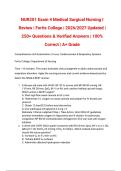
NUR201 Exam 4 Medical Surgical Nursing I
Review | Fortis College | 2026/2027 Updated |
250+ Questions & Verified Answers | 100%
Correct | A+ Grade
Comprehensive Unit Examination | Focus: Cardiovascular & Respiratory Systems
Fortis College | Department of Nursing
Time: 110 minutes. This exam evaluates clinical judgment in adult cardiovascular and
respiratory disorders. Apply the nursing process and current evidence-based practice.
Select the SINGLE BEST answer.
1. A 68-year-old male with HFrEF (EF 30 %) arrives with BP 88/50 mmHg, HR
110/min, RR 28/min, SpO₂ 86 % on RA, and crackles halfway up both lungs.
Which action is MOST urgent?
A. Start high-flow nasal cannula at 60 L/min
B. *Administer 2 L oxygen via nasal cannula and prepare for IV diuretic per
protocol
C. Obtain 12-lead ECG before any intervention
D. Give sublingual nitroglycerin 0.4 mg × 3
Rationale: Clinical Judgment Step = Take Action. AHA 2026 HF guidelines
prioritize immediate oxygen for hypoxemia and IV diuretic for pulmonary
congestion; BP 88/50 contraindicates nitroglycerin; ECG can wait until oxygen
initiated.
2. A client with COPD GOLD grade 3 presents with RR 24/min, SpO₂ 89 % on 2 L NC,
ABG pH 7.28, PaCO₂ 65 mmHg, HCO₃ 34 mEq/L. Which ordered intervention
should the nurse question?
A. Increase O₂ to 4 L/min via NC
B. *Initiate BiPAP as ordered
C. Administer albuterol-ipratropium nebulizer
, D. Obtain sputum culture
Rationale: Clinical Judgment = Analyze Cues/Generate Solutions. GOLD 2027
warns against high-flow O₂ in COPD with hypercapnia; may worsen V/Q
mismatch. BiPAP, bronchodilators, and culture are appropriate.
3. A patient with new-onset A-fib (HR 150/min, BP 90/60 mmHg) receives a
diltiazem bolus. Which finding requires immediate follow-up?
A. HR decreases to 110/min
B. BP increases to 110/70 mmHg
C. *BP drops to 70/40 mmHg
D. Patient reports fatigue
Rationale: Clinical Judgment = Evaluate Outcomes. AHA 2027 AFib guideline:
rapid-rate control must not compromise perfusion; SBP < 90 mmHg signals
hypotension requiring vasopressor or pacing readiness.
4. A patient with STEMI receives tenecteplase. Five minutes later he reports itchy
throat and hives. Which action is priority?
A. Stop infusion and call pharmacy
B. *Stop infusion, give epinephrine 0.3 mg IM, call rapid response
C. Slow infusion and give diphenhydramine 25 mg PO
D. Continue infusion; monitor every 15 min
Rationale: Clinical Judgment = Take Action. AHA 2026 ACS guidelines:
anaphylaxis is infusion emergency—stop drug, give epinephrine IM first, then
H1-blocker and steroids.
5. A client with acute asthma (Peak flow 150 L/min, predicted 400) receives
albuterol and ipratropium. After 3 treatments peak flow is 180 L/min, RR 28, SpO₂
91 %. Which is next?
A. Discharge with PO steroids
B. *Give magnesium sulfate 2 g IV over 20 min per protocol
C. Start theophylline drip
D. Obtain chest X-ray only
Rationale: Clinical Judgment = Generate Solutions. NHLBI 2026 asthma
exacerbation: magnesium is adjunct for severe exacerbation (peak < 40 %
predicted) unresponsive to initial bronchodilators.
6. A patient with HFpEF on metoprolol 50 mg BID has BP 100/60, HR 48/min, clear
lungs, no edema. Which instruction is appropriate?
A. Hold metoprolol and call prescriber
B. *Administer scheduled dose and reassess; consider dose reduction at next
round if symptomatic
C. Double dose to increase HR
D. Start dopamine drip
Review | Fortis College | 2026/2027 Updated |
250+ Questions & Verified Answers | 100%
Correct | A+ Grade
Comprehensive Unit Examination | Focus: Cardiovascular & Respiratory Systems
Fortis College | Department of Nursing
Time: 110 minutes. This exam evaluates clinical judgment in adult cardiovascular and
respiratory disorders. Apply the nursing process and current evidence-based practice.
Select the SINGLE BEST answer.
1. A 68-year-old male with HFrEF (EF 30 %) arrives with BP 88/50 mmHg, HR
110/min, RR 28/min, SpO₂ 86 % on RA, and crackles halfway up both lungs.
Which action is MOST urgent?
A. Start high-flow nasal cannula at 60 L/min
B. *Administer 2 L oxygen via nasal cannula and prepare for IV diuretic per
protocol
C. Obtain 12-lead ECG before any intervention
D. Give sublingual nitroglycerin 0.4 mg × 3
Rationale: Clinical Judgment Step = Take Action. AHA 2026 HF guidelines
prioritize immediate oxygen for hypoxemia and IV diuretic for pulmonary
congestion; BP 88/50 contraindicates nitroglycerin; ECG can wait until oxygen
initiated.
2. A client with COPD GOLD grade 3 presents with RR 24/min, SpO₂ 89 % on 2 L NC,
ABG pH 7.28, PaCO₂ 65 mmHg, HCO₃ 34 mEq/L. Which ordered intervention
should the nurse question?
A. Increase O₂ to 4 L/min via NC
B. *Initiate BiPAP as ordered
C. Administer albuterol-ipratropium nebulizer
, D. Obtain sputum culture
Rationale: Clinical Judgment = Analyze Cues/Generate Solutions. GOLD 2027
warns against high-flow O₂ in COPD with hypercapnia; may worsen V/Q
mismatch. BiPAP, bronchodilators, and culture are appropriate.
3. A patient with new-onset A-fib (HR 150/min, BP 90/60 mmHg) receives a
diltiazem bolus. Which finding requires immediate follow-up?
A. HR decreases to 110/min
B. BP increases to 110/70 mmHg
C. *BP drops to 70/40 mmHg
D. Patient reports fatigue
Rationale: Clinical Judgment = Evaluate Outcomes. AHA 2027 AFib guideline:
rapid-rate control must not compromise perfusion; SBP < 90 mmHg signals
hypotension requiring vasopressor or pacing readiness.
4. A patient with STEMI receives tenecteplase. Five minutes later he reports itchy
throat and hives. Which action is priority?
A. Stop infusion and call pharmacy
B. *Stop infusion, give epinephrine 0.3 mg IM, call rapid response
C. Slow infusion and give diphenhydramine 25 mg PO
D. Continue infusion; monitor every 15 min
Rationale: Clinical Judgment = Take Action. AHA 2026 ACS guidelines:
anaphylaxis is infusion emergency—stop drug, give epinephrine IM first, then
H1-blocker and steroids.
5. A client with acute asthma (Peak flow 150 L/min, predicted 400) receives
albuterol and ipratropium. After 3 treatments peak flow is 180 L/min, RR 28, SpO₂
91 %. Which is next?
A. Discharge with PO steroids
B. *Give magnesium sulfate 2 g IV over 20 min per protocol
C. Start theophylline drip
D. Obtain chest X-ray only
Rationale: Clinical Judgment = Generate Solutions. NHLBI 2026 asthma
exacerbation: magnesium is adjunct for severe exacerbation (peak < 40 %
predicted) unresponsive to initial bronchodilators.
6. A patient with HFpEF on metoprolol 50 mg BID has BP 100/60, HR 48/min, clear
lungs, no edema. Which instruction is appropriate?
A. Hold metoprolol and call prescriber
B. *Administer scheduled dose and reassess; consider dose reduction at next
round if symptomatic
C. Double dose to increase HR
D. Start dopamine drip


