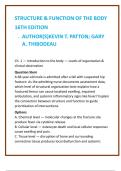
STRUCTURE & FUNCTION OF THE BODY
16TH EDITION
• AUTHOR(S)KEVIN T. PATTON; GARY
A. THIBODEAU
Ch. 1 — Introduction to the body — Levels of organization &
clinical observation
Question Stem
A 68-year-old male is admitted after a fall with suspected hip
fracture. As the admitting nurse documents assessment data,
which level of structural organization best explains how a
fractured femur can cause localized swelling, impaired
ambulation, and systemic inflammatory signs like fever? Explain
the connection between structure and function to guide
prioritization of interventions.
Options
A. Chemical level — molecular changes at the fracture site
produce fever via cytokine release.
B. Cellular level — osteocyte death and local cellular responses
cause swelling and pain.
C. Tissue level — disruption of bone and surrounding
connective tissue produces local dysfunction and systemic
,effects.
D. Organism level — the patient's whole-body response to
injury explains all findings.
Correct Answer
C
Rationales
Correct (C): A fractured femur disrupts bone tissue and
surrounding connective and vascular tissues; tissue-level
disruption impairs local function (structural support, blood
containment), causes edema and pain, and permits
inflammatory mediators to enter circulation, linking local
structure to systemic signs; nursing implications include
immobilization, edema control, and monitoring systemic
response.
A (Incorrect): Chemical/molecular mediators contribute but do
not alone explain the mechanical loss of support and swelling
— they are part of the tissue response.
B (Incorrect): Cellular responses occur, but the observable
swelling and loss of load-bearing are manifestations at the
tissue level where cells, extracellular matrix, and vasculature
interact.
D (Incorrect): The organism level describes whole-body
outcomes but lacks specificity for why local swelling and
impaired ambulation occur.
,Teaching Point
Tissue-level disruptions explain local structural loss plus
systemic inflammatory consequences.
Citation
Patton, K. T., & Thibodeau, G. A. (2020). Structure & function of
the body (16th ed.). Ch. 1.
2️⃣
Reference
Ch. 1 — Introduction to the body — Anatomical position &
directions
Question Stem
During handover the surgeon instructs the nurse to assess the
patient’s lateral epicondyle. The nurse is uncertain which side to
assess. Using anatomical position and direction terms, which
description correctly locates the lateral epicondyle relative to
the midline of the body, and why does this matter when
documenting laterality for postoperative checks?
Options
A. Lateral epicondyle is proximal to the midline and lies toward
the midline; correct documentation prevents proximal nerve
injury.
B. Lateral epicondyle is farther from the midline (away from
median plane); correct laterality prevents wrong-site surgery
and miscommunication.
, C. Lateral epicondyle is superficial and anterior; this helps
determine incision placement.
D. Lateral epicondyle is medial to the midline; this clarifies the
side for postoperative neurovascular checks.
Correct Answer
B
Rationales
Correct (B): “Lateral” denotes away from the median plane;
specifying lateral versus medial using anatomical position
prevents misidentification of the surgical site and ensures
correct postoperative monitoring and documentation.
A (Incorrect): “Proximal” refers to closeness to trunk, not
relation to midline; the statement misuses directional terms.
C (Incorrect): While the epicondyle may be superficial,
“anterior” is incorrect — lateral describes side relation, not
depth or front/back.
D (Incorrect): Lateral is not medial; mislabeling would increase
risk of wrong-site care.
Teaching Point
Use anatomical position terms (medial/lateral) to prevent
laterality errors in care.
Citation
Patton, K. T., & Thibodeau, G. A. (2020). Structure & function of
the body (16th ed.). Ch. 1.
16TH EDITION
• AUTHOR(S)KEVIN T. PATTON; GARY
A. THIBODEAU
Ch. 1 — Introduction to the body — Levels of organization &
clinical observation
Question Stem
A 68-year-old male is admitted after a fall with suspected hip
fracture. As the admitting nurse documents assessment data,
which level of structural organization best explains how a
fractured femur can cause localized swelling, impaired
ambulation, and systemic inflammatory signs like fever? Explain
the connection between structure and function to guide
prioritization of interventions.
Options
A. Chemical level — molecular changes at the fracture site
produce fever via cytokine release.
B. Cellular level — osteocyte death and local cellular responses
cause swelling and pain.
C. Tissue level — disruption of bone and surrounding
connective tissue produces local dysfunction and systemic
,effects.
D. Organism level — the patient's whole-body response to
injury explains all findings.
Correct Answer
C
Rationales
Correct (C): A fractured femur disrupts bone tissue and
surrounding connective and vascular tissues; tissue-level
disruption impairs local function (structural support, blood
containment), causes edema and pain, and permits
inflammatory mediators to enter circulation, linking local
structure to systemic signs; nursing implications include
immobilization, edema control, and monitoring systemic
response.
A (Incorrect): Chemical/molecular mediators contribute but do
not alone explain the mechanical loss of support and swelling
— they are part of the tissue response.
B (Incorrect): Cellular responses occur, but the observable
swelling and loss of load-bearing are manifestations at the
tissue level where cells, extracellular matrix, and vasculature
interact.
D (Incorrect): The organism level describes whole-body
outcomes but lacks specificity for why local swelling and
impaired ambulation occur.
,Teaching Point
Tissue-level disruptions explain local structural loss plus
systemic inflammatory consequences.
Citation
Patton, K. T., & Thibodeau, G. A. (2020). Structure & function of
the body (16th ed.). Ch. 1.
2️⃣
Reference
Ch. 1 — Introduction to the body — Anatomical position &
directions
Question Stem
During handover the surgeon instructs the nurse to assess the
patient’s lateral epicondyle. The nurse is uncertain which side to
assess. Using anatomical position and direction terms, which
description correctly locates the lateral epicondyle relative to
the midline of the body, and why does this matter when
documenting laterality for postoperative checks?
Options
A. Lateral epicondyle is proximal to the midline and lies toward
the midline; correct documentation prevents proximal nerve
injury.
B. Lateral epicondyle is farther from the midline (away from
median plane); correct laterality prevents wrong-site surgery
and miscommunication.
, C. Lateral epicondyle is superficial and anterior; this helps
determine incision placement.
D. Lateral epicondyle is medial to the midline; this clarifies the
side for postoperative neurovascular checks.
Correct Answer
B
Rationales
Correct (B): “Lateral” denotes away from the median plane;
specifying lateral versus medial using anatomical position
prevents misidentification of the surgical site and ensures
correct postoperative monitoring and documentation.
A (Incorrect): “Proximal” refers to closeness to trunk, not
relation to midline; the statement misuses directional terms.
C (Incorrect): While the epicondyle may be superficial,
“anterior” is incorrect — lateral describes side relation, not
depth or front/back.
D (Incorrect): Lateral is not medial; mislabeling would increase
risk of wrong-site care.
Teaching Point
Use anatomical position terms (medial/lateral) to prevent
laterality errors in care.
Citation
Patton, K. T., & Thibodeau, G. A. (2020). Structure & function of
the body (16th ed.). Ch. 1.