

A patient's IV has infiltrated. Which of the - Remove IV
following interventions should the nurse - Elevate affected extermity
carry out? SATA - Apply a warm compress
How often should the nurse flush a - Every 8 hours
patient's peripheral IV? - Before and after IV infusions
The nurse notices their patient's IV site is Infiltration
swollen and cool to the touch. Which
complication should the nurse suspect?
Which of the following fluids is a 0.45% sodium chloride (1/2NS)
hypotonic solution?
Which type of fluid solution pulls fluid Hypertonic
from the cells?
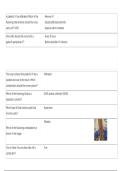
Phlebitis
Which of the following complications is
shown in this image
True or False: You can draw labs off a True
central line?
,Which type of fluid solution will Hypertonic
decrease edema and increase urine
output?
A patient, who has heart failure, is Fluid overload
recieving isotonic fluids. They are at an
increased risk for what?
Which of the following is the BEST Daily weights
measurment to determine if a patient is
in fluid volume overload?
- Thirst
Which of the following are signs of
- Hypotension
HYPOVOLEMIA? SATA
- Poor skin turgor
A patient is diagnosed with - Decreased blood pressure
HYPOVOLEMIA. What would be - Increased heart rate
expected for vital sign values? - Increased respiratory rate
Which of the following medication class Diuretics
should the nurse expect to be ordered
for a patient with HYPERVOLEMIA?
, - Crackles auscultated in the lungs
Which of the following are signs of
- Presence of juglar vein distension
HYPERVOLEMIA? SATA
- Increased blood pressure
What are winged infusion butterfly One time infusion of an IV push administration
peripheral IV's used for?
What are short over the needle catheter Continuous or intermittent infusions, short-term duration
peripheral IV's used for? (~96 hours)
What are midline cathater peripheral IV's - Continuous or intermittent infusion, longer duration (4-6 weeks)
used for? - Placed in an upper arm vein by guided ultrasound
Where are peripheral IV's usually Upper extremities
placed?
What are should be avoided when Points of flexion to decrease risk of complication
placing a peripheral IV?
How are IV cathaters sized by? By gauge, the smaller the gauge the larger the diameter of the catheter
What should the nurse ask themselves The reason for the IV to help determine location and size
before placing a peripheral IV?
Trauma, surgery, blood transfusion
What are IV gauges 14, 16 and 18 used
for?
, Continuous or intermittent infusions, blood
transfusions
What are 20 gauge IV's used for?
Continuous or intermittent infusions, children
and elderly patients, blood or blood products
in pediatrics and
What are 22 gauge IV's used for? neonates (if patients only access available due
to poor veins can give blood thru 22 gauge
might have to be run slower does not break up
red blood cells
Fragile veins, any IV infusion for pediatrics or
neonates
What are 24 gauge IV's used for?
- Assess dressing
How can you prevent infection for
- Look for signs of infection at insertion site
peripheral IV's?
- Change IV site and IV tubing every 72-96 hours (per facility policy)
What are the compilcations of peripheral - Phlebitis
IV's? - Infiltration
following interventions should the nurse - Elevate affected extermity
carry out? SATA - Apply a warm compress
How often should the nurse flush a - Every 8 hours
patient's peripheral IV? - Before and after IV infusions
The nurse notices their patient's IV site is Infiltration
swollen and cool to the touch. Which
complication should the nurse suspect?
Which of the following fluids is a 0.45% sodium chloride (1/2NS)
hypotonic solution?
Which type of fluid solution pulls fluid Hypertonic
from the cells?
Phlebitis
Which of the following complications is
shown in this image
True or False: You can draw labs off a True
central line?
,Which type of fluid solution will Hypertonic
decrease edema and increase urine
output?
A patient, who has heart failure, is Fluid overload
recieving isotonic fluids. They are at an
increased risk for what?
Which of the following is the BEST Daily weights
measurment to determine if a patient is
in fluid volume overload?
- Thirst
Which of the following are signs of
- Hypotension
HYPOVOLEMIA? SATA
- Poor skin turgor
A patient is diagnosed with - Decreased blood pressure
HYPOVOLEMIA. What would be - Increased heart rate
expected for vital sign values? - Increased respiratory rate
Which of the following medication class Diuretics
should the nurse expect to be ordered
for a patient with HYPERVOLEMIA?
, - Crackles auscultated in the lungs
Which of the following are signs of
- Presence of juglar vein distension
HYPERVOLEMIA? SATA
- Increased blood pressure
What are winged infusion butterfly One time infusion of an IV push administration
peripheral IV's used for?
What are short over the needle catheter Continuous or intermittent infusions, short-term duration
peripheral IV's used for? (~96 hours)
What are midline cathater peripheral IV's - Continuous or intermittent infusion, longer duration (4-6 weeks)
used for? - Placed in an upper arm vein by guided ultrasound
Where are peripheral IV's usually Upper extremities
placed?
What are should be avoided when Points of flexion to decrease risk of complication
placing a peripheral IV?
How are IV cathaters sized by? By gauge, the smaller the gauge the larger the diameter of the catheter
What should the nurse ask themselves The reason for the IV to help determine location and size
before placing a peripheral IV?
Trauma, surgery, blood transfusion
What are IV gauges 14, 16 and 18 used
for?
, Continuous or intermittent infusions, blood
transfusions
What are 20 gauge IV's used for?
Continuous or intermittent infusions, children
and elderly patients, blood or blood products
in pediatrics and
What are 22 gauge IV's used for? neonates (if patients only access available due
to poor veins can give blood thru 22 gauge
might have to be run slower does not break up
red blood cells
Fragile veins, any IV infusion for pediatrics or
neonates
What are 24 gauge IV's used for?
- Assess dressing
How can you prevent infection for
- Look for signs of infection at insertion site
peripheral IV's?
- Change IV site and IV tubing every 72-96 hours (per facility policy)
What are the compilcations of peripheral - Phlebitis
IV's? - Infiltration


