ATI TEAS 7 Science Exam Review | 2026/2027
ATI TEAS 7 NURSING SCIENCE EXAM 2026/2027
Anatomy, Physiology & Life Sciences Review
77 Questions and Correct Answers | Graded A+ | 100% Verified
Total Questions: 77 | Time Limit: 63 minutes (Science Section)
All correct answers are indicated in bold cyan. Detailed rationales provided for each question.
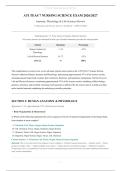
Section Questions Percentage
Human Anatomy & 1–54 ~67%
Physiology
Life & Physical Sciences 55–77 ~33%
TOTAL 77 100%
This comprehensive exam review covers all major content areas tested on the ATI TEAS 7 Science Section.
Section I addresses Human Anatomy and Physiology, representing approximately 67% of the science section,
encompassing all major body systems, their structures, functions, and regulatory mechanisms. Section II covers
Life and Physical Sciences, constituting approximately 33% of the science section, including cellular biology,
genetics, chemistry, and scientific reasoning. Each question is followed by the correct answer in bold cyan blue
and a detailed rationale explaining the underlying scientific principles.
SECTION I: HUMAN ANATOMY & PHYSIOLOGY
(Questions 1–54 | Approximately 67% of the Science Section)
▸ Body Organization & Homeostasis
1. Which of the following represents the correct sequence of levels of structural organization in the human body,
from simplest to most complex?
A. Chemical, Cell, Tissue, Organ, Organ System, Organism
B. Cell, Chemical, Tissue, Organ, Organism, Organ System
C. Chemical, Tissue, Cell, Organ System, Organ, Organism
D. Organism, Organ System, Organ, Tissue, Cell, Chemical
Correct Answer: A. Chemical, Cell, Tissue, Organ, Organ System, Organism
Rationale: The correct hierarchy from simplest to most complex is: Chemical (atoms/molecules) → Cellular (cell) → Tissue
(groups of similar cells) → Organ (multiple tissue types) → Organ System (coordinated organs) → Organism (complete
living being). This is a foundational concept in anatomy and physiology and forms the basis for understanding all subsequent
body system relationships.
1
, ATI TEAS 7 Science Exam Review | 2026/2027
2. A patient's blood glucose level rises after a meal. The pancreas releases insulin, which causes glucose levels to
decrease back to the normal range. This is an example of which type of feedback mechanism?
A. Positive feedback B. Negative feedback
C. Neutral feedback D. Feedforward regulation
Correct Answer: B. Negative feedback
Rationale: Negative feedback is the most common homeostatic control mechanism. When a variable deviates from its set point
(elevated glucose), the body initiates a response (insulin release) that counteracts the change and restores the variable to
normal. Positive feedback amplifies a change (e.g., oxytocin during childbirth), which is not the case here.
3. The term 'distal' in anatomical terminology refers to a position that is:
A. Closer to the midline of the body B. Farther from the point of attachment or origin
C. Closer to the head or superior part D. Toward the back of the body
Correct Answer: B. Farther from the point of attachment or origin
Rationale: Distal means farther from the point of attachment or the trunk of the body. For example, the wrist is distal to the
elbow. Proximal (option A) means closer to the point of attachment. Superior (option C) means toward the head. Posterior
(option D) means toward the back.
4. Which body cavity contains the lungs and heart?
A. Abdominal cavity B. Pelvic cavity
C. Thoracic cavity D. Cranial cavity
Correct Answer: C. Thoracic cavity
Rationale: The thoracic cavity, enclosed by the rib cage, contains the lungs (pleural cavities) and the heart (pericardial cavity
within the mediastinum). The abdominal cavity contains digestive organs, the pelvic cavity contains reproductive organs and
bladder, and the cranial cavity houses the brain.
▸ Tissues
5. Which type of epithelial tissue is best suited for areas subject to wear and tear, such as the skin?
A. Simple squamous epithelium B. Stratified squamous epithelium
C. Simple columnar epithelium D. Pseudostratified columnar epithelium
Correct Answer: B. Stratified squamous epithelium
Rationale: Stratified squamous epithelium consists of multiple layers of cells, with flattened cells on the surface. This
multilayered structure provides protection against mechanical stress and abrasion, making it ideal for the epidermis, oral
cavity, esophagus, and vagina. Simple squamous epithelium is too thin for protection; it functions in diffusion (alveoli, blood
vessels).
2
, ATI TEAS 7 Science Exam Review | 2026/2027
6. Which connective tissue type is primarily responsible for transporting oxygen, nutrients, and waste products
throughout the body?
A. Adipose tissue B. Cartilage
C. Blood D. Dense regular connective tissue
Correct Answer: C. Blood
Rationale: Blood is a specialized connective tissue with a fluid matrix (plasma) and formed elements (erythrocytes,
leukocytes, and thrombocytes). It functions as the body's primary transport system, carrying oxygen via hemoglobin in RBCs,
nutrients, hormones, and metabolic waste. Adipose stores energy, cartilage provides structural support, and dense regular
connective tissue (tendons, ligaments) provides tensile strength.
7. Which type of muscle tissue is found in the walls of hollow organs such as the stomach and intestines?
A. Skeletal muscle B. Cardiac muscle
C. Smooth muscle D. Striated muscle
Correct Answer: C. Smooth muscle
Rationale: Smooth muscle is involuntary, non-striated muscle tissue found in the walls of hollow organs (stomach, intestines,
bladder, blood vessels). It is responsible for peristalsis and regulating blood vessel diameter. Skeletal muscle is voluntary and
attaches to bone. Cardiac muscle is found only in the heart.
8. Astrocytes, oligodendrocytes, and microglia are examples of:
A. Neurons that transmit electrical signals B. Neuroglia that support and protect neurons
C. Muscle cells in the nervous system D. Epithelial cells in the brain
Correct Answer: B. Neuroglia that support and protect neurons
Rationale: Neuroglia (glial cells) are non-neuronal cells that support, protect, and nourish neurons in the nervous system.
Astrocytes maintain the blood-brain barrier and regulate extracellular ion concentration. Oligodendrocytes produce myelin
in the CNS. Microglia are phagocytic cells that remove debris and pathogens. Neurons are the functional signaling cells of
the nervous system.
▸ Integumentary System
9. Which layer of the epidermis is responsible for producing new keratinocytes through continuous cell division?
A. Stratum corneum B. Stratum lucidum
C. Stratum granulosum D. Stratum basale
Correct Answer: D. Stratum basale
Rationale: The stratum basale (basal layer) is the deepest layer of the epidermis and contains stem cells that undergo
continuous mitosis to produce new keratinocytes. These cells gradually migrate toward the surface, becoming keratinized and
eventually forming the stratum corneum. The stratum corneum is the outermost dead cell layer providing the barrier function.
3
ATI TEAS 7 NURSING SCIENCE EXAM 2026/2027
Anatomy, Physiology & Life Sciences Review
77 Questions and Correct Answers | Graded A+ | 100% Verified
Total Questions: 77 | Time Limit: 63 minutes (Science Section)
All correct answers are indicated in bold cyan. Detailed rationales provided for each question.
Section Questions Percentage
Human Anatomy & 1–54 ~67%
Physiology
Life & Physical Sciences 55–77 ~33%
TOTAL 77 100%
This comprehensive exam review covers all major content areas tested on the ATI TEAS 7 Science Section.
Section I addresses Human Anatomy and Physiology, representing approximately 67% of the science section,
encompassing all major body systems, their structures, functions, and regulatory mechanisms. Section II covers
Life and Physical Sciences, constituting approximately 33% of the science section, including cellular biology,
genetics, chemistry, and scientific reasoning. Each question is followed by the correct answer in bold cyan blue
and a detailed rationale explaining the underlying scientific principles.
SECTION I: HUMAN ANATOMY & PHYSIOLOGY
(Questions 1–54 | Approximately 67% of the Science Section)
▸ Body Organization & Homeostasis
1. Which of the following represents the correct sequence of levels of structural organization in the human body,
from simplest to most complex?
A. Chemical, Cell, Tissue, Organ, Organ System, Organism
B. Cell, Chemical, Tissue, Organ, Organism, Organ System
C. Chemical, Tissue, Cell, Organ System, Organ, Organism
D. Organism, Organ System, Organ, Tissue, Cell, Chemical
Correct Answer: A. Chemical, Cell, Tissue, Organ, Organ System, Organism
Rationale: The correct hierarchy from simplest to most complex is: Chemical (atoms/molecules) → Cellular (cell) → Tissue
(groups of similar cells) → Organ (multiple tissue types) → Organ System (coordinated organs) → Organism (complete
living being). This is a foundational concept in anatomy and physiology and forms the basis for understanding all subsequent
body system relationships.
1
, ATI TEAS 7 Science Exam Review | 2026/2027
2. A patient's blood glucose level rises after a meal. The pancreas releases insulin, which causes glucose levels to
decrease back to the normal range. This is an example of which type of feedback mechanism?
A. Positive feedback B. Negative feedback
C. Neutral feedback D. Feedforward regulation
Correct Answer: B. Negative feedback
Rationale: Negative feedback is the most common homeostatic control mechanism. When a variable deviates from its set point
(elevated glucose), the body initiates a response (insulin release) that counteracts the change and restores the variable to
normal. Positive feedback amplifies a change (e.g., oxytocin during childbirth), which is not the case here.
3. The term 'distal' in anatomical terminology refers to a position that is:
A. Closer to the midline of the body B. Farther from the point of attachment or origin
C. Closer to the head or superior part D. Toward the back of the body
Correct Answer: B. Farther from the point of attachment or origin
Rationale: Distal means farther from the point of attachment or the trunk of the body. For example, the wrist is distal to the
elbow. Proximal (option A) means closer to the point of attachment. Superior (option C) means toward the head. Posterior
(option D) means toward the back.
4. Which body cavity contains the lungs and heart?
A. Abdominal cavity B. Pelvic cavity
C. Thoracic cavity D. Cranial cavity
Correct Answer: C. Thoracic cavity
Rationale: The thoracic cavity, enclosed by the rib cage, contains the lungs (pleural cavities) and the heart (pericardial cavity
within the mediastinum). The abdominal cavity contains digestive organs, the pelvic cavity contains reproductive organs and
bladder, and the cranial cavity houses the brain.
▸ Tissues
5. Which type of epithelial tissue is best suited for areas subject to wear and tear, such as the skin?
A. Simple squamous epithelium B. Stratified squamous epithelium
C. Simple columnar epithelium D. Pseudostratified columnar epithelium
Correct Answer: B. Stratified squamous epithelium
Rationale: Stratified squamous epithelium consists of multiple layers of cells, with flattened cells on the surface. This
multilayered structure provides protection against mechanical stress and abrasion, making it ideal for the epidermis, oral
cavity, esophagus, and vagina. Simple squamous epithelium is too thin for protection; it functions in diffusion (alveoli, blood
vessels).
2
, ATI TEAS 7 Science Exam Review | 2026/2027
6. Which connective tissue type is primarily responsible for transporting oxygen, nutrients, and waste products
throughout the body?
A. Adipose tissue B. Cartilage
C. Blood D. Dense regular connective tissue
Correct Answer: C. Blood
Rationale: Blood is a specialized connective tissue with a fluid matrix (plasma) and formed elements (erythrocytes,
leukocytes, and thrombocytes). It functions as the body's primary transport system, carrying oxygen via hemoglobin in RBCs,
nutrients, hormones, and metabolic waste. Adipose stores energy, cartilage provides structural support, and dense regular
connective tissue (tendons, ligaments) provides tensile strength.
7. Which type of muscle tissue is found in the walls of hollow organs such as the stomach and intestines?
A. Skeletal muscle B. Cardiac muscle
C. Smooth muscle D. Striated muscle
Correct Answer: C. Smooth muscle
Rationale: Smooth muscle is involuntary, non-striated muscle tissue found in the walls of hollow organs (stomach, intestines,
bladder, blood vessels). It is responsible for peristalsis and regulating blood vessel diameter. Skeletal muscle is voluntary and
attaches to bone. Cardiac muscle is found only in the heart.
8. Astrocytes, oligodendrocytes, and microglia are examples of:
A. Neurons that transmit electrical signals B. Neuroglia that support and protect neurons
C. Muscle cells in the nervous system D. Epithelial cells in the brain
Correct Answer: B. Neuroglia that support and protect neurons
Rationale: Neuroglia (glial cells) are non-neuronal cells that support, protect, and nourish neurons in the nervous system.
Astrocytes maintain the blood-brain barrier and regulate extracellular ion concentration. Oligodendrocytes produce myelin
in the CNS. Microglia are phagocytic cells that remove debris and pathogens. Neurons are the functional signaling cells of
the nervous system.
▸ Integumentary System
9. Which layer of the epidermis is responsible for producing new keratinocytes through continuous cell division?
A. Stratum corneum B. Stratum lucidum
C. Stratum granulosum D. Stratum basale
Correct Answer: D. Stratum basale
Rationale: The stratum basale (basal layer) is the deepest layer of the epidermis and contains stem cells that undergo
continuous mitosis to produce new keratinocytes. These cells gradually migrate toward the surface, becoming keratinized and
eventually forming the stratum corneum. The stratum corneum is the outermost dead cell layer providing the barrier function.
3