Miss M’s Vicarious Liability Structure
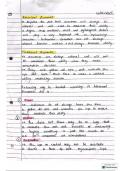
E is Employee
D is Employer
D may be vicariously liable for E's actions.
In general, vicarious liability will not occur in relationships that rely on a contract for
services, i.e. someone employed as an independent contractor. The relationship must rely on
a contract of service, i.e. someone who is an employee.
There are three tests to establish if an employee is employed or self-employed.
First it must be proven the employer has sufficient control of the employee (Yewens v
Noakes) or (Hawley). Here D has sufficient control of E because...
Next the employee's work must be integrated into the business - Integration test (Cox v
Ministry of Justice). Factors such as x suggests E’s work is integrated in the business.
Lastly, all other factors which are consistent with a contract of service must be considered -
multiple test (Ready Mixed Concrete).
E.g. If there is uniform, equipment, mutuality of obligation, control then discuss these others
factors and state how they are consistent with being an employee.
As it has been proven E is an employee, next it must be proven the incident occurred during
the course of employment.
Was E's conduct closely related to the task they had to perform? (Mohamud v Morrison)
(Lister).
E.g. if an employee working in a shop assaults a customer while helping them, it could be
considered closely related to their job because interacting with customers is part of their role,
even though the act of assaulting someone is unacceptable.)
It must be shown E was acting in an unauthorised way during the course of employment
(Limpus)
Not vicariously liable if there is no close connection (Beard)
(For example, if the wrongful act (reckless driving) is closely related to the employee's job
duties (driving and delivering parcels), the employer could still be vicariously liable for the
harm caused, even though the employee’s actions went beyond what was authorised.)
If E has acted on a frolic of his own where they have acted outside the scope of
employment, then D will not be held vicariously liable (Hilton)
As all elements have been proven, D may be potentially liable for vicarious liability.
E is Employee
D is Employer
D may be vicariously liable for E's actions.
In general, vicarious liability will not occur in relationships that rely on a contract for
services, i.e. someone employed as an independent contractor. The relationship must rely on
a contract of service, i.e. someone who is an employee.
There are three tests to establish if an employee is employed or self-employed.
First it must be proven the employer has sufficient control of the employee (Yewens v
Noakes) or (Hawley). Here D has sufficient control of E because...
Next the employee's work must be integrated into the business - Integration test (Cox v
Ministry of Justice). Factors such as x suggests E’s work is integrated in the business.
Lastly, all other factors which are consistent with a contract of service must be considered -
multiple test (Ready Mixed Concrete).
E.g. If there is uniform, equipment, mutuality of obligation, control then discuss these others
factors and state how they are consistent with being an employee.
As it has been proven E is an employee, next it must be proven the incident occurred during
the course of employment.
Was E's conduct closely related to the task they had to perform? (Mohamud v Morrison)
(Lister).
E.g. if an employee working in a shop assaults a customer while helping them, it could be
considered closely related to their job because interacting with customers is part of their role,
even though the act of assaulting someone is unacceptable.)
It must be shown E was acting in an unauthorised way during the course of employment
(Limpus)
Not vicariously liable if there is no close connection (Beard)
(For example, if the wrongful act (reckless driving) is closely related to the employee's job
duties (driving and delivering parcels), the employer could still be vicariously liable for the
harm caused, even though the employee’s actions went beyond what was authorised.)
If E has acted on a frolic of his own where they have acted outside the scope of
employment, then D will not be held vicariously liable (Hilton)
As all elements have been proven, D may be potentially liable for vicarious liability.