

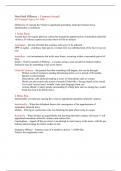
Non-Fatal Offences – Common Assault
S39 Criminal Justice Act 1988
Defined as: D causing the Victim to apprehend immediate unlawful violence/force,
intentionally or recklessly.
1 Actus Reus
Assault does not require physical contact but instead the apprehension of immediate unlawful
violence. If violence cannot occur then there will be no assault.
Apprehend – the fear of belief that violence will occur or be inflicted
DPP v Logdon – pointing a fake gun to a woman who was unbeknownst of the fact it was not
real.
Immediate – not instantaneous but in the near future, occurring within a reasonable period of
time.
Smith v Chief Constable of Woking – a woman seeing a man outside her locked window
fearing he may do something to her in the future.
Unlawful Violence – the general fear that something will happen, this can be through:
- Written words (Constanza) sending threatening letters over a period of 20 months
- Spoken words (Ireland)
- Silent phone calls (Ireland) making a series of silent phone calls to women
- Words can also remove the action of assault (Tuberville v Savage) hand on his sword,
if it weren’t assize time I wouldn’t take such language from you
- Actions (Read v Coker) people surrounding D rolling their sleeves stating they would
break his neck if he did not leave
2 Mens Rea
Intentionally or recklessly causing the victim to apprehend immediate unlawful violence
Intentionally – When the defendant desires the consequence of the apprehension of
immediate unlawful force.
Mohan – Driving at a policeman who was blocking his path when trying to escape
Recklessly – When D takes an unjustifiable risk knowing that their conduct will cause V will
apprehend immediate unlawful violence and realises this.
Cunningham – ripped off the gas meter in an attempt to steal money in the meter, with the gas
leaking and poisoning his future mother-in-law.
Summary Offence – Sentence max of 6 months in prison +/ £5000 fine
Tried in the magistrates court
S39 Criminal Justice Act 1988
Defined as: D causing the Victim to apprehend immediate unlawful violence/force,
intentionally or recklessly.
1 Actus Reus
Assault does not require physical contact but instead the apprehension of immediate unlawful
violence. If violence cannot occur then there will be no assault.
Apprehend – the fear of belief that violence will occur or be inflicted
DPP v Logdon – pointing a fake gun to a woman who was unbeknownst of the fact it was not
real.
Immediate – not instantaneous but in the near future, occurring within a reasonable period of
time.
Smith v Chief Constable of Woking – a woman seeing a man outside her locked window
fearing he may do something to her in the future.
Unlawful Violence – the general fear that something will happen, this can be through:
- Written words (Constanza) sending threatening letters over a period of 20 months
- Spoken words (Ireland)
- Silent phone calls (Ireland) making a series of silent phone calls to women
- Words can also remove the action of assault (Tuberville v Savage) hand on his sword,
if it weren’t assize time I wouldn’t take such language from you
- Actions (Read v Coker) people surrounding D rolling their sleeves stating they would
break his neck if he did not leave
2 Mens Rea
Intentionally or recklessly causing the victim to apprehend immediate unlawful violence
Intentionally – When the defendant desires the consequence of the apprehension of
immediate unlawful force.
Mohan – Driving at a policeman who was blocking his path when trying to escape
Recklessly – When D takes an unjustifiable risk knowing that their conduct will cause V will
apprehend immediate unlawful violence and realises this.
Cunningham – ripped off the gas meter in an attempt to steal money in the meter, with the gas
leaking and poisoning his future mother-in-law.
Summary Offence – Sentence max of 6 months in prison +/ £5000 fine
Tried in the magistrates court


