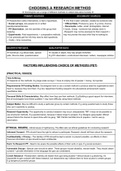
CHOOSING A RESEARCH METHOD
✽ Sociologists use a range of different methods to collect data about society ✽
PRIMARY SOURCES SECONDARY SOURCES
✽ Researchers collect themselves, to test a hypothesis. ✽ Info that’s been collected, created by someone else
~ Social surveys. Ask people Q’s in written ~ Official Stats. Produce by govs. E.g crime, divorce.
questionnaire/interview. ~ Documents. Letter, email, photographs, internet.
~ PP Observation. Join the activities of the group their + Quick, Cheap - someone has already done it.
studying. - Research may not be precisely for their research =
~ Experiments. Field experiments, + comparative methods. may not provide the exact infor they’re looking for.
+ Can precisely get the info they need to test hypothesis.
- Costly + time consuming.
QUANTITATIVE DATA QUALITATIVE DATA
✽ Numerical, e.g official stats, opinion ✽ Studies in depth, they way people think/feel.
polls, Divorce stats, questionnaires. E.g PP observation, unstructured interviews. Letters, newspaper articles.
FACTORS INFLUENCING CHOICE OF METHODS (PET)
(PRACTICAL ISSUES)
Time & Money.
✽ Depends on the methods. E.g large-scale surveys = have to employ lots of people = money, but quicker.
Requirements Of Funding Bodies. Sociologists have to use a certain method to produce data the organisations want
them to, because they fund them. E.g Gov department funding research into educational achievement require
quantitative data.
Personal Skills & Characteristics. May affect how they use their methods. E.g Building a good rapport for interviews.
Not all sociologists have these qualities = may have difficulty using these methods.
Subject Matter. May be difficult to study a particular group by certain methods. E.g using questionnaire to study those
who can’t read/write is useless.
Research Opportunity. The opportunity to conduct research may occur unexpectedly TMT it may not be possible to
use structured methods. E.g questionnaires, because it takes longer to prepare. E.g Glasgow gang leader offered
James Patrick the chance to spend time with his gang. TMT Patrick had little time to prepare + had to use pp
observation.
(ETHICAL ISSUES) - Moral issues of right/wrong. The BSA sets out ethical guidelines for conducting research.
Informed Consent - PPs should have the right to refuse to participate. Research should tell them about the research.
Confidentiality + Privacy - The identity of PPs should be kept a secret, to prevent possible -ve effects on them.
Personal information of pps should be kept confidential.
Harm To Research PP - Need to be aware the possible effects of their work on pps. E.g social exclusion.
Vulnerable Groups - Special care should be taken. These groups include disability, mental health. They should obtain
consent + provide information in the language the pps can understand.
Covert Research - Researchers’ identity are hidden from pps being studied = ethical issues e.g deceiving. It’s
impossible to gain consent with these research, but researchers say it allows them to have access to certain groups.
E.g dangerous powerful groups.
,(THEORETICAL ISSUES) Whether we can obtain an accurate picture of society. This will effect the methods we
choose to use.
Validity - A method that produces a true picture of what something a like. Closer to the truth. Methods
include qualitative data, e.g PP observation - greater insight.
Reliability - Replicability. Able to repeat the research, to get same results.
Representativeness - Whether the pp we study reflect the population we’re interested in. It’s time
consuming to study every child, for example. Large samples that have good sampling techniques produce
representative data.
Methodological perspective - Choice of method is influenced by sociologist's perspective.
POSITIVISTS INTERPRETIVISTS
✽Society has an objective, factual reality. ✽ We construct reality through the meanings we
✽ Society has an influence over its members, create.
shaping their behaviour patterns. ✽ Our actions are based on meanings, they’re not
✽ Use quantitative data to measure these patterns. the product of external forces.
✽ By using these methods, they can discover the ✽Qualitative data to uncover the meanings.
objective scientific laws of cause + effects. ✽ By using these methods - can gain a subjective
✽ Include experiments, official stats, structured understanding of actors’ meanings.
interviews. ✽ Include pp observation, unstructured interviews
= Reliable + Representative. = Valid data.
FACTORS INFLUENCING CHOICE OF TOPICS
✽ Several factors influence their choice when deciding what topic they wish to study.
# The Sociologist’s Perspective: Theoretical perspective is a major influence. A feminist research is more
likely to choose to study domestic violence, because gender inequality is their main concern.
# Society’s Values: Society's values change + so will the focus of the research. E.g rise of today’s
environmentalist concerns have created an interest in green crimes.
# Practical Factors: Inaccessibility of certain situations may restrict the topic they plan to study. E.g
Studying global corporations + their decisions.
# Funding Bodies: Most research need funding from an external place. E.g government agencies +
businesses. As the funding body is paying for the research, it’ll determine the topic to be investigated.
TRIANGULATION.
✽A combination of methods.
✽Use 2 or more sources to have a more
rounded picture by studying the same thing
from more than 1 viewpoint.
✽ So methods can complement each other.
,THE PROCESS OF RESEARCH.
1) MAKING AN AIM/HYPOTHESIS.
Hypothesis. Aim.
✽ Most studies will have a general aim/hypothesis ✽ More general.
-- (an explanation that can be tested) ✽ Shows what we intend to study.
✽ Can formulate a specific hypothesis as a C+E + Open ended - not trying to prove a particular
statement. hypothesis.
✽ The the hypothesis is false, we must discard it. + Can gather any data that is interesting about a
+ gives direction to our research. Will know if the situation.
information gathered will confirm or disprove hypothesis. ✽ Favoured by interpretivists, as they’re interested in
✽ Positivists favour this - can seek C+E relationships. understanding actor’ meanings.
2) OPERATIONALISING CONCEPTS.
✽ The process of turning a sociological theory into something measurable. E.g A sociologist studying the effect of social
class on educational achievement might use parental occupation to measure the theory of ‘social class’.
✽ Once they’ve operationalised the concept, they start to think of questions that measure it. E.g ‘What is your job?’.
✽ Positivists are concerned to operationalise concepts, because testing the hypothesis is important.
3) PILOT STUDY.
✽ Do this before conducting the main survey.
✽ Do a draft version of the method on a small sample.
✽ This is so any issues will be detected + can be ‘ironed out’. TMT the actual survey goes as smoothly as possible.
✽ It may reveal questions that are baly worded, or the answers are hard to analyse. TMT carrying out a pilot study should
be possible to finalise the method.
4) SAMPLES & SAMPLING.
✽ It’s not possible to include every single person in our study, so we have to
choose a sample of people to include.
✽ Sample - a smaller sub-group taken from the wider group we’re interested in.
✽ Sampling - the process of creating a sample.
✽ Sampling occurs to ensure that the people we’ve chosen represents the
people who we couldn’t include.
✽ If the sample is representative = generalisable. (What positivists favour)
Sampling Frame.
✽ 1st, need a list of all the members of the population they’re interested in studying.
✽ It’s important the list that is used as a sampling frame is accurate + up to date.
✽ Once there is a sampling frame, they choose the sample.
Sampling Techniques.
Random Sampling: Simplest technique. Sample is selected by chance, e.g names being drawn out of a hat. Everyone
has an equal chance of being selected.
Quasi - Random/Systematic Sampling: Every nth person in the sampling frame is selected. E.g using every 36th
name on a list.
Stratified Random Sampling: The researcher breaks down the population in the sampling frame by age, class,
gender. The sample is then created in the same proportions.
Quota Sampling: The population is stratified + then the interviewer is given a quota e.g 20 females. The research has
to try to find the respondents who fit this category. The interviewers we’ll keep doing this till their quota is filled.
, Non-representative Sampling.
✽ Not all studies use representative sampling techniques, because of p
ractical + theoretical reasons.
{Practical Reasons}
- The characteristics of the research population e.g age may not be known = impossible to create a sample
that exactly reflect the research population.
- May be impossible to create a sampling frame for that particular research population. E.g Not all criminals are
convicted = no complete list to select a sample from.
- Respondents may refuse to participate. E.g some criminals may refuse, as their responses may be passed to
the police.
If it’s not possible to obtain a representative sample.. They use snowball or opportunity samples.
- Snowballs Sampling: Collecting sample by contacting specific individuals, who are asked to suggest other who
might be interviewed + so on. Not representative, but can contact a sample of people who might be difficult to find. E.g
criminals.
- Opportunity Sampling: Choosing individuals who are easiest to access. E.g choosing people from passer-by in
the street.
{Theoretical Reasons}
- Some researchers may choose not to create a representative sample, because of their methodological
perspective.
- Interpretivists think it’s more important to have valid data + a deep understanding of social actors’ meanings,
than to find general laws of behaviour.
- They’re less concerned to make generalisations, so may opt for unrepresentative samples. E.g Case studies.
>>>>>>>>> Once we’ve selected the sample, we can begin to collect data about the topic <<<<<<<<
✽ Sociologists use a range of different methods to collect data about society ✽
PRIMARY SOURCES SECONDARY SOURCES
✽ Researchers collect themselves, to test a hypothesis. ✽ Info that’s been collected, created by someone else
~ Social surveys. Ask people Q’s in written ~ Official Stats. Produce by govs. E.g crime, divorce.
questionnaire/interview. ~ Documents. Letter, email, photographs, internet.
~ PP Observation. Join the activities of the group their + Quick, Cheap - someone has already done it.
studying. - Research may not be precisely for their research =
~ Experiments. Field experiments, + comparative methods. may not provide the exact infor they’re looking for.
+ Can precisely get the info they need to test hypothesis.
- Costly + time consuming.
QUANTITATIVE DATA QUALITATIVE DATA
✽ Numerical, e.g official stats, opinion ✽ Studies in depth, they way people think/feel.
polls, Divorce stats, questionnaires. E.g PP observation, unstructured interviews. Letters, newspaper articles.
FACTORS INFLUENCING CHOICE OF METHODS (PET)
(PRACTICAL ISSUES)
Time & Money.
✽ Depends on the methods. E.g large-scale surveys = have to employ lots of people = money, but quicker.
Requirements Of Funding Bodies. Sociologists have to use a certain method to produce data the organisations want
them to, because they fund them. E.g Gov department funding research into educational achievement require
quantitative data.
Personal Skills & Characteristics. May affect how they use their methods. E.g Building a good rapport for interviews.
Not all sociologists have these qualities = may have difficulty using these methods.
Subject Matter. May be difficult to study a particular group by certain methods. E.g using questionnaire to study those
who can’t read/write is useless.
Research Opportunity. The opportunity to conduct research may occur unexpectedly TMT it may not be possible to
use structured methods. E.g questionnaires, because it takes longer to prepare. E.g Glasgow gang leader offered
James Patrick the chance to spend time with his gang. TMT Patrick had little time to prepare + had to use pp
observation.
(ETHICAL ISSUES) - Moral issues of right/wrong. The BSA sets out ethical guidelines for conducting research.
Informed Consent - PPs should have the right to refuse to participate. Research should tell them about the research.
Confidentiality + Privacy - The identity of PPs should be kept a secret, to prevent possible -ve effects on them.
Personal information of pps should be kept confidential.
Harm To Research PP - Need to be aware the possible effects of their work on pps. E.g social exclusion.
Vulnerable Groups - Special care should be taken. These groups include disability, mental health. They should obtain
consent + provide information in the language the pps can understand.
Covert Research - Researchers’ identity are hidden from pps being studied = ethical issues e.g deceiving. It’s
impossible to gain consent with these research, but researchers say it allows them to have access to certain groups.
E.g dangerous powerful groups.
,(THEORETICAL ISSUES) Whether we can obtain an accurate picture of society. This will effect the methods we
choose to use.
Validity - A method that produces a true picture of what something a like. Closer to the truth. Methods
include qualitative data, e.g PP observation - greater insight.
Reliability - Replicability. Able to repeat the research, to get same results.
Representativeness - Whether the pp we study reflect the population we’re interested in. It’s time
consuming to study every child, for example. Large samples that have good sampling techniques produce
representative data.
Methodological perspective - Choice of method is influenced by sociologist's perspective.
POSITIVISTS INTERPRETIVISTS
✽Society has an objective, factual reality. ✽ We construct reality through the meanings we
✽ Society has an influence over its members, create.
shaping their behaviour patterns. ✽ Our actions are based on meanings, they’re not
✽ Use quantitative data to measure these patterns. the product of external forces.
✽ By using these methods, they can discover the ✽Qualitative data to uncover the meanings.
objective scientific laws of cause + effects. ✽ By using these methods - can gain a subjective
✽ Include experiments, official stats, structured understanding of actors’ meanings.
interviews. ✽ Include pp observation, unstructured interviews
= Reliable + Representative. = Valid data.
FACTORS INFLUENCING CHOICE OF TOPICS
✽ Several factors influence their choice when deciding what topic they wish to study.
# The Sociologist’s Perspective: Theoretical perspective is a major influence. A feminist research is more
likely to choose to study domestic violence, because gender inequality is their main concern.
# Society’s Values: Society's values change + so will the focus of the research. E.g rise of today’s
environmentalist concerns have created an interest in green crimes.
# Practical Factors: Inaccessibility of certain situations may restrict the topic they plan to study. E.g
Studying global corporations + their decisions.
# Funding Bodies: Most research need funding from an external place. E.g government agencies +
businesses. As the funding body is paying for the research, it’ll determine the topic to be investigated.
TRIANGULATION.
✽A combination of methods.
✽Use 2 or more sources to have a more
rounded picture by studying the same thing
from more than 1 viewpoint.
✽ So methods can complement each other.
,THE PROCESS OF RESEARCH.
1) MAKING AN AIM/HYPOTHESIS.
Hypothesis. Aim.
✽ Most studies will have a general aim/hypothesis ✽ More general.
-- (an explanation that can be tested) ✽ Shows what we intend to study.
✽ Can formulate a specific hypothesis as a C+E + Open ended - not trying to prove a particular
statement. hypothesis.
✽ The the hypothesis is false, we must discard it. + Can gather any data that is interesting about a
+ gives direction to our research. Will know if the situation.
information gathered will confirm or disprove hypothesis. ✽ Favoured by interpretivists, as they’re interested in
✽ Positivists favour this - can seek C+E relationships. understanding actor’ meanings.
2) OPERATIONALISING CONCEPTS.
✽ The process of turning a sociological theory into something measurable. E.g A sociologist studying the effect of social
class on educational achievement might use parental occupation to measure the theory of ‘social class’.
✽ Once they’ve operationalised the concept, they start to think of questions that measure it. E.g ‘What is your job?’.
✽ Positivists are concerned to operationalise concepts, because testing the hypothesis is important.
3) PILOT STUDY.
✽ Do this before conducting the main survey.
✽ Do a draft version of the method on a small sample.
✽ This is so any issues will be detected + can be ‘ironed out’. TMT the actual survey goes as smoothly as possible.
✽ It may reveal questions that are baly worded, or the answers are hard to analyse. TMT carrying out a pilot study should
be possible to finalise the method.
4) SAMPLES & SAMPLING.
✽ It’s not possible to include every single person in our study, so we have to
choose a sample of people to include.
✽ Sample - a smaller sub-group taken from the wider group we’re interested in.
✽ Sampling - the process of creating a sample.
✽ Sampling occurs to ensure that the people we’ve chosen represents the
people who we couldn’t include.
✽ If the sample is representative = generalisable. (What positivists favour)
Sampling Frame.
✽ 1st, need a list of all the members of the population they’re interested in studying.
✽ It’s important the list that is used as a sampling frame is accurate + up to date.
✽ Once there is a sampling frame, they choose the sample.
Sampling Techniques.
Random Sampling: Simplest technique. Sample is selected by chance, e.g names being drawn out of a hat. Everyone
has an equal chance of being selected.
Quasi - Random/Systematic Sampling: Every nth person in the sampling frame is selected. E.g using every 36th
name on a list.
Stratified Random Sampling: The researcher breaks down the population in the sampling frame by age, class,
gender. The sample is then created in the same proportions.
Quota Sampling: The population is stratified + then the interviewer is given a quota e.g 20 females. The research has
to try to find the respondents who fit this category. The interviewers we’ll keep doing this till their quota is filled.
, Non-representative Sampling.
✽ Not all studies use representative sampling techniques, because of p
ractical + theoretical reasons.
{Practical Reasons}
- The characteristics of the research population e.g age may not be known = impossible to create a sample
that exactly reflect the research population.
- May be impossible to create a sampling frame for that particular research population. E.g Not all criminals are
convicted = no complete list to select a sample from.
- Respondents may refuse to participate. E.g some criminals may refuse, as their responses may be passed to
the police.
If it’s not possible to obtain a representative sample.. They use snowball or opportunity samples.
- Snowballs Sampling: Collecting sample by contacting specific individuals, who are asked to suggest other who
might be interviewed + so on. Not representative, but can contact a sample of people who might be difficult to find. E.g
criminals.
- Opportunity Sampling: Choosing individuals who are easiest to access. E.g choosing people from passer-by in
the street.
{Theoretical Reasons}
- Some researchers may choose not to create a representative sample, because of their methodological
perspective.
- Interpretivists think it’s more important to have valid data + a deep understanding of social actors’ meanings,
than to find general laws of behaviour.
- They’re less concerned to make generalisations, so may opt for unrepresentative samples. E.g Case studies.
>>>>>>>>> Once we’ve selected the sample, we can begin to collect data about the topic <<<<<<<<