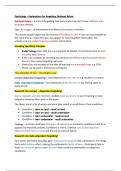
Psychology – Explanations for forgetting: Interference
Interference Theory:
Interference – forgetting because one memory blocks another, causing one or more
memories to be distorted or forgotten.
Some forgetting occurs because two pieces of information disrupt each other,
resulting in forgetting one or both.
Interference has been proposed mainly as an explanation for forgetting long-term
memory because we can’t get access to them, even though they are available.
Types of Interference:
Proactive interference – when older memories interfere with newer ones. E.g. a
teacher has learnt so many names in the past, she struggles to remember her
current students.
Retroactive interference – when a newer memory interferes with an older one.
E.g. a teacher has learnt so many names this year, she struggles to remember any
from last year.
Research into the effects of similarity:
McGeoch and McDonald studied retroactive interference by changing the
amount of similarity between two sets of material.
Participants had to learn a list of 10 words, until they were 100% accurate.
They then learned a new list.
There were six groups of participants who had to learn different types of new
lists:
Group 1 – synonyms – words with the same meanings as the originals.
Group 2 – antonyms – words with opposite meanings to the originals.
Group 3 – words unrelated to the original ones.
Group 4 – consonant syllables
Group 5 – three-digit number.
Group 6 – no new list – these participants rested (control group).
Findings and conclusions - John McGeoch and William McDonald found the most similar
material (synonyms) produced the worst recall and therefore interference is strongest
when memories are similar.
Evaluation:
Strength – Real-world situations – Researchers (Baddeley and Hitch) asked rugby
players to recall the names of teams they had played against during a rugby season. The
Interference Theory:
Interference – forgetting because one memory blocks another, causing one or more
memories to be distorted or forgotten.
Some forgetting occurs because two pieces of information disrupt each other,
resulting in forgetting one or both.
Interference has been proposed mainly as an explanation for forgetting long-term
memory because we can’t get access to them, even though they are available.
Types of Interference:
Proactive interference – when older memories interfere with newer ones. E.g. a
teacher has learnt so many names in the past, she struggles to remember her
current students.
Retroactive interference – when a newer memory interferes with an older one.
E.g. a teacher has learnt so many names this year, she struggles to remember any
from last year.
Research into the effects of similarity:
McGeoch and McDonald studied retroactive interference by changing the
amount of similarity between two sets of material.
Participants had to learn a list of 10 words, until they were 100% accurate.
They then learned a new list.
There were six groups of participants who had to learn different types of new
lists:
Group 1 – synonyms – words with the same meanings as the originals.
Group 2 – antonyms – words with opposite meanings to the originals.
Group 3 – words unrelated to the original ones.
Group 4 – consonant syllables
Group 5 – three-digit number.
Group 6 – no new list – these participants rested (control group).
Findings and conclusions - John McGeoch and William McDonald found the most similar
material (synonyms) produced the worst recall and therefore interference is strongest
when memories are similar.
Evaluation:
Strength – Real-world situations – Researchers (Baddeley and Hitch) asked rugby
players to recall the names of teams they had played against during a rugby season. The