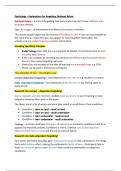
Psychology – Explanations for forgetting: Retrieval failure
Retrieval Failure – a form of forgetting, that occurs when we don’t have sufficient cues
to access memory.
Cue – A, ‘trigger’, of information that allows us to access a memory.
The reason people forget may be because of insufficient cues. If cues are not available at
the same time as recall, then you may appear to have forgotten information, but
actually you are unable to access available information.
Encoding Specificity Principle:
Endel Tulving states that if a cue is going to be helpful, it must be present at both
encoding and retrieval.
If the cues available at encoding and retrieval are different (or if cues are entirely
absent), then some forgetting will occur.
Some cues are encoded at the time of learning in a meaningful way e.g. STM.
These can be used in mnemonic techniques.
Two examples of non – meaningful cues:
Context dependent forgetting – recall depends on external cue e.g. weather or a place.
State -dependent forgetting – recall depends on an internal cue e.g. feeling upset or
being drunk.
Research into context – dependent forgetting:
Duncan Gooden and Alan Baddeley studied deep-sea divers, to see if training on land
helped or hindered their work in the water.
The divers learnt a list of words and were later asked to recall them in four conditions:
Condition 1: learn on land – recall on land
Condition 2: learn on land – recall underwater
Condition 3: learn underwater - recall on land
Condition 4: learn underwater - recall underwater
Findings – accurate recall was 40% lower in mismatched contexts (conditions 2 and 3) as
opposed to matched contexts (conditions 1 and 4). External cues at learning were
different to the ones at recall and this led to retrieval failure.
Research into state-dependent forgetting:
Sara Carter and Helen Cassaday gave antihistamine drugs to their participants. The drugs
had a mild sedative effect, making the participants slightly drowsy. Participants had to
learn lists of words and passages of prose then recall the information creating four
conditions:
Retrieval Failure – a form of forgetting, that occurs when we don’t have sufficient cues
to access memory.
Cue – A, ‘trigger’, of information that allows us to access a memory.
The reason people forget may be because of insufficient cues. If cues are not available at
the same time as recall, then you may appear to have forgotten information, but
actually you are unable to access available information.
Encoding Specificity Principle:
Endel Tulving states that if a cue is going to be helpful, it must be present at both
encoding and retrieval.
If the cues available at encoding and retrieval are different (or if cues are entirely
absent), then some forgetting will occur.
Some cues are encoded at the time of learning in a meaningful way e.g. STM.
These can be used in mnemonic techniques.
Two examples of non – meaningful cues:
Context dependent forgetting – recall depends on external cue e.g. weather or a place.
State -dependent forgetting – recall depends on an internal cue e.g. feeling upset or
being drunk.
Research into context – dependent forgetting:
Duncan Gooden and Alan Baddeley studied deep-sea divers, to see if training on land
helped or hindered their work in the water.
The divers learnt a list of words and were later asked to recall them in four conditions:
Condition 1: learn on land – recall on land
Condition 2: learn on land – recall underwater
Condition 3: learn underwater - recall on land
Condition 4: learn underwater - recall underwater
Findings – accurate recall was 40% lower in mismatched contexts (conditions 2 and 3) as
opposed to matched contexts (conditions 1 and 4). External cues at learning were
different to the ones at recall and this led to retrieval failure.
Research into state-dependent forgetting:
Sara Carter and Helen Cassaday gave antihistamine drugs to their participants. The drugs
had a mild sedative effect, making the participants slightly drowsy. Participants had to
learn lists of words and passages of prose then recall the information creating four
conditions: