

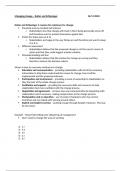
Managing change – Kotter and Schlesinger 16/11/2022
Kotter and Schlesinger 4 reasons for resistance for change:
Parochial (narrow minded) self interest
o Stakeholders fear that change will result in them being personally worse off
and therefore want to protect themselves against this.
Prefer the status quo (as It is)
o Stakeholders are happy in the way things are and therefore just want to keep
it as it is.
Different assessment
o Stakeholders believe that the proposed change is not the correct course of
action and that they could suggest a better solution.
Misunderstanding and fear
o Stakeholders believe that the motives for change are wrong and they
therefore mistrust the decision makers.
Shows 6 ways to overcome resistance to change:
Education and communication – providing stakeholders with all of the necessary
information to help them understand the reason for change, how it will be
implemented and the proposed outcome.
Participation and involvement – providing a sense of ownership to stakeholders so
they feel part of the whole change process.
Facilitation and support – providing the necessary skills and resources to help
stakeholders feel more confident with the change process.
Negotiation and agreement – increase two-way communication by bargaining with
stakeholders and if necessary, making compromises to the change process.
Manipulation and co-operation – use of project champions who may receive
incentives and are tasked with winning around others.
Explicit and implicit coercion – pushing change through despite resistance. This may
be last resort.
Example – Royal Mail striking over delayering of management
Don’t want to change the ways of working
1) C/
2) Ax
3) D/
4) A/
5) B/
Kotter and Schlesinger 4 reasons for resistance for change:
Parochial (narrow minded) self interest
o Stakeholders fear that change will result in them being personally worse off
and therefore want to protect themselves against this.
Prefer the status quo (as It is)
o Stakeholders are happy in the way things are and therefore just want to keep
it as it is.
Different assessment
o Stakeholders believe that the proposed change is not the correct course of
action and that they could suggest a better solution.
Misunderstanding and fear
o Stakeholders believe that the motives for change are wrong and they
therefore mistrust the decision makers.
Shows 6 ways to overcome resistance to change:
Education and communication – providing stakeholders with all of the necessary
information to help them understand the reason for change, how it will be
implemented and the proposed outcome.
Participation and involvement – providing a sense of ownership to stakeholders so
they feel part of the whole change process.
Facilitation and support – providing the necessary skills and resources to help
stakeholders feel more confident with the change process.
Negotiation and agreement – increase two-way communication by bargaining with
stakeholders and if necessary, making compromises to the change process.
Manipulation and co-operation – use of project champions who may receive
incentives and are tasked with winning around others.
Explicit and implicit coercion – pushing change through despite resistance. This may
be last resort.
Example – Royal Mail striking over delayering of management
Don’t want to change the ways of working
1) C/
2) Ax
3) D/
4) A/
5) B/


