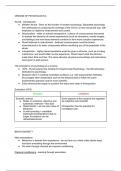
ORIGINS OF PSYCHOLOGY🏫
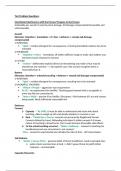
Wundt - Introspection
● Wilhelm Wundt - Seen as the founder of modern psychology. Separated psychology
from philosophy by analysing the workings of the mind in a more structured way, with
emphasis on objective measurement and control.
● Structuralism - relies on trained introspection, a theory of consciousness that seeks
to analyse the elements of mental experiences (such as sensations, mental images,
and feelings) and how these elements combine to form more complex experiences
● Wundt believed in reductionism - believed consciousness could be broken
down/reduced to its basic components without sacrificing any of the properties of the
whole
● Introspection - Highly trained assistants would be given a stimulus, such as a ticking
metronome, and would reflect on the experience. Would report what the stimulus
made them think and feel. The same stimulus, physical surroundings and instructions
were given to each person.
The emergence of psychology as a science
● 1879 - Wundt opened the Institute for Experimental Psychology - the first laboratory
dedicated to psychology.
● Research done in carefully controlled conditions (i.e. with experimental methods).
Encouraged other researchers such as the behaviourists to follow the same
experimental approach and be more scientific.
● Early behaviourists began to question the status and value of introspection
Evaluation (AO3)
Strengths Limitations
Scientific method: Some aspects of the research are regarded
● Relies on empirical, objective and as subjective and scientific
systematic methods = less bias
● Deterministic = we can see cause of Introspection has the potential for
behaviour investigator bias
● Is self-correcting = unreliable
explanations/explanations that no
longer fit evidence can be
refined/abandoned
BEHAVIOURIST🐁
Main assumptions
● Behaviour is learned from experience - we are born as a blank slate (tabula rasa)
and learn everything through the environment
● We learn through classical and operant conditioning
Classical conditioning - learning through association
, Pavlov’s dog study:
● Food (unconditioned stimulus) -> salivation (unconditioned response)
● Bell (neutral stimulus) -> no response
● Food (unconditioned stimulus) + bell (neutral stimulus) -> salivation (unconditioned
response)
● Bell (conditioned stimulus) -> salivation (conditioned response)
(Now associate bell with food, producing same response to food and bell - conditioned
response)
Operant conditioning - learning through reinforcement and punishment
● Behaviour which is reinforced (rewarded) will likely be repeated, behaviour which is
not reinforced tends to die out-or be extinguished (i.e., weakened), behaviour which
is punished will occur less frequently
● Reinforcers - Responses from the environment that increase the probability of a
behaviour being repeated. Reinforcers can be either positive (give a reward) or
negative (remove something undesirable)
● Punishers - Responses from the environment that decrease the likelihood of a
behaviour being repeated. Punishment weakens behaviour
● Neutral operants - responses from the environment that neither increase nor
decrease the probability of a behaviour being repeated
Evaluation (AO3)
Strengths Limitations
Can be used to explain a wide variety of Suggests that all behaviour is learned but
behaviours, from the process of learning, to doesn’t take cognitive and biological factors
addiction and language acquisition into account (focuses too much on nurture
and ignores nature) - thus is an incomplete
explanation of the learning process in
Has practical application, such as token humans and animals
economy - a system in which targeted
behaviours are reinforced with tokens The use of animals in applying the laws of
(secondary reinforcers) and later learning to humans has been criticised, as
exchanged for rewards (primary reinforcers) humans are more complex than animals +
- can be applied in classrooms, prisons and ethical issues in animal experiments
psychiatric hospitals
Mechanistic and reductionist
Uses observable behaviour - scientific,
objective - scientific methods such as
laboratory experiments allow great control
over variables
SOCIAL LEARNING THEORY👀
Main assumptions
Wundt - Introspection
● Wilhelm Wundt - Seen as the founder of modern psychology. Separated psychology
from philosophy by analysing the workings of the mind in a more structured way, with
emphasis on objective measurement and control.
● Structuralism - relies on trained introspection, a theory of consciousness that seeks
to analyse the elements of mental experiences (such as sensations, mental images,
and feelings) and how these elements combine to form more complex experiences
● Wundt believed in reductionism - believed consciousness could be broken
down/reduced to its basic components without sacrificing any of the properties of the
whole
● Introspection - Highly trained assistants would be given a stimulus, such as a ticking
metronome, and would reflect on the experience. Would report what the stimulus
made them think and feel. The same stimulus, physical surroundings and instructions
were given to each person.
The emergence of psychology as a science
● 1879 - Wundt opened the Institute for Experimental Psychology - the first laboratory
dedicated to psychology.
● Research done in carefully controlled conditions (i.e. with experimental methods).
Encouraged other researchers such as the behaviourists to follow the same
experimental approach and be more scientific.
● Early behaviourists began to question the status and value of introspection
Evaluation (AO3)
Strengths Limitations
Scientific method: Some aspects of the research are regarded
● Relies on empirical, objective and as subjective and scientific
systematic methods = less bias
● Deterministic = we can see cause of Introspection has the potential for
behaviour investigator bias
● Is self-correcting = unreliable
explanations/explanations that no
longer fit evidence can be
refined/abandoned
BEHAVIOURIST🐁
Main assumptions
● Behaviour is learned from experience - we are born as a blank slate (tabula rasa)
and learn everything through the environment
● We learn through classical and operant conditioning
Classical conditioning - learning through association
, Pavlov’s dog study:
● Food (unconditioned stimulus) -> salivation (unconditioned response)
● Bell (neutral stimulus) -> no response
● Food (unconditioned stimulus) + bell (neutral stimulus) -> salivation (unconditioned
response)
● Bell (conditioned stimulus) -> salivation (conditioned response)
(Now associate bell with food, producing same response to food and bell - conditioned
response)
Operant conditioning - learning through reinforcement and punishment
● Behaviour which is reinforced (rewarded) will likely be repeated, behaviour which is
not reinforced tends to die out-or be extinguished (i.e., weakened), behaviour which
is punished will occur less frequently
● Reinforcers - Responses from the environment that increase the probability of a
behaviour being repeated. Reinforcers can be either positive (give a reward) or
negative (remove something undesirable)
● Punishers - Responses from the environment that decrease the likelihood of a
behaviour being repeated. Punishment weakens behaviour
● Neutral operants - responses from the environment that neither increase nor
decrease the probability of a behaviour being repeated
Evaluation (AO3)
Strengths Limitations
Can be used to explain a wide variety of Suggests that all behaviour is learned but
behaviours, from the process of learning, to doesn’t take cognitive and biological factors
addiction and language acquisition into account (focuses too much on nurture
and ignores nature) - thus is an incomplete
explanation of the learning process in
Has practical application, such as token humans and animals
economy - a system in which targeted
behaviours are reinforced with tokens The use of animals in applying the laws of
(secondary reinforcers) and later learning to humans has been criticised, as
exchanged for rewards (primary reinforcers) humans are more complex than animals +
- can be applied in classrooms, prisons and ethical issues in animal experiments
psychiatric hospitals
Mechanistic and reductionist
Uses observable behaviour - scientific,
objective - scientific methods such as
laboratory experiments allow great control
over variables
SOCIAL LEARNING THEORY👀
Main assumptions